
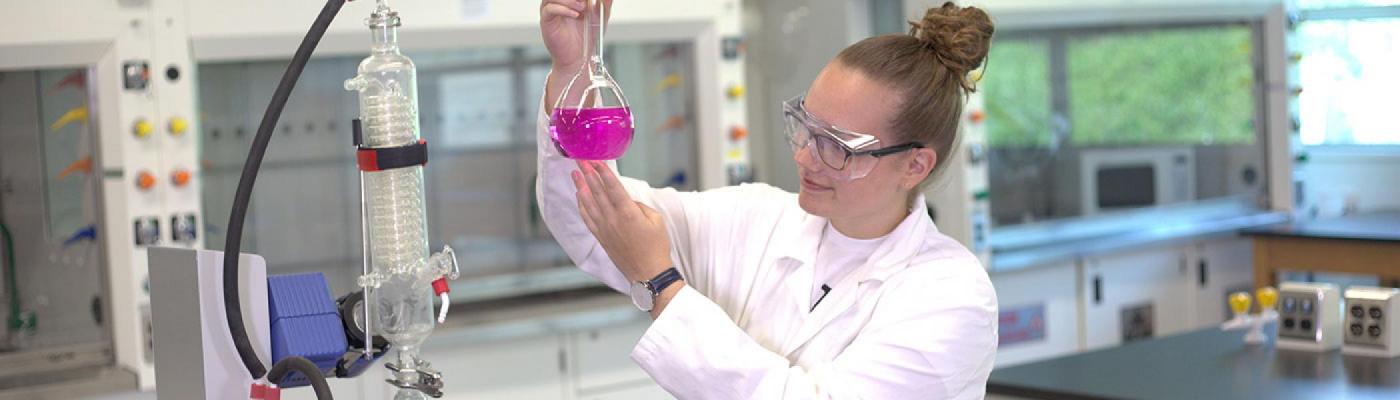
Working in science spaces generally means there can be an increased risk of exposure to a variety of chemicals. The Chemical Safety Program is intended to provide you with the proper information needed to ensure protection of your health and safety while in these spaces. The information on this page should be reviewed along with the Chemical Safety Program and WHMIS training modules.
HECHMET Chemical Inventory Program
The HECHMET system is used for hazardous material management at Trent University. This system helps to ensure the university's chemical inventory is up to date and critical information is readily accessible during emergency situations. Use of this system supports compliance under the Environmental Protection Act and Occupational Health and Safety Act, as well as reducing overall risks associated with using, handling, and storing chemical products.
Each chemical product purchased at Trent is assigned a unique barcode number and label upon arrival to the campus Shipping and Receiving Centre, and is then entered into the database.
Chemical Ordering Instructions
To access and use HECHMET, please contact healthandsafety@trentu.ca, including your name, department, and laboratory location. A unique login will be generated to access the database.
HECHMET Chemical Inventory Program: LOGIN
The "HECHMET How - To" guide is also available for employees to review on VIP.
HECHMET is only available from Computers on Trent University Computer Networks on Campus or with an authorized VPN.
Safety Data Sheet Library
Chemwatch is used as the university's SDS library and is available to all members of the university community. Chemwatch should be used by staff to complete and maintain their laboratory SDS binders. All of those working in science spaces are encouraged to review SDS for products they are working with and around.
Click on the link below to access Chemwatch. Download the General User Guide for instructions.

Labelling
All labs have a responsibility to ensure chemicals and reagents are properly labelled.
To assist with the understanding of requirements under Ontario Regulation 860 (WHMIS), the guidance document linked below was created. Please share this document with all lab personnel. Improper, poor, or lack of labelling is a potential risk to everyone if there are spills, fires, inadvertent contact, chemical incompatibilities, and so on.
Labelling samples is critical for anything stored your lab fridge or freezer or in a 'community' or shared walk-in fridge or freezer. Historical samples that are left after you leave can pose a risk to other users if they contain hazardous materials.
WHMIS Sample and Lab Chemical Labelling
Training
The WHMIS and Chemical Safety Program training modules review important information under this program. These trainings should be completed in conjuncture with reviewing the information on this page. Visit the Science Safety Training page for more information.
Designated Substance Program
Ontario has created specific requirements for work involving any one of eleven hazardous materials known as “designated” substances. Requirements include a written assessment of exposure and a review of that assessment by the Joint Health and Safety Committee. Additional requirements apply to designated substances found in building materials; in most cases a designated substance assessment must be completed and provided to the contractor(s) before a demolition or renovation project can begin.
The 11 designated substances are: Acrylonitrile, arsenic, asbestos, benzene, coke oven emissions, ethylene oxide, isocyanates, lead, mercury, silica, and vinyl chloride.
Hazardous Waste Disposal Procedures
The following guidelines are to be followed when disposing of hazardous chemicals. Review the waste procedures for all science buildings below:
Old and Unstable Chemicals
Legacy Chemicals are those chemicals that have been purchased in the past and are still in storage. They may or may not have been opened. Like food, many chemicals tend to "go bad" over time. Sometimes that means that they become less "potent" while other times they can become less stable and more reactive. Exposure to a variety of things like water, air or even light can cause some chemicals to become much more hazardous then when they were originally manufactured and purchased. This can cause extremely hazardous situations, especially when unknowledgeable personnel are involved. Most chemicals have expiry dates and any chemical approaching its expiry date should be disposed of through hazardous waste. Chemicals which are significantly past their expiry dates should be assessed for their reactivity and stability before being placed in the hazardous chemical waste rooms. For more information on the stability of chemicals please read the SDS sheet under the section stability and reactivity.
Additional Resources - Chemical Safety Program
Chemicals Safety Program Overview
Workplace Hazardous Materials Information System (WHMIS)
Acquisition of Hazardous Materials in the Sciences
Sample and Chemical Labelling Requirements (for Compliance with WHMIS Regulations)
Incompatible Chemical Segregation Table
Standard Operating Procedures
Dangerously Reactive Chemicals SOP (2019)
Poisonous and Corrosive Gases SOP (2019)
Pyrophoric and Water Reactive SOP (2019)
Super Acids and Super Bases SOP (2019)
»Hazardous Materials Identification Guide