

Co-op work terms will provide students with an opportunity to build valuable connections, gain hands-on relevant experience to their program of study, explore diverse workplaces as a full-time paid employee, and graduate with a distinct career advantage.
Three non-credit co-op work terms (COOP 2100P, 3100P, 4100P) are required. Depending on the program’s work term schedule, students will either follow the co-op alternating model where they will complete separate work experiences, each 12-16 weeks (at least 420 hours) or the co-op continuing model where they will complete a single 12-month work experience.
See the Co-op Work Term Schedule page for more information.
Work Term Requirements
| Learning Objectives | Co-op students must develop 5 learning objectives for each co-op work term. Students are expected to reflect on their learning objectives throughout the course of the work term. After learning objectives have been submitted on the Student Experience Portal (SEP), they will be reviewed and approved. |
| Work Term Evaluations | Students will be required to complete a midterm evaluation halfway through their experience and a final evaluation at the end of their experience. Students are encouraged to engage in open and honest reflection, thinking about areas where they excelled and areas to strengthen. Employers will also submit a midterm and final evaluation. |
| Work Term Report | At the end of the work term, students are required to complete a 1,000-word Work Term Report, reflecting on the overall experience and their career development. The Work Term Report is submitted at the same time as the Final Evaluation and uploaded to your Work Term Record in the SEP. |
| Once all work term documentation is received and upon a successful employer evaluation, students will have officially completed their work term. All work term courses are PASS/FAIL. | |
Co-op Job Search FAQ
Review our frequently asked questions to learn more about the co-op job search experience.
Are co-op work terms guaranteed?
Every effort is made to find suitable work terms for students enrolled in the co-op programs, but a work term opportunity cannot be guaranteed for every student. The co-op work term process is competitive and dependent upon many factors including labour market conditions, the student’s job search efforts, the student’s performance in job interviews, and their academic performance.
Will I be matched to a co-op job?
Co-op students are accountable for securing their own work term. Students must be actively applying to all suitable jobs on the Co-op Job Board, job searching on their own, booking appointments with co-op staff, attending their job interviews prepared, and responding to employers in a timely manner.
Where can I find co-op jobs?
Co-op students have access to the Co-op Job Board in the Student Experience Portal (SEP). The jobs posted on the Co-op Job Board have been reviewed by the Co-op Team. Students are also encouraged to search for jobs externally, on sites such as Indeed, LinkedIn, Canada Job Bank, and employer career sites.
Can I find my own co-op job?
Yes! Students can find their own co-op job through their network. It is important to connect with your Co-op Coordinator to ensure the job meets the co-op work term requirements (paid, 420+ hours, and related to your program).
How many jobs should I apply for?
All co-op students should anticipate applying to upwards of 20 opportunities for each work term. It is imperative that students begin their job search early. Students who are unable to obtain a suitable co-op opportunity in an upcoming work term are expected to continue with an academic study term.
What happens if I can’t secure a co-op job?
Every program has a set work term schedule that accommodates specific program requirements and labour market needs, ensuring work terms do not interfere with required course offerings. If a student is in a co-op program following the co-op alternating model and they do not secure their first work term, they are expected to book an appointment with their Co-op Coordinator on the Student Experience Portal to discuss work term remapping options.
Students are also expected to meet with an Academic Advisor to confirm remapping can be accommodated based on credits needed and course offerings. The further along a student is in their degree, the harder it is to remap while also keeping the best interests of the student in mind. Students will only be granted the opportunity to remap a work term once. If a student fails to secure their work term a second time, they will be removed from the co-op program.
If a student is in a co-op program following the continuing model and is unable to secure their 12-month work term in Year 3 Summer as scheduled, the missed work term experience would be delayed to Year 4 Fall. If a co-op student fails to secure their work term experience in Year 4 Fall or is unable to complete their 12-month co-op work term yet otherwise fulfills degree requirements, they will be awarded an Honours degree without the co-op designation.
When remapping a work term, it is essential for students to meet with their Co-op Coordinator first, and then an Academic Advisor to review their options.
If a student misses a second work term, they are no longer be eligible to continue in the co-op program and will move into the single-major Honours degree without the co-op designation.
OSAP & Your Work Term
Co-op students are eligible to apply for OSAP during their study terms and to apply for full-time funding while completing their work term, which will help with living costs. Students enrolled in a co-op program need to follow specific application instructions to avoid being underfunded.
If students miss a work term and decide to remap their co-op work/study schedule, it is important that they notify their Co-op Coordinator and complete a Change of Information Form for OSAP through the myTrent portal as soon as possible to prevent issues with their funding, such as overpayment.
To learn more, read the financial aid webpage about OSAP and Co-op.
Questions about OSAP can be directed to Financial Aid at financialaid@trentu.ca or 705-748-1524.
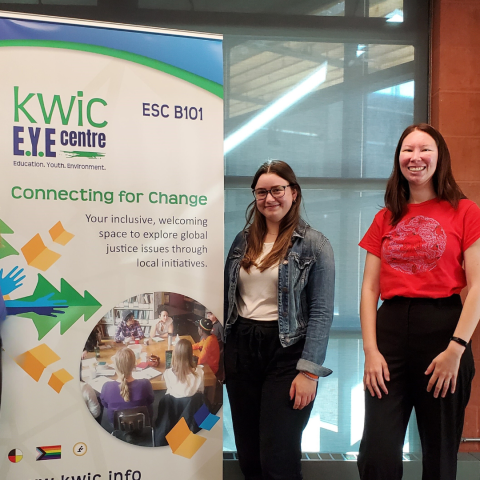
Co-op Student Highlight
Abbey McIntyre (Lady Eaton College), second-year Gender & Social Justice co-op student, worked as an Education Facilitator, Gender Equality with Kawartha World Issues Centre.
Abbey's role focuses on supporting projects related to the Sustainable Development Goals (SDG), such as SDG 5 – Amplifying Gender Equality. Abbey had the opportunity to gain experience working as part of a collaborative team and individually while developing and delivering informative workshops and events related to SDG topics to the community.
“My experience at KWIC has taught me about advocacy which in many aspects has also led to a deeper understanding of myself and others. KWIC has been an empowering opportunity that gave me the foundation to pursue journalism on social and global issues in the future!”
TESTIMONIALS
Read more about the diverse work term experiences of our co-op students here!