
Being prepared before a job interview with a well-put-together list of professional references can help you secure the opportunity you are applying to. When choosing the best references to give to a potential employer, you should consider who will provide the most accurate representation of your work ethic, skills, and achievements relevant to the position.

What are professional references?
A professional reference is provided by someone who can give your potential employer positive remarks on your qualities from past roles. This could include previous employers, supervisors, organization/club leaders, professors, colleagues, or anyone else who is able to attest to your work ethic and past accomplishments.
Whom should I ask to be a referee?
The contacts you provide for references can vary depending on which job/position you are applying for. You want references closely related to the position you are applying for if possible. When deciding on whom to, choose people you believe would speak highly on behalf of your skills, strengths, and work ethic. It may be someone that you worked for, you worked alongside, or someone you considered as a mentor. If possible, include at least one reference who resides in Canada.
How do I ask someone to provide a reference for me?
Once you have decided who your referees will be:
-
Contact them and get their permission.
-
Ask for contact info, current employment details and availability.
-
When requesting a reference, share all relevant application materials, including the job description, your resume, cover letter, and any deadlines.
-
Be sure to follow up and thank your reference after the selection process is complete. Update them on the outcome, regardless of the result, and express your appreciation for their support throughout the process.
What are academic references?
Academic references are provided by professors or other academic supervisors for proof of scholarly performance. Academic references may be needed when applying to internships, education programs, or other opportunities in the academic or professional field. Instructors teach hundreds of students each term. It can be helpful to remind them about the course you took, your performance, and any other interactions you may have had with them.
How many people should I ask?
Your potential employer may ask you for a certain number of references, but typically it is good to have 3-4 ready.
When should I provide them?
If your potential employer requests references, they should be provided to them on a separate
document from your resume, after the interview. Your references will be contacted, so you do not need reference letters unless specified.
Questions that might be asked to a reference
- Please describe your relationship with the candidate, and how long you’ve known them.
- What are some of the candidate’s key strengths and areas where they can improve?
- How likely would you be to hire this candidate again?
- Please describe with examples how well the candidate receives feedback.
- How does the candidate react in stressful situations?
Professional Reference tips
-
Maintain your professional network – You never know when you might need a reference, so it's important to stay connected and nurture the important professional relationships in your life.
-
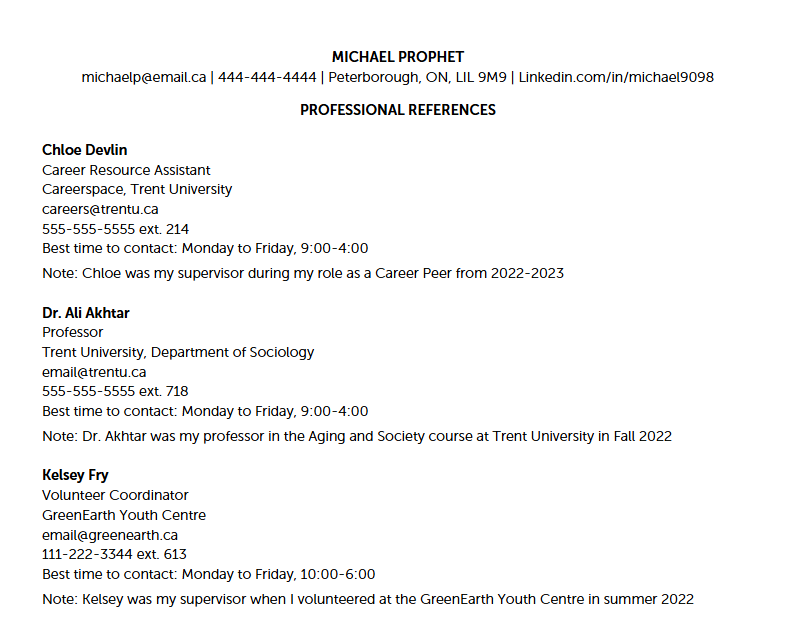
Try to have a variety of references, such as one from a volunteer position, one professional, and one academic.
-
Prepare your reference sheet on a different document from your resume and only provide it upon request. Make sure it matches your cover letter and resume (same font and contact information)
-
If you have reference letters, they can be attached to your reference sheet if relevant to the position.
-
Ask for a strong reference – Anyone can provide a reference, so be specific about what you are looking for
-
If you sense hesitation, ask someone else – There are many reasons why someone might not want to provide a reference. They might not have capacity, or they might not feel like they know you well enough.
-
If you have a reference outside of Canada, it is best to let your potential employer know, and have it noted on your references list.
-
Avoid language barriers between your references and potential employer.
-
If you are new to Canada, build references by finding volunteer or extracurricular
opportunities.
Format Example