
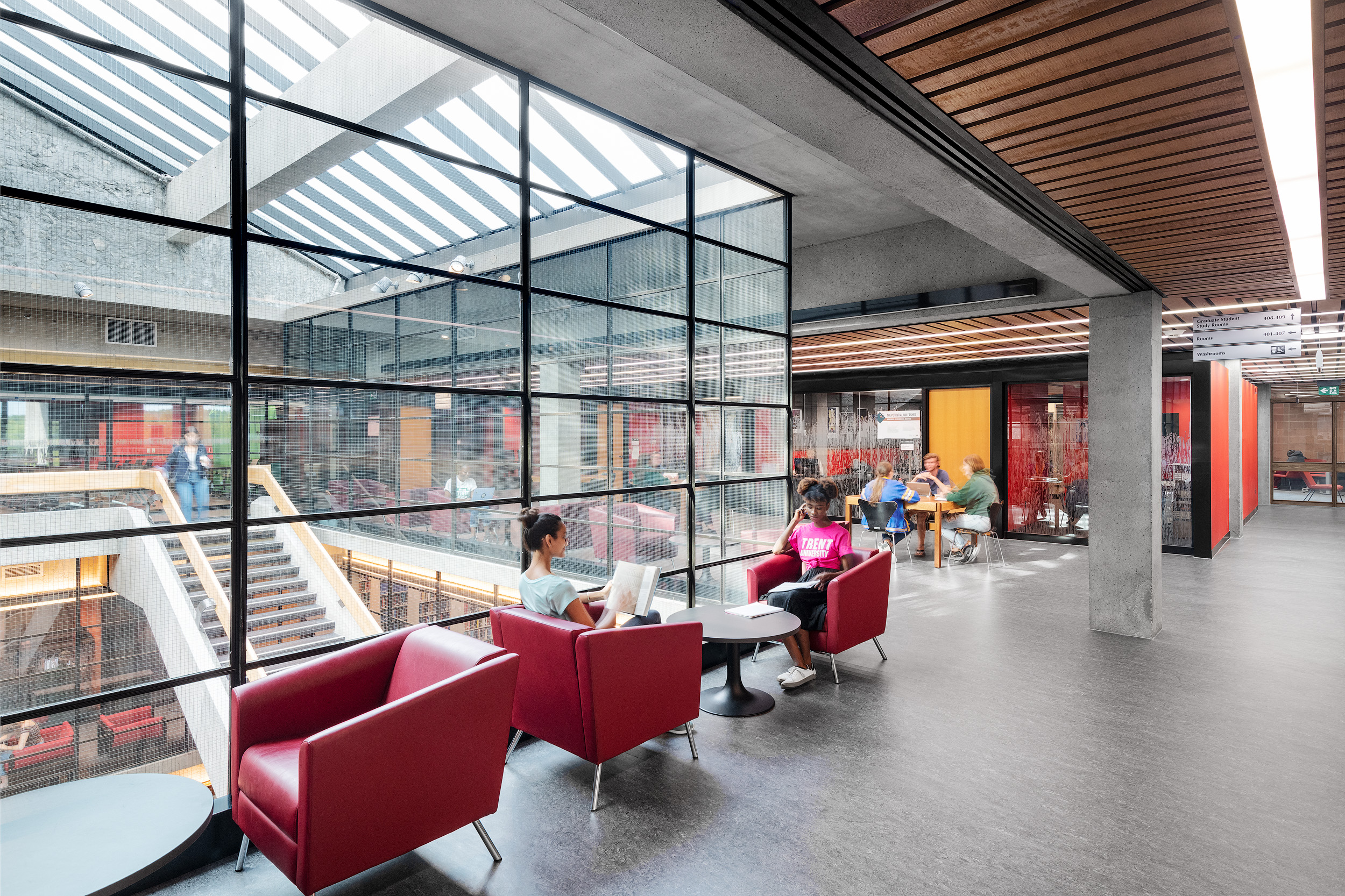
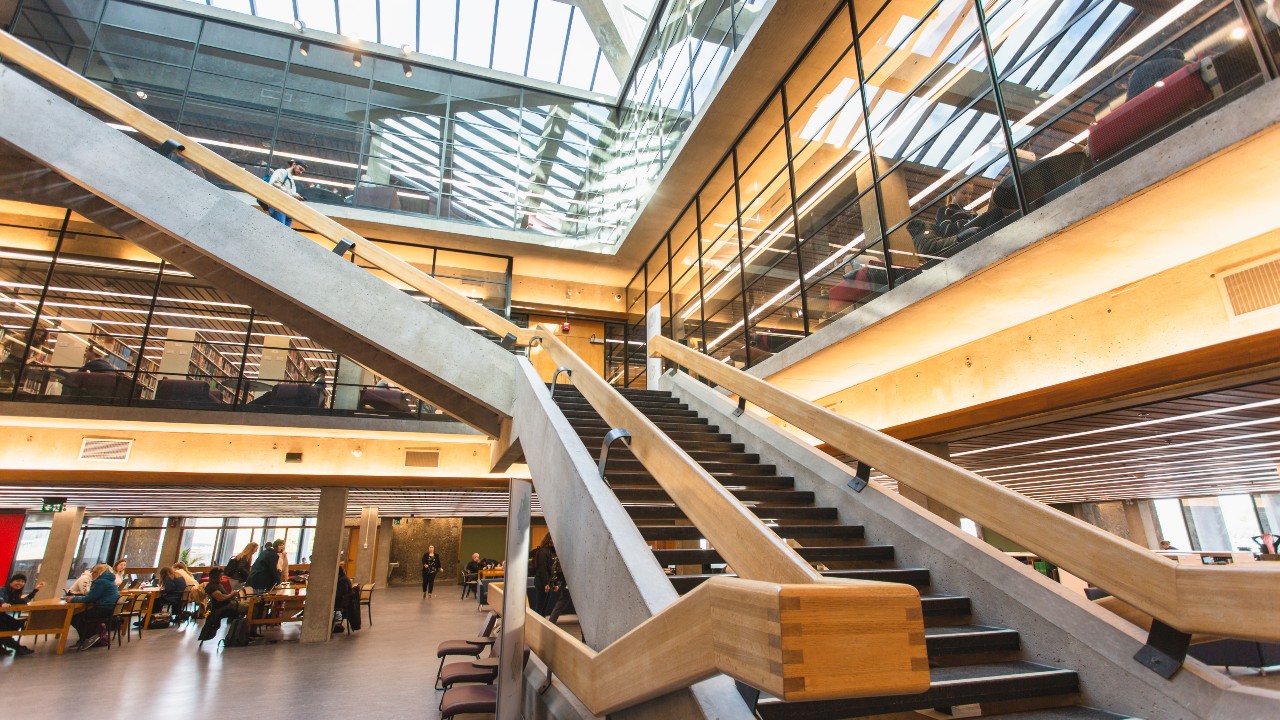
Like today’s most contemporary libraries, the transformed Bata Library offers many diverse social and experiential opportunities with the aim of promoting community and a sense of belonging – one of the hallmarks of a Trent education. The enhanced library builds on this environment by allowing students to move seamlessly from collaborative engagement in class to collaborative study spaces in the library.
Trent’s library of the future is also well-equipped to ensure Trent students, faculty and staff can meet future demands around technology and new models of educational delivery. New technological infrastructure allows users to search everything within Trent’s resources and outside of Trent at the same time – ensuring all materials can be accessed anytime, anywhere.
Accordion Title
Honouring Ron Thom & Heritage Stewardship
The founders of Trent envisioned the library as the intellectual hub of campus, a focal point, and a welcoming space. Designed by Ron Thom, one of Canada’s most renowned architects, the library remains at the heart of the campus and continues to be acknowledged around the world as an iconic example of Ron Thom’s modernist architecture.
The redesign and renovation of the Bata Library paid particular attention to the unique history and legacy of this significant architectural treasure. As part of this process, the University undertook a campus-wide assessment of the heritage value of various spaces, including a focused Cultural Heritage Evaluation Report of the Bata Library. The report outlined the significance of the building, identified key heritage attributes, and played a key role in the discussions and design evaluation for the Bata transformation.
Perkins+Will, the architects for the project, proposed a design approach that respected these heritage values by being responsive to the original context and planning intentions of the library—preserving elements such as the textured and exposed aggregate rubble walls, the wooden and concrete trellises that shade the windows, and the soaring, light-filled atrium.
Heritage Stewardship
Trent University has always been committed to and celebrated for its outstanding student experience delivered in a natural and built setting that inspires and elevates learning. In particular, Trent’s initial buildings, designed by Ron Thom, are recognized as important architectural assets in the mid-century modern style.
Recognizing its primary role as an academic institution and cognizant of its limited financial capabilities, the University acknowledged the importance of maintaining the spaces it inherited for both their academic and cultural value. Trent committed to establishing appropriate heritage management policies and engaged others to assist in actively promoting and raising funds to ensure heritage features, sacred spaces, and cultural resources remained available for future generations to enjoy.
Design Response to Key Heritage Attributes
A list of heritage attributes for the Bata Library was established within the Cultural Heritage Evaluation Report. The proposed transformation does not affect each attribute, although all were considered during the design process. Any modification that addresses a key heritage attribute has been carefully assessed and reviewed by the Perkins+Will design team, the University and ARA/AREA, the Heritage consultants.
The following is a list of the key attributes and the corresponding measures that will be taken to respect these attributes during the transformation:
| ATTRIBUTE | DESIGN RESPONSE |
|---|---|
| 4 storey height | No impact or adjustments to the height |
| Flat cantilevered roof and projections | No impact |
| Square floor plan rotated 90 degrees with triangular projections presenting eight corners | The re-planning and insertions of new program respect the ‘pin wheel’ square floor plan. Attention was paid to the continuity of circulation and views that reinforce the square floor plan |
| Textured exposed rubble aggregate concrete walls | No impact with exception of minor repairs to the existing canopy at the drop off due to spalling concrete and exposed rebar. Repairs will be made to match existing. |
| Wooden and Concrete overhangs shading the windows on the exterior and cedar trellises | Existing cedar trellises will be repaired where possible, with specific sections to be replaced with material to match existing in specie, finish and dimension, if necessary. |
| Partly square interior atrium with open stairway lit by skylight | No changes to the square interior atrium. The skylight will be reconstructed following the geometry and dimensions of the existing. |
| Alternating rows of wood ceiling tiles in concentric squares around atrium on all levels | A custom millwork solution will replicate the wood ceiling tiles in terms of dimensions, species, finish and integration with lighting. The new solution will be suspended by current T-bar framing and rods providing more stability and addressing the current challenge of plenum access. New program insertions into the floor plate may have a contemporary ceiling treatment that complement the original design |
| Original wood and glass partition walls | Original partitions that remain will be refurbished. Some original partitions need to be either removed or relocated. New partitions for support programs will be designed to emulate the existing partition details. The program components that support 21st century learning will have a distinctive but respectful articulation of wall, ceiling, glazing and frame elements |
| Built in wood study carrels | The majority of carrels remain in place. Those that are removed will be handed over to the University |
| Views to and from the Otonabee River | New planning has actually increased the amount of views from the corners of the square plan and restoring the original experience envisioned by Ron Thom |
| Incorporation of trails and steps along the river | No impact on this attribute |
| Strip windows with narrow mullions between concrete planes and blocks | With exception of repairing panes with broken seals, there is no impact on this attribute |
| Interior warm colours and materials | Selection of materials and colours for support programs will be made with an understanding of the original palette. Design team has access to the specified colours and materials. For spaces that support new spaces and programs the selection will be complementary but legible as a new insertion |
| Large pane interior glass enclosure around the atrium on the 3rd and 4th floor | No impact on this attribute |
| Built in and movable objects designed or chosen by Ron Thom | In the occasion there is an impact on built in cabinets, they will be removed intact, protected and stored by the University. Regarding movable objects the University is continuing to evaluate costs and sources of support to refurbish where possible. These pieces will be removed off site before construction commences. |
Accordion Title
New Features of the Revitalized Bata Library
Like today’s most contemporary libraries, the revitalized Bata Library offers many diverse social and experiential opportunities with the aim to promote community and a sense of belonging – one of the hallmarks of a Trent education.
Trent is also known for our collaborative learning environment. The revitalized Bata Library builds on this environment by allowing students to move seamlessly from collaborative engagement in class to collaborative study spaces in the library. Bata Library is also well-equipped to ensure our students, faculty and staff can meet future demands around technology and new models of educational delivery. New technological infrastructure allows users to search everything within Trent’s resources and outside of Trent at the same time – ensuring all materials can be accessed anytime, anywhere.
- An entrepreneurship and social innovation centre – providing a valuable site for social engagement in experiential learning, and development of new experiential learning projects and work placements for students
- Various locations for carefully selected book, print and digital collections and resources
- Three research centres: Trent Centre for Aging and Society; Indigenous Environmental Studies Institute; Canadian Centre for Environmental Modelling in Chemistry
- Two visualization labs – many disciplines are engaging with art and technology through new mediums, such as gaming, and Trent's new lab allows for the creation of more sophisticated visualization tools – including virtual realities, 3D printing – for teaching and research
- Critical Making Studio gives students, faculty, and librarians access to the tools they need in order to produce objects that will assist their research, teaching, and learning
- Educational design research studio to support faculty across all disciplines in learning about and implementing the most recent developments in higher education teaching practice
- A presentation practice room - a space where students can prepare, create and practice presentations for seminars and classes with their peers, or independently
- Interactive student spaces (group and individual) to promote social engagement and collaborative learning - spaces like this are central to modern libraries
- Design elements to promote environmental sustainability, including a green wall
- Preserved and refreshed original Ron Thom décor and furnishings.
- A stunning living green wall feature on the main floor with casual seating areas
Accordion Title
Library Services and Resources
Bata Library offers a wide range of services and resources, from the ability to borrow books from the library collection to accessing reserves and interlibrary loans to receiving research assistance from librarians and library staff. Here are some services and resources available to the Trent and broader community:
- IT Services will include reserved equipment pickup and drop off, device troubleshooting, hardware imaging and walk-up incident support
- 12 new group study rooms, now available for booking through the myTrent portal under room bookings
- A new presentation practice room that can be booked by larger groups (up to 12 students) with technology to enable students to practice presentations
- Full Wi-Fi service in all areas of Bata Library
- The Maps, Data and Government Information Centre (MaDGIC) on the fourth floor open for consultation
- Computing & Printing Stations
- Two new computer commons, complete with 26 iMacs and 78 PCs on the first and second floors (relocated from the various temporary computer locations around campus in place for the transformation), in addition to existing printing and copying stations
- Graduate student carrels – these heritage pieces have been refinished and are available to be reserved.
- Two new graduate reading rooms for graduate students are on the fourth floor, featuring comfortable furnishings and study desks for silent study
Accordion Title
Philanthropic and Financial Support
The $18 million library transformation project was made possible through an $8.1 million funding infusion from the federal and provincial governments, $7.9 million from Trent University, and $2.1 million from philanthropic donations.
The Bata project was set in motion in 2015, by longtime friends and supporters of the University, David and Joan Moore. The Moores donated $1 million to help begin the planning process of the transformation, and then committed another $250,000 in matching dollars to inspire others to give. Other significant donations to the transformed Bata Library included funding from Paul Odette ’72, whose father helped build the Bata Library in 1967, and the Bata Family through the Bata Family Shoe Foundation who supported the Entrepreneurship and Social Innovation Centre.