
Trent University
MyTrent
  • Academics
    • Undergraduate Programs
    • Graduate Programs
    • Trent Online
    • Summer Courses
    • Continuing Education
    • Study Abroad
    • Academic Calendar
    • Academic Timetable
    • Academic Skills Centre
    • Academic Advising
    • Library
    • Centre for Teaching and Learning
  • Admissions
    • Undergraduate
    • Thinking of Applying
    • Already Applied
    • Received an Offer
    • Accepted My Offer
    • Graduate
    • International
    • Indigenous
    • Returning to Trent
    • Transfer
  • Services & Support
    • Academic Advising
    • Academic Skills Centre
    • Administrative Departments
    • Alumni Services
    • Athletics
    • Campus Security
    • Careerspace
    • Colleges
    • Communications
    • Conferences
    • Financial Aid
    • Financial Services
    • Health & Wellness
    • Indigenous Services
    • Information Technology
    • International Students
    • Learning Support
    • Parking
    • Printshop
    • Recruitment
    • Registrar's Office
    • Residence & Housing
    • Student Clubs
    • TrentU Card
  • Research
    • Research at Trent
    • Research Centres
    • Find an Expert
    • Resources
  • Give to Trent
  • About Trent
    • About Trent
    • Careers
    • Giving to Trent
    • Governance
    • How to Find Us
    • Media
    • News & Events
    • President's Office
    • Staff Directory
    • Trent Facts
    • Contact Us
  • Campus Locations
    • Peterborough
    • Durham GTA
    • Online
  • Future Students
    • Undergraduate
    • Thinking of Applying
    • Already Applied
    • Received an Offer
    • Accepted My Offer
    • Graduate
    • International
    • Indigenous
    • Returning to Trent
    • Transfer
  • Current Students
  • The Colleges of Trent
  • Alumni
  • Apply
  • Visit
  • Give
  • Peterborough
  • Durham GTA
  • Map
  • Careers
  • Directions
  • Library
  • Site Map
  • Bookstore
Skip to main content Home
  • Peterborough
  • Durham GTA
  • Online
  • MyTrent
MENU
A student studying on the floor
Trent University
Academic Skills
  • Welcome
  • Appointments
  • How To Guides
  • Documentation Guide
  • Programs & Events
  • Contact
  1. Trentu.ca
  2. Academic Skills
  3. Documentation Guide
  4. Chicago Style: Citing Other Sources

Chicago Style: Citing Other Sources

  • Lecture, address or debate
  • Citing Indigenous Oral Knowledge
  • Work of art
  • Film
  • Television program
  • Interviews
  • Personal communication (email, telephone call)
  • Sound recording
  • Dissertation or thesis, unpublished and published
  • Archival sources
  • Citing a source (that you have not read) that is Cited in Another Source
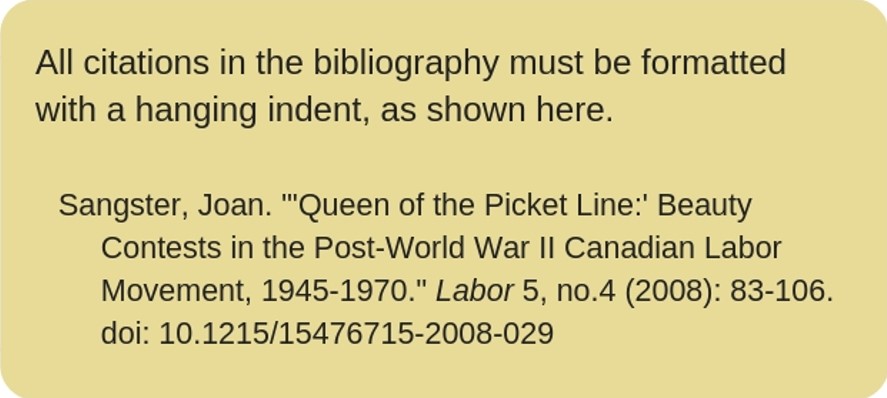
Sample reference entry in Chicago Style formatted with a hanging indent.


Recorded Lecture or Speech

First Footnote/Endnote

1. Sumiko Polacco, "Overview of Canadian law," lecture, FRSC 5000Q, Trent University, June 9, 2021, https://trentu.yuja.com/V/Video?isPlaying=false&startTime=0&isExternalPlayRequest=true&z=1&u=733a1505-dbda-471a-8851-70d1e71eab3c.

Subsequent Footnotes/Endnotes

2. Polacco, "Overview of Canadian law".

Bibliography

FirstName LastName. "Title of Speech." Format, meeting description, Location [if known], Date. Duration. URL.

Example

Sumiko Polacco, "Overview of Canadian law." Lecture, FRSC 5000Q, Trent University, June 9, 2021, https://trentu.yuja.com/V/Video?isPlaying=false&startTime=0&isExternalPlayRequest=true&z=1&u=733a1505-dbda-471a-8851-70d1e71eab3c.

Notice: The title of the lecture is in quotation marks.


Unrecorded Lecture or Speech 

Include as much information as possible about the title, sponsor, location, and date of the talk that you are citing.

First Footnote/Endnote

1. Fiona Harris-Stoertz, "Why Did the Crusades Happen?" Lecture, History 1500, Trent University, September 25, 2009. 

Subsequent Footnote/Endnote

2. Harris-Stoertz, "Why did the Crusades Happen?"

Bibliography

LastName FirstName. 'Title of Lecture." Format. Meeting Description, Location, Date. 

Example

Harris-Stoertz, Fiona. "Why Did the Crusades Happen?" Lecture. History 1500, Trent University, September 25, 2009.


Work of Art

The way in which you cite an image or work of visual art depends on where you found it.

  • If you are referencing a work of art in a museum, you need to include the artist's name, the date it was created, and the museum and city that it is located in.
  • If you are referencing a reproduction of a work of art that you accessed online, you will also need the date of access and a URL address.

Work of Art in a Museum

First Footnote/Endnote

1. Josef Sudek, Still Life: Egg, Glass, 1950, The Art Gallery of Ontario, Toronto.

Subsequent Footnotes/Endnotes

3. Sudek, Still Life: Egg, Glass.

Bibliography

Artist's Name, Last Name First. Work of Art. Date of Composition. Institution Where Work Is Shown, City Where Institution Is Located.

Example

Sudek, Josef. Still Life: Egg, Glass. 1950. The Art Gallery of Ontario, Toronto.

Work of Art on the Web

First Footnote/Endnote

2. Josef Sudek, Still Life: Egg, Glass, 1950, The Art Gallery of Ontario, Toronto, February 22, 2010.  http://www.ago.net/new-art-photography.

Subsequent Footnotes/Endnotes

3. Sudek, Still Life: Egg, Glass.

Bibliography

Artist's Name, Last Name First. Work of Art. Date of Composition. Institution Where Work Is Shown, City Where Institution Is Located.  Date Accessed. URL

Example

Sudek, Josef. Still Life: Egg, Glass. 1950. The Art Gallery of Ontario, Toronto. February 22, 2010. http://www.ago.net/new-art-photography

Work of Art Reproduced in a Book

First Footnote/Endnote

3. Bayeux Tapestry, Musee de la Tapisserie de Bayeux, Bayeux, Normandy. The Mystery of the Bayeux Tapestry, by David J. Bernstein (London: Weidenfeld and Nicolson, 1986) plate 28.

(In this example, the artist is unknown, so the entry begins with the title of the artwork itself.)

Subsequent Footnotes/Endnotes

7. Bayeux Tapestry, The Mystery of the Bayeux Tapestry, plate 28.

Bibliography

Artist's Name, Last Name First. Work of Art.  Institution Where Work Is Shown, City Where Institution Is Located. Title of Book.  By Book Author.  City Where Published: Publisher, Year of Publication. Plate or Page Number.

Example

Bayeux Tapestry. Musee de la tapisserie de Bayeux, Bayeux, Normandy. The Mystery of the Bayeux Tapestry. By David J. Bernstein. London: Weidenfeld and Nicolson, 1986. Plate 28.

Notice: The title of the work of art is in italics. When the work of art has been reproduced on the web or in a book, state the artist's name, the title of the artwork, the institution or private owner of the work, and the city where it is located. For a book, the page, slide, figure or plate number by which it is designated in the source is also given.


Film

When citing a film, include the title of the film, the medium (DVD, video, or streaming service), the director, the original release date of the film, the location and name of the production company, and the release date of the DVD/Video.

If you want to cite a particular scene from a DVD, you can treat it like a chapter in a book and put it into quotation marks.

First Footnote/Endnote

1. "Dorothy meets the Scarecrow," The Wizard of Oz, directed by Victor Fleming (Metro-Goldwyn-Mayer, 1939), Criterion on Demand, https://media3.criterionpic.com/htbin/wwform/006?T=W55300.

Subsequent Footnotes/Endnotes

2. "Dorothy says goodbye," The Wizard of Oz.

Bibliography

LastName, FirstName, dir. Title of Film. Medium. Publisher, Year. Format, URL [if applicable]. 

Example

Fleming, Victor, dir. The Wizard of Oz. Metro-Goldwyn-MYER, 1939. Criterion on Demand, https://media3.criterionpic.com/htbin/wwform/006?T=W55300.

Notice: Film titles are in italics.


Television Program

First Footnote/Endnote

1. Influenza 1918, Television, directed by Robert Kenner (Boston: WGBH PBS, 2009).

Subsequent Footnotes/Endnotes

2. Influenza 1918.

Bibliography

Title of Program. Medium. Director. Local Station City: Station and Network, Date Aired.

Example

Influenza 1918. Television. Directed by Robert Kenner. Boston: WGBH PBS, 2009.

Notice: Titles of television programs are in italics.


Interviews

When citing an interview, include as much of the following information as possible: name of the person interviewed and identifying information if necessary, name of the interviewer, and the place and/or date of the interview.

Interview that You Conducted

First Footnote/Endnote

1. Mary Ann Armstrong (Senior Academic Skills Instructor), in discussion with the author, February 22, 2010, Trent University.

Subsequent Footnotes/Endnotes

2. Armstrong, discussion.

Bibliography

Name of the person interviewed (identifying information if necessary). In discussion with the author. Date of the interview. Location of the interview.

Example

Mary Ann Armstrong (Senior Academic Skills Instructor). In discussion with the author. February 22, 2010. Trent University.

Interview Conducted by Someone Other than You

First Footnote/Endnote

2. Mary Ann Armstrong (Senior Academic Skills Instructor), interview with George Fogarasi, February 22, 2010, Trent University.

Subsequent Footnotes/Endnotes

3. Armstrong, interview.

Bibliography

Name of the person interviewed (identifying information if necessary). Interview with Interviewer's name. Date of the interview. Location of the interview.

Example

Armstrong, Mary Ann (Senior Academic Skills Instructor). Interview with George Fogarasi. February 22, 2010. Trent University.

Notice: The name of the person interviewed is listed first.  If you are citing an interview that you conducted, use the term "discussion." If you are citing an interview conducted by someone else, use the term "interview."


Personal Communication (Email, Telephone Call)

First Footnote/Endnote

1. Sally Chivers, e-mail message to author, February 20, 2010.

2. Sally Chivers, telephone call with author, February 20, 2010.

Subsequent Footnotes/Endnotes

3. Chivers, email.

4. Chivers, telephone call.

Bibliography

Author's name. Medium. Date.

Example 1

Chivers, Sally. E-mail Message to Author. February 20, 2010.

Example 2

Chivers, Sally. Telephone Call to Author. February 20, 2010.


Sound Recording

First Footnote/Endnote

1. Pete Seeger, Pete Seeger's Greatest Hits, Compact Disc, Sony, CK65711, 2002.

Subsequent Footnotes/Endnotes

2. Seeger, Pete Seeger's Greatest Hits.

Bibliography

Composer's (or Other's) Name, Last Name First. Title of Recording. Medium. Manufacturer, Catalogue number.

Example

Seeger, Pete. Pete Seeger's Greatest Hits. Compact Disc. Sony, CK65711.

Notice: The title of the CD is in italics. Just before the date of the CD release you must include the catalogue number of the CD (this is generally listed on the spine of the CD). In this example, the catalogue number is CK65711.


Dissertation or Thesis

Put the title of a master's thesis or doctoral dissertation in quotation marks and specify which type of document it is in the citation. If you obtained the thesis online or from a database, you will need to provide the URL or other appropriate locator information.

First Footnote/Endnote

1. Van Nguyen-Marshall, "Issues of Poverty and Poor Relief in Colonial North Vietnam: The Interaction Between Colonial Modernism and Elite Vietnamese Thinking" (PhD diss., University of British Columbia, 2002), 12.

Subsequent Footnotes/Endnotes

2. Nguyen-Marshall, "Issues of Poverty," 10.

Bibliography

LastName, FirstName. "Title of Dissertation or Thesis." Identify degree/document type, Institution/Location, Year. Access information [URL or database information].

Example

Nguyen-Marshall, Van. "Issues of Poverty and Poor Relief in Colonial North Vietnam: The Interaction Between Colonial Modernism and Elite Vietnamese Thinking." PhD diss., University of British Columbia, 2002.


Archival Sources

The Trent University Archives holds a wide variety of materials including individual pieces of correspondence, diaries, manuscripts, ledgers, maps, printed ephemera (programs, schedules, visiting cards, tickets, or brochures), posters or broadsides, maps, architectural records, recordings and more.  These may be in print, microform or digital format. In addition we hold older published material like newspapers and books in our Rare Books Section as well as Trent Masters and Ph.D. theses and selected Honours theses.

Unpublished archival material is cited so that the material may again be retrieved from our collection.  It is always best to include more rather than less information when citing archival documents. Generally, items are listed from the general to the specific, beginning with the Trent University Archives as the first entry. Remember that if you use a copy of an item like a photograph, or illustration taken from a source in the Trent University Archives in your work, you must give a credit to the Trent University Archives.

Below are some sources of information on citing archival sources.

  • Archival Citations: Suggestions for the Citation of Documents at the Public Archives of Canada. Ed. by Terry Cook. Ottawa: Public Archives Canada, 1983. (Available in Bata Library)
  • Guide to Citing Archival Records. Archives of Ontario. Customer Service Guide 107.
  • How to Cite Archival Sources. Library and Archives Canada.

Citing a source (that you have not read) that is Cited in Another Source

At times you may wish to quote or refer to work in a source that you have not read in its original form but that you came across in a source written by a different author. You are free to do so, but, in your footnote/endnote you must make it clear that you did not find this information in its original source. To do so, cite the original source, followed by the words “quoted in,” followed by the source that you found it in.

For example, you may write:

Many newspapers attempted to arouse public support for the military by publishing patriotic descriptions of soldiers. For example, the photograph of one solider was captioned, “He fought in the Malayan jungles where the terrorists hide.”1

However, you need to make it clear that you did not read this caption in the original newspaper, but in an article that described it.

First Footnote/Endnote

1. Bantu Mirror 11 February 1956 quoted in Tim Stapleton, "'Bad Boys': Infiltration and Sedition in the African Military Units of the Central African Federation (Malawi, Zambia and Zimbabwe) 1953-163," The Journal of Military History 73, no.4 (2009): 1175.

Subsequent Footnotes/Endnotes

2. Bantu Mirror in Stapleton, "'Bad Boys,'" 1189.

Bibliography

Title of primary source. Date of primary source. Quoted in Author of secondary source. "Article Title."  Title of Journal Volume Number (Year of Publication):  Page Range.

Example

Bantu Mirror. 11 February 1956. Quoted in Tim Stapleton. "'Bad Boys': Infiltration and Sedition   in the African Military Units of the Central African Federation (Malawi, Zambia and Zimbabwe) 1953-163." The Journal of Military History 73, no.4 (2009): 1167-1193.

Bibliography

  • Common Citation Questions
  • Documentation Style by Discipline
  • APA Style
  • MLA Style
  • Chicago Style
    • Footnotes and Endnotes
    • Bibliography
      • Chicago Style: Citing Periodicals
      • Chicago Style: Citing Books
      • Chicago Style: Citing Book Sections
      • Chicago Style: Citing Electronic Sources
      • Chicago Style: Citing Other Sources
      • Chicago Style: Citing Primary Sources
    • Formatting Guidelines and Sample Paper
    • Chicago Style Author-Date System
  • CSE Style

Related Links

  • Academic Advising
  • Bata Library
  • Durham Academic Skills
  • Careerspace
Trent University Logo

Trent University respectfully acknowledges it is located on the treaty and traditional territory of the Mississauga Anishnaabeg. We offer our gratitude to First Peoples for their care for, and teachings about, our earth and our relations. May we honour those teachings.

The Campaign For
Momentous
Action Research Leadership Debate Performance Connection Discovery Ideas Places Stewardship Support Possiblity

Peterborough

1600 West Bank Drive
Peterborough, ON Canada, K9L 0G2

Toll Free: 1-855-MY-TRENT

Campus Map

Durham Greater Toronto Area

55 Thornton Road South
Oshawa, ON Canada, L1J 5Y1

Phone: 905-435-5100

Campus Map

Social Media Directory
  • Contact
  • Directions
  • Site Map
  • Accessibility
  • Privacy
  • @ Copyright 2025 Trent University