Research Institutes, Centres & Groups
Research Centres and Institutes at Trent play a critical role in our pursuit of research excellence with national and international recognition, diversity of research across scholarly disciplines, an emphasis on interdisciplinary research, and involvement of students in research
Listed alphabetically
- Agricultural Soil Health Lab
- Canadian Environmental Modelling Centre
- Ecosystems and Global Change Group
- Environmental Geoscience Research Group
- Environmental Isotope Geochemistry & Mass Spectrometry Applications
- Experimental Methods and Media Lab (EMM Lab)
- Frost Centre for Canadian Studies and Indigenous Studies
- International Institute for Environmental Studies
- Institute for Watershed Science
- James McLean Oliver Ecological Centre
- Power GeoLab
- TRACE Lab
- Trent Centre for Aging and Society
- Trent Climate Station
- Trent Community Research Centre
- Trent Environmental Wind Tunnel
- Trent Microenvironment Laboratory
- Trent Research Farm
- Trent University Nature Areas
- TSE Teaching Greenhouse
- U-Links Centre for Community-Based Research
- Water Quality Centre
Agricultural Soil Health (ASH) Lab
Our main research interests involve assessing the role of microbial communities in ecosystem functioning and assessing the impacts of climate change and agricultural management on soil health, soil carbon, and nutrient dynamics. Our research group uses a variety of biogeochemical, isotopic, and molecular methods to assess soil health metrics and the functional and taxonomic abundance, potential activity, and diversity of soil microbial communities in relation to anthropogenic changes within natural and agricultural systems. We focus on improving soil health as a means to better protect Canada’s valuable natural resources while improving food security.
Canadian Environmental Modelling Centre
Canadian Environmental Modelling Centre (CEMC) was established as part of the Environmental and Resource Studies (ERS) program at Trent University in July of 1995. The major focus of the CEMC has been the development and evaluation of mass balance models which describe the fate of chemicals in the environment. Applications include the phenomena of bioaccumulation in food chains, prediction of the fate of contaminants in the Great Lakes and in regions of Canada and the U.S. and estimates of the global distribution of chemicals, especially their tendency to condense in cold climates such as the Canadian Arctic. There has also been some effort toward the correlation of the physio-chemical properties of contaminants.
Ecosystems and Global Change Group
Jointly led by Prof Andrew Tanentzap (Canada Research Chair in Climate Change and Northern Ecosystems) and Dr Erik Emilson (Research Scientist, Canadian Forest Service sector of Natural Resources Canada) ecosystemchange.com
Environmental Geoscience Research Group
The EGRG studies the impacts of changes in climate, land use and pollutant inputs on terrestrial and aquatic ecosystems. Pollutants include acid rain, excess nutrients, ozone, microplastics and heavy metals. Information from our studies is used in steady-state and dynamic models to predict 'acceptable levels' of pollutants that will not cause adverse biological effects according to present knowledge. Output from these model runs may be used as a guide for policy makers to establish pollutant emission targets.
Environmental Isotope Geochemistry & Mass Spectrometry Applications (ENIGMA)
At ENIGMA, research activities are carried out on environmental and isotope geochemistry and analytical chemistry, in particular: (i) elucidating how biogeochemical processes impact the cycle of nutrients, trace elements and isotopes (TEIs) in the environment and (ii) developing new analytical tools for applications to environmental issues.
Experimental Methods and Media Lab (EMM Lab)
The Experimental Methods and Media Lab (EMM Lab) provides resources and structure for interdisciplinary collaboration at Trent University. Led by Dr Anne Pasek (Canada Research Chair in Media, Culture, and the Environment), EMM Lab aims to foster capacities in emerging and experimental methods of inquiry that draw on strengths—and reach audiences—beyond traditional modes of academic writing. It is both a media lab, providing production equipment for film, video, audio, print, and critical code projects, and a methods co-laboratory, in which faculty and students explore creative methods of research and research-dissemination.
Frost Centre for Canadian Studies and Indigenous Studies
Frost Centre for Canadian Studies and Indigenous Studies is a research centre and the home for two graduate programs, the MA in Canadian Studies and Indigenous Studies, and the PhD in Canadian Studies (jointly-sponsored with Carleton University). In both research and teaching, the Centre strives to create a vibrant, intellectual space for research, writing, debate and discussion on past and current themes and issues relating to Canadian Studies and Indigenous Studies.
International Institute for Environmental Studies
The primary mission of the IIES is to support academic and research enterprises in the areas of environmental science, environmental management, and sustainability studies of the Member Institutions that join in accordance with our Governance Document. The IIES also supports the research needs and interests of its governmental and industrial partners.
Institute for Watershed Science
Institute for Watershed Science (IWS) is a unique interdisciplinary and inter-institutional alliance for integrated science, facility sharing, expert consultation, management services, training and technology transfer on watershed ecosystem management, health, protection and rehabilitation. The IWS leads and encourages the development of integrated scientific analysis and understanding of ecological processes within watersheds. The institutional partnership is between Trent University, Fleming College, and the Ministry of Natural Resources (MNR).
James McLean Oliver Ecological Centre
The James McLean Oliver Ecological Centre is a field station located near Bobcaygeon on Pigeon Lake. The waterfront property consists of 110 ha (270 acres), and provides a location for study of various habitats on the property and in the area. Several Trent University graduate and undergraduate students have conducted research on site, and undergraduate courses are held there annually. The Centre also provides accommodation for graduates and professors to stay while doing their research.
Power GeoLab
An environmental geoscience laboratory led by Ian Power, Assistant Professor and Tier 2 Canada Research Chair in Environmental Geoscience, and based in the School of the Environment. The goal of our research is to better understand fundamental geochemical, mineralogical, and geobiological processes that are relevant to addressing environmental challenges including carbon management and sequestration, an emerging field in geosciences that is ripe for scientific inquiry and technological advances.
TRACE Lab
Transdisciplinary Action confronting Contaminants in the Environment is an environmental forensics lab with a focus on environmental justice, bringing together environmental toxicology, chemistry, and community knowledges.
Trent Centre for Aging and Society
Trent Centre for Aging and Society brings together faculty, visiting scholars, students and community members with an interest in aging, and it supports innovative research, education and community engagement that is responsive to the challenges and opportunities facing older people and aging communities in Peterborough, across Canada and internationally.
Trent Climate Station
Established and started data collection on November 15th, 2022 at 1:30 pm, the Climate Station is located on the Trent Farm property along Pioneer Road and shares the site with an Environment Canada Climate Reference Station. The station collects a full suite of weather and soil measurements, which will support teaching and research at the Farm and in the broader community.
Trent Community Research Centre
Trent Community Research Centre (TCRC) facilitates community-based research in Peterborough City and County, City of Kawartha Lakes, Durham Region, Northumberland County, and Haliburton. Operating within Trent University's CareerSpace, the TCRC brings together the knowledge and research needs of the community with the research expertise of Trent University faculty and students.
Trent Environmental Wind Tunnel
TEWT is a low-speed, open-loop wind tunnel research facility designed for simulation of the atmospheric boundary layer both in clean air and with sediment transport. The development of this facility was completed entirely 'in-house' with funds provided by the Natural Sciences and Engineering Research Council, the Canadian Foundation for Innovation (CFI) and Trent University (TU-NSRC).
Trent Microenvironment Laboratory
Trent Research Farm
Since its inception in 2014, the Trent Farm has provided leadership in this area by training future small-scale, sustainable farmers, contributing to local food security, and serving as a model of how agriculture can positively interface with natural features.
Trent University Nature Areas
Trent University has a large, attractive and ecologically diverse campus with designated Nature Areas, covering approximately 300 ha (740 acres), which are used for teaching, scientific research, and nature interpretation. These areas also provide opportunities for outdoor recreation and enhance the campus aesthetically.
TSE Teaching Greenhouse
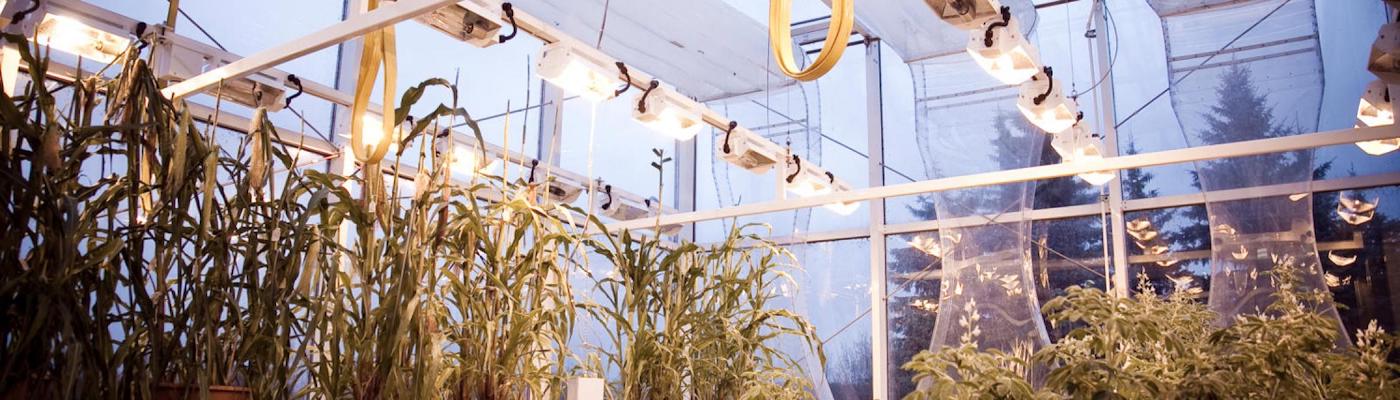
Learn about temperature, humidity, air velocity, and light intensity in the TSE greenhouse, located on-campus in the Environmental Science Building.
U-Links Centre for Community-Based Research
U-Links Centre for Community-Based Research works with community partners, and faculty and students from Trent University to facilitate resource and research exchanges, and to foster community development in many aspects of life in Haliburton County including social services, culture and recreation, health, agriculture and the environment. Trent has collaborated with organizations and citizens of the Haliburton Highlands since 1989 through the TCRC and U-LINKS.
Water Quality Centre
Water Quality Centre (WQC) is dedicated to the development and application of innovative new techniques for the analysis of organic and inorganic contaminants at the isotopic, elemental and molecular scale. The WQC is a multidisciplinary facility that utilizes state-of-the-art instrumentation. Its focus is the determination of trace quantities of inorganic and organic substances found in aquatic environments. Biological material, sediments, soils, fly ash, industrial by-products, and municipal wastewaters are also investigated with respect to their potential impact on the water quality.