

Advancing a modern understanding of the namesake of Champlain College
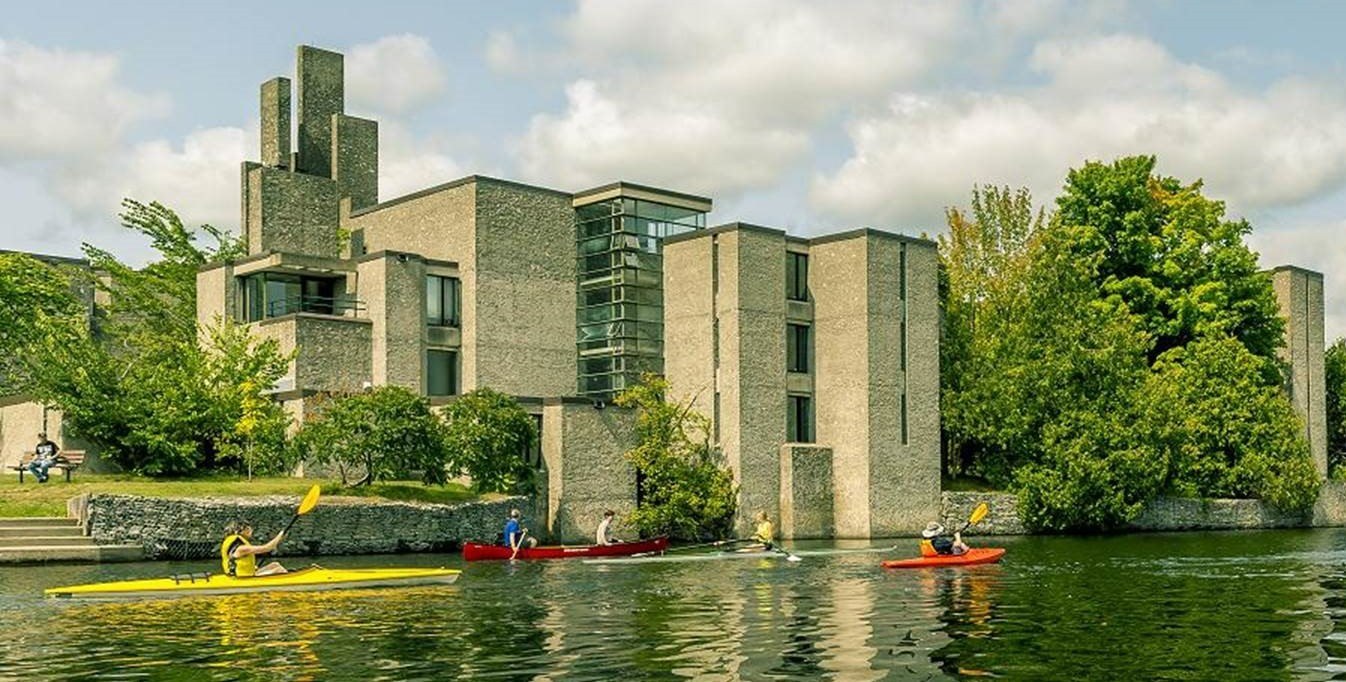
Established in 1965, Champlain College was the first college to be built in the collegiate vision of the University’s founding president Tom Symons. Named after the explorer Samuel de Champlain, this vibrant campus community is located on the west bank of the Otonabee River that Champlain himself travelled, led by the Michi Saagig Anishinaabeg.
Today, Champlain College embraces Indigenous, English and French-Canadian cultures on its path of reconciliation and evolving perspectives of our complex shared history. Champlain College’s spirit of adventure, exploration, and global citizenship are captured in a refreshed college motto: “Continuer nos découvertes”, “Continue our discoveries” – the “nos” / “our” replacing the previous “my” to better express the ongoing discoveries of our shared history.
This web resource will share background information on the college’s namesake, the importance that the naming played in fostering relations between Ontario and Québec, and will shed light on the complexity that the name of a European explorer now signifies in a time of truth telling and reconciliation with Indigenous peoples.
Accordion Title
What has Trent done to review the legacy of Champlain at Trent University?
In a spirit of reconciliation and recognizing that universities have a special role to play in discussion and debate about important contemporary issues, Trent University established a committee to consider and reflect upon the Champlain legacy at Trent. You can learn more about the Champlain Committee, the Report and its recommendations, among them to keep the Champlain name while providing context and an understanding of our shared history in an era of truth and reconciliation.
The Champlain Report and its recommendations were approved and endorsed by Trent University’s Board of Governors. Some of the insights from the Champlain Committee’s investigation are woven into this website to encourage further learning, questioning, and reconciliation.
Accordion Title
Who is Samuel de Champlain?
While many things remain unknown about the life of Samuel de Champlain, we do know that he was an:
Explorer - He was a sailor, soldier, and settler whom historians have framed as the “father of New France”.
Academic - He was a careful observer, writer of journals, and map maker whose early cartography is noted for its accuracy and detail. His notes, illustrations and maps remain a valuable record that provides insights into the era.
Diplomat - He strived to build lasting relationships with various peoples including the Wendat and Anishinaabe. He chose to ally himself with these nations, participating in their existing conflicts with other First Nations, a decision which has further complicated his legacy with Indigenous peoples.
Settler - He established two French settlements in North America, Port Royal in Nova Scotia and Québec City, which is the capital of the province of Québec.
He was a leader in a complicated time.
This link directs you to a website produced by the Ontario Heritage Trust that offers different perspectives from scholars on Champlain: Ontario Heritage Trust | Champlain through the eyes of North Americans
For a more complete overview of his time and activities in Canada, see: Samuel de Champlain 1604-1616 | Virtual Museum of New France (historymuseum.ca)
For more on Champlain’s travels through Ontario with his Indigenous allies, see: https://www.heritagetrust.on.ca/plaques/champlain-in-ontario-1615-1
Accordion Title
What is the significance of naming Trent's first Symons campus college "Champlain"?
In 1964, Trent University started with two residential colleges and a classroom complex situated in downtown Peterborough. By this time, Canadian General Electric had recently donated 150 acres to the north of the City and plans for its development were already underway. For this new campus of Trent University (later called the Symons Campus), a list of possible building names was compiled. It was suggested that the key structures would have names such as “Faryon” or “Champlain” to honour prominent individuals with a local connection.
It was soon decided that the first college on this new campus would be named after Samuel de Champlain, the seventeenth-century French explorer and colonial administrator. In the 1960s, Trent University was touted as “Canada’s University;” a space that would put the study of Canada first, regardless of the discipline. In this milieu, it was though that naming the institution’s most substantial college (at that point) after a French-Canadian icon would be an important gesture of unity.
Laying of the cornerstones
In October 1965, during the 350th anniversary of Champlain's expedition in the region, a ceremony was held that saw the laying of the cornerstones for Champlain College. The event brought together Québec premier Jean Lesage with Ontario premier John Roberts to celebrate the birth of a new educational institution and a renewed partnership between French-speaking and English-speaking Canadians. Today, in Champlain College’s Great Hall you can still see the flags of Ontario and Quebec flying together. One of the recommendations of the Champlain Committee was to introduce a third pillar in recognition of Indigenous languages through the introduction of a new “cornerstone” symbol to the College, recognizing the traditional territory of the Michi Saagig Anishnaabeg and the Anishnaabemowin language of the First Nation. Plans are underway to implement this recommendation.
Click here for more on the laying of the original cornerstones for Champlain College.
Accordion Title
How does our namesake influence the culture of Champlain College?
Champlain College is steadfast in its efforts to build stronger connections with First Nations on the traditional territory where Trent is located, Indigenous communities and encourage our members to seek and experience Indigenous educational opportunities. Annually, we support the Trent Temagami Colloquium, arrange student visits to the Curve Lake Powwow and Petroglyphs park, and contribute to Trent's National Truth and Reconciliation Day programming. We also hold in high regard past achievements like The Great Walk in 2018 and the Speaking My Truth Panel Discussion in 2014.
Champlain College is committed to preserving tradition while promoting diversity and accessibility for all cultures in a rapidly changing landscape grounded in truth and reconciliation. Our programming continually adapts to celebrate Indigenous and local cultures as well as those from around the globe, fostering unity among culturally-diverse individuals.
We take great pride in upholding our longstanding traditions, which include hosting events such as the Bon Temps Carnival, International Education Week activities, and the annual Trent Linguistics Festival. These initiatives demonstrate our enduring dedication to celebrating global perspectives.
The spirit of personal discovery is a fundamental aspect of our college culture, reflected in our mottos. Our official motto, "Continue mes découvertes," “Continue my discoveries”, a phrase taken from Champlain's journal, has recently been revised to "Continue nos découvertes" to emphasize the importance of shared history, collective learning and exploration in our daily lives. "DARE to be Champlain" embodies the essence of discovery, adventure, reflection, and engagement throughout our academic pursuits.
Our dedication to educating students about the historical significance of canoe travel in our region drives our efforts to offer canoeing experiences at Camp Wanapite, during the Fall College Weekend, and on trips to the Kawartha Highlands. Additionally, Champlain College collaborates with FPHL to host a Rotary Club high school canoe trip called “Adventures in Understanding,” providing a space for youth to explore the complexities of Indigenous and settler relationships.
Our symbols, including the Champlain coat of arms/crest featuring azure blue with a crown, fleur-de-lis, waves, and a compass rose, pay homage to Champlain's legacy and serve as guiding elements in our academic journey. The compass, often depicted independently, holds significance for the college in various ways. Champlain himself was adept in using a compass as a navigational tool, making it a symbol of direction and purpose that guides us throughout our educational pursuits as the depth of our understanding evolves. It is also a signifier of the importance of the four directions, a foundational teaching for the Anishnaabeg peoples and many other first nations, represented in the medicine wheel.
In line with the recommendations of the Champlain Report, Champlain College is dedicated to incorporating Indigenous language and history into our identity, artwork, symbols, and names. Collaborating with Champlain College Cabinet, orientation leaders, and ambassadors, the College principal is reviewing our traditions, programming, and taglines for opportunities to be more inclusive in language and programming. Orientation team members have undergone training with the First People House of Learning (FPHL), and Champlain Ambassadors have conducted an art inventory of the College to ensure we are inclusive and respectful. Champlain Cabinet is committed to investing in the display of Indigenous art in College spaces. The College Office continues to enhance collaborations with Indigenous leaders, offering diverse Indigenous programming within the College community.
More reading on the 94 Calls to Action:
Trent University website and resources for Honouring Truth & Reconciliation Day
Accordion Title
Additional Reading
The College Office has copies of two books on the history of Samuel de Champlain, and his travels through the region. We invite you to come to the College Office to check out either of these two books and we encourage further reading by a broad range of scholars, some of which are shared on the website of the Champlain Committee.
Champlain's Dream by David Hackett Fischer
Jones, Elwood, Peter Adams and Al Brunger, eds. Finding Champlain’s Dream: Champlain, First Nations, and French Culture in Peterborough and the Kawarthas. Peterborough: Trent Valley Archives, 2015.
Title
Questions?
If you have questions about Champlain College or have ideas to support our path towards rIf you have questions about Champlain College or have ideas to support our path towards reconciliation please reach out to us by phone: 705748-1011 ex. 7788, email: champlain@trentu.ca, or drop by for a visit CCS 202.1 (up the stairs from the Great Hall).
We want to hear from you.