



Trent Talks: High School Edition
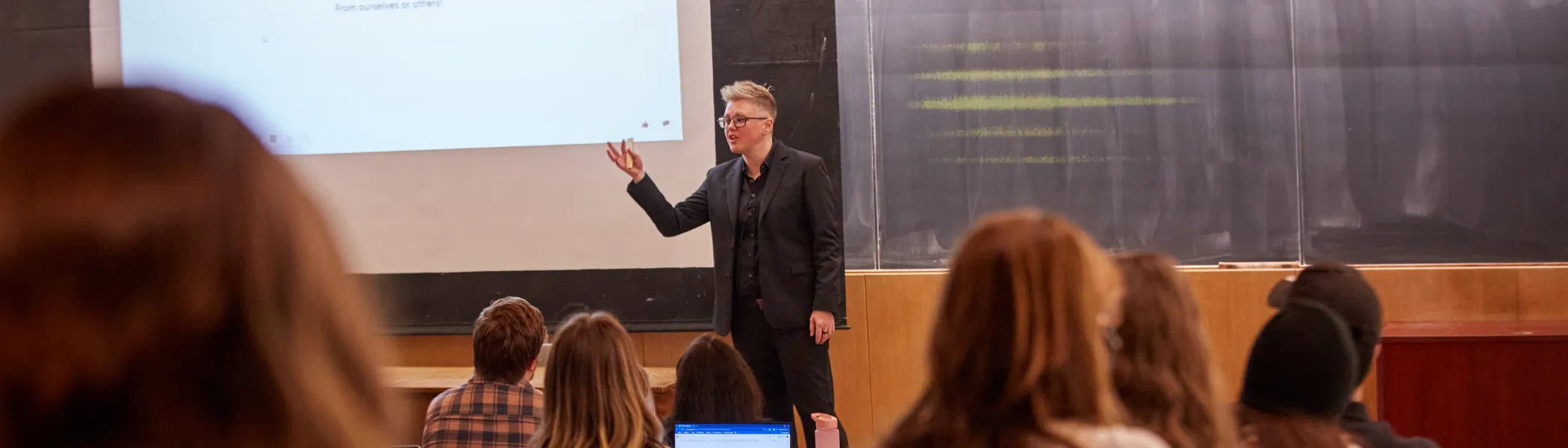
Trent Talks is a series of short and informative lectures prepared by Trent faculty for secondary school classes. These talks are a way for Trent University to give back to our community by sharing our passion for research, teaching, and learning.
REQUEST A TRENT TALK FOR YOUR SCHOOL
TRENT TALKS 2026
Trent faculty below are available to engage your students in conversation about their research across a variety of disciplines. Each talk is roughly 45-60 minutes in length and can be delivered virtually or in person.
ANTHROPOLOGY

Dr. Helen Haines
Associate Professor, Department of Anthropology
Indiana Jones and.... the School of Anthropology?
This talk contrasts the popular image of archaeology as seen in movies with what it is really like to be an archaeologist. It will discuss what anthropology is all about, how archaeology fits into this larger discipline, and why anthropology important for understanding the modern world.
Note that Helen is on sabbatical for fall 2026; bookings can be made for January 2027 onward.

Dr. Amy Scott
Associate Professor, Anthropology
The History of Us!
A brief history of human evolution and what makes us different from our closest primate cousins. How our big brains have helped us develop a complex material culture so we can survive and thrive on our planet.
The Human Skeleton
As the foundation of our biological bodies, the human skeleton holds a wealth of information about us. From forensic investigations to anthropological explorations of our species, the secrets of the human skeleton will be explored.
BIOLOGY

Dr. Joanna Feeeland
Professor, Biology
Evolution in the 21st Century
Evolution is arguably the most important process on earth, but many people view it as a historical process that is not immediately relevant to our day-to-day lives. In this talk I will use examples such as vaccines, pathogens, invasive species, and species at risk to illustrate some of the many ways in which evolution continues to impact us and the world around us.
BUSINESS

Dr. Chantelle Whidden
Lecturer, Business Administration
Future-Ready: Hiring Skills, Inclusion, and Careers in Human Resources
This session introduces students to the world of hiring and work—from résumé building and interviews to understanding bias and inclusive workplaces. With a special focus on neurodiversity, students learn how different strengths are valued at work and how to advocate for themselves. The lecture also demystifies human resources, highlighting HR career paths, designations, and how business careers connect to real-world impact. Content can be customized to align with course outcomes.

Dr. Carolee Cosgrove
Assistant Professor, Business Administration
Sources of Competitive Advantage in Business and Your Personal Life
Sometimes a company’s source of competitive advantage is not related to the products or services it sells, but to some other resource or capability it possesses, like the company’s culture. In this talk, Dr. Carolee Cosgrove will explain a key theory in strategic management that not only helps explain why some firms outperform other firms but may help you develop your own personal strategy for success.
Dr. Rob Elkington
Assistant Professor, Trent School of Business
Effective Leadership in Challenging Times
In this highly interactive session, participants explore how to define leadership and the implications of this definition. Once a definition of leadership emerges, the participants discuss various leadership approaches. Finally, participants complete the session with a discussion on what effective leadership in 21st-century Canadian organizations might entail.
CHILD AND YOUTH STUDIES

Dr. Yana Berardini
Assistant Professor, Child & Youth Studies
What is "Child and Youth Studies"?
In exploring various definitions for “youth” and “children”, students will begin to understand just how complex the lines are between children and youth versus adults. Three discourses of childhood/youth will be presented and then applied to everyday examples, which include TV shows, events, and policies. Concepts of "chid work" versus "child labour", in the context of the Global North and Global South will also be discussed, to allow students to appreciate the diverse experiences of childhood and note the complexity in generating potential solutions. Finally, I will introduce the concept of “young carers” and share some examples of childhoods in the UK versus in Canada.

Dr. Alba Agostino
Associate Professor and Chair, Child and Youth Studies
Who Am I: How Music Preferences Impact Identity Development
Adolescence is a crucial developmental period which many youth engage in identity formation processes. Research indicates that music may play a significant role in shaping identity during these formative year. The lecture will explore Identity theory and the impact of music and music icons.
COMMUNICATIONS

Dr. Christopher Cwynar
Assistant Professor, Communications
Media & Technology
A break down of how public media keeps up in a fast-changing digital world. From evolving program formats to the rise of new platforms and media personalities, the talk will explore how technology and social change are reshaping what we watch, listen to, and trust.

Dr. Andrew Monti
Assistant Professor, Communications
Do It For The Plot
This session introduces high school students to the big ideas of communication through a fast-paced, interactive taste of Trent’s Communications program.Students explore how communication evolved—from spoken language to AI—and why it matters in a complex, changing world. The session blends a participatory lecture with a hands-on workshop focused on curiosity, clarity of purpose, and self-expression. Through quotes, visuals, and reflection, students practice turning ideas that inspire them into their own thinking.
The goal is to spark genuine interest in communication, deepen learning habits, and invite students to imagine their future at Trent University.
CULTURAL STUDIES
EDUCATION
Dr. Karleen Pendleton Jiménez
Professor, Trent School of Education
AI and Social Justice
AI is a brave, new world, filled with tools that can make our lives easier, help us with schoolwork, business, and art. However, it can just as easily harm us and the earth. In this session learn how to identify and avoid AI discrimination like sexism, racism, and homophobia, and instead use AI to help support your voice, your creativity, and your politics.
ENGLISH

Dr. Andrew Loeb
Assistant Professor (LTA), Department of English
The Purpose of Playing in Shakespeare's England
This talk explores what it was like to go to a play in London around the turn of the 17th century, what sorts of exciting and unusual stories audiences saw brought to life on the stage by Shakespeare and some of his contemporaries, and how those audiences became active participants in the making of dramatic meaning.
ENVIRONMENT

Dr. Stephen Hill
Associate Professor, Associate Director, School of the Environment
Climate & Energy Policy in Canada
This talk asks why actions to address climate change have been so slow, and suggests ideas for accelerating the transition to a low-carbon future.
HISTORY
Dr. Melanie Buddle
Principal, Gzowski College, Part-Time Faculty, History, Canadian Studies
History of Happiness
How different societies and eras have understood, pursued, and defined happiness.

Dr. James Onusko
Principal, Champlain College, Adjunct Professor, History
Just Playin’ Around? Studying Children and Childhood in History
The history of childhood, childhood and youth has become an important sub-genre in historical study. How has childhood changed over time, in different contexts around the globe? What are some of the differences between childhood and child? Why is it important to study young people in history? How do we do this?
The Home Children – Why Do They Matter?
In the late nineteenth and early twentieth centuries, thousands of “little immigrants,” some as young as three years old, came to Canada from Britain. Who were these youngsters? What were their lives like in Britain? What did they do and where did they go when they came to Canada? How were they treated in Canada? Are they still significant in 2024 in Canada?
Suburbs in Canada – Peaceful Oases or Something Else?
Millions of Canadians live in suburbs today, and tens of millions have lived in suburbs in the past. Everyone has an image of what the suburbs look like and represent – are they right though? Is there more than 1 type of suburb? Are suburbs predominantly peaceful and boring, as many seem to believe? Have suburbs changed over time?
Boom Kids – Who Were They and Why Do They Still Matter?
Building on my book, Boom Kids: Growing Up in the Calgary Suburbs, 1950-1970, I will explore how the baby boomers and postwar suburbia remain a touchstone. In many ways, the era stands still in time; an idyllic period with great hopes. Was it truly the best of times for young people and their families? What were some of the major challenges that children and adolescents faced in this period? What did young people have to say themselves about their lives?
Shakespeare: Should We Still Read His Works?
We will explore the question: Should we still read Shakespeare? Who was he and was he important in his time? What, if anything, is so special about Shakespeare and his works? Should we “read” or should we “watch” Shakespeare? Who is left out, when we focus on Shakespeare?
Was it a Common Sense Revolution?
The Common Sense Revolution (CSR) was one of the most significant public policy changes in Ontario in the past 30 years. What was the CSR? Why was it significant then and why is it still important today? What is neoliberalism and how did it impact the CSR? Why does the CSR matter to me?
PSYCHOLOGY

Dr. Korri Bickle
Assistant Professor, Psychology
Who am I? My personality and me!
Have you ever wondered why you are the way you are? Are you the exact same person at Grandma's house for tea and at a party with your friends? Maybe not... let's find out why! This talk will cover personality and how our environment or the situation we are in seems to change how we behave.

Dr. Raheleh Saryazdi
Assistant Professor, Psychology
Virtual Reality in Psychology Research
Virtual reality (VR) is not only popular with teenagers — older adults are also using VR, including persons living with dementia. In this talk, I will go over the use of VR in psychology research. This will include two recently completed VR based studies. The first study looked at whether using VR in the home could help increase conversations between persons living with dementia and the family members who care for them. This serves to improve the quality of life for both parties. The second study explored whether adding smells to a VR experience could help increase our ability to remember objects and scenes.