
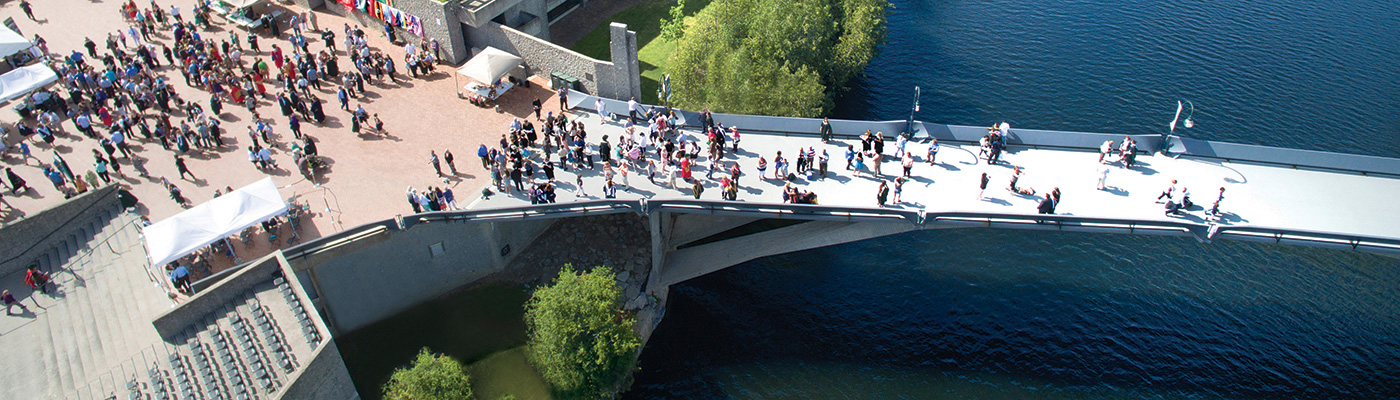
In a spirit of reconciliation, and recognizing that universities have a special role to play in discussion and debate about important contemporary issues, Trent University and Champlain College have established a committee to consider and reflect upon the Champlain legacy at Trent.
The members of the Champlain Committee include students, alumni, faculty and staff with a mix of expertise and perspectives that include Indigenous knowledge and scholarship; ethics; history and heritage.
Members of the Trent community, and the public, are encouraged to make written submissions to the committee expressing their thoughts and opinions on the legacy of Champlain’s name as it relates to one of the University’s oldest Colleges. All submissions will be reviewed and considered.
In the spirit of free inquiry and the Trent tradition of the respectful exchange of ideas, there are no foregone conclusions. The committee’s investigation, including the review of all input, will result in a final report to the President.
Thank you for your interest. We invite you to explore the links, information and resources on this site.
Resources and Information
Accordion Title
President Groarke’s Message to the University Community
Colleagues,
In a spirit of reconciliation, and in a broader context which recognizes that universities have a special role to play in discussion and debate about important contemporary issues, the University and Champlain College are establishing a committee to consider and reflect upon the Champlain legacy at Trent. The committee’s deliberations are rooted in questions that have been raised about the Champlain bust and associated artwork.
I appreciate the help and advice of many people as I have reached out to members of our community who can bring relevant expertise and experience to this discussion (and other discussions that could result from it). The Committee will be chaired by Marilyn Burns, our Vice President of Colleges. The Committee itself will determine a process for reviewing the history of Samuel de Champlain as it relates to Trent University, and will encourage consultation with the Trent community and local First Nations. A special effort will be made to consult with Trent alumni, and especially Champlain alumni, on the questions the committee considers. The Committee will aim to bring a report to the Office of the President at the end of the winter 2022 term.
The members of the Champlain Committee include students, alumni, faculty and staff with a mix of expertise and perspectives that include Indigenous knowledge and scholarship; ethics; history and heritage. I want to personally thank them for taking time out of their busy schedules to be a part of this important discussion. I have included a list of committee members and a brief profile of their backgrounds below.
Best regards,
Leo
Leo Groarke
President & Vice-Chancellor
705-748-1011 ext. 1090
trentu.ca/president
Instagram: @trentuprezleo
Accordion Title
Champlain Committee Principles & Process
Background
The Champlain Committee at Trent University was established during a time of heightened awareness of the impacts of colonization and the imperative for truth and reconciliation.
At Trent University, questions have arisen at various times about Champlain College, its namesake Samuel de Champlain (c. 1567–1635), and the name itself, as well as artwork and sculpture displayed at the college. The year 2021 marked the first National Day for Truth and Reconciliation, recognized at the University through a Treaty Rock installation at Symons Campus and a Treaty Wall at the Durham GTA campus.
These latest initiatives build on Trent’s 50 years of leadership in Indigenous Studies and the University’s 1993 Statement of Affirmation and Support, upholding the institution’s commitment to Indigenous knowledge and incorporating traditional teachings and perspectives into its curricular and extracurricular programming.
Along with these central perspectives exists an evolving history of Champlain College that currently involves 2,151 students and more than 10,000 alumni who bring their own distinct attachments to their college.
Goal
In light of the above, the Champlain Committee will endeavour to provide a report that gives guidance and recommendations to the University regarding the representation of Samuel de Champlain as it relates to the identity of the college, possibly including, but not limited to, imagery, language, objects and contextual information.
Principles and Process
To do so, the Committee will:
- Gain an awareness of current questions and conversations about the Champlain College identity from various stakeholders, rights holders and representatives from within and outside the Trent community.
- Come to a contemporary understanding of the legacy of Samuel de Champlain, informed by historical accounts and scholarly material, as well as current understandings of colonial figures.
- Provide due consideration and exceptional access to advice from and dialogue with Elders and Chiefs, as well as the Trent University Alumni Council.
- Receive input and review perspectives from a variety of groups and individuals, including students, faculty, staff and alumni—especially alumni of Champlain College—as well as experts and others who may wish to contribute written submissions.
- Consider what might constitute an approach that is distinctly Trent.
Accordion Title
Committee Members
Committee Members
- Nicole Bell ’86
- Marilyn Burns (Chair) ’00
- Gracie Crafts ’18
- Yancy Craig ’95
- Michael Eamon
- Harvey McCue ’66
- Kate Norlock
- Emma Phillips ’17
- François Senécal ’83
Nicole Bell ’86
Nicole Bell is Anishinaabe, Bear Clan, from Kitigan Zibi First Nation in Maniwaki, Quebec. An alumna of Trent, she earned her B.A. and Ph.D. at the University and is currently an associate professor in the School of Education.
Her research interests include Indigenous culture-based education, land-based learning, the inclusion of Indigenous knowledge in public schooling and teacher education, decolonization and healing, and Indigenous research theory and methodology.
Marilyn Burns (Chair) ’00
Marilyn Burns is the vice-president of Communications & Enrolment at Trent University and oversees Trent’s five colleges. She is a Peter Robinson alumna, later joined Julian Blackburn and Gzowski colleges, studied at Traill College for her master’s degree, and is a fellow of Champlain College.
Her scholarly interests include semiotics and the role of words and imagery in our lives, as well as in promoting the University’s reputation and identity.
Gracie Crafts ’18
Gracie Crafts is Anishinaabe from Wasauksing First Nation and a student in the Indigenous Environmental Science B.Sc. program. She is the senior fire keeper at the First Peoples House of Learning tipi, where she has worked closely with Elders from Curve Lake and visited with Knowledge Keepers from across North America and Turtle Island.
Gracie is the vice-president of student engagement and orientation for the Trent University Native Association (TUNA). She was also an Orientation Week leader for Gzowski College.
Yancy Craig ’95
Yancy Craig is a proud alumnus of Trent and Champlain College whose family connections are Oneida from Six Nations of the Grand River. He is vice-president of Indigenous and Government Relations at Indspire.
Previously, he was a senior advisor at the Assembly of First Nations and director of strategic development at the National Association of Friendship Centres. Yancy has also held roles with the federal government, including Environment Canada and Aboriginal and Northern Development Canada, with a focus on economic development, international affairs and social policy.
Michael Eamon
Michael Eamon is the principal of Traill College and a professor of public history. He has contributed research and articles to Trent University’s series of 50th-anniversary plaques.
Michael was a co-author of the University’s Heritage Stewardship Policy and co-chairs Trent’s Heritage Committee. He previously worked as a plaque researcher for the Ontario Heritage Trust, including on the 400th-anniversary plaque commemorating Champlain in Ontario. He also held management roles at Parks Canada and Library and Archives Canada, working in historical interpretation and exhibitions.
Harvey McCue ’66
Harvey McCue, Waubageshig, C.M., M.A. (McMaster), is Anishinaabe from the Georgina Island First Nation. He was part of the first cohort to move into Champlain College residence in January 1967, served as the third president of the Champlain College Student Council, and remains a fellow of Champlain College.
Harvey also served as chair of the Otonabee College Names Committee, which recommended that the theatre be named after Chanie (Charlie) Wenjack. Before becoming a consultant specializing in Indigenous issues, Harvey helped establish the Native Studies Department at Trent, where he taught for 14 years.
Kate Norlock
Kate Norlock is the Kenneth Mark Drain Chair in Ethics. She has been a professor in the Department of Philosophy for 11 years and serves as a faculty fellow at Lady Eaton College.
Kate’s research interests include the ethics of complaint, forgiveness and anti-oppression practices. She brings experience from her roles as an academic program chair, faculty union executive member and member of presidential advisory committees. She is a newcomer to Canada and a new Canadian citizen.
Emma Phillips ’17
Emma Phillips is a student in the Bachelor of Environmental Science and Studies program. As prime minister of the Champlain College Cabinet, she brings three years of Cabinet experience, having previously served as cultural affairs representative and community and sustainability representative.
Emma has also been involved with the orientation team, most recently as a senior leader. In her work with Parks Canada, she collaborated with Indigenous partners on education and conservation decisions and projects.
François Senécal ’83
François Senécal is an alumnus of Trent and a former member of Champlain College. He holds a B.A. in Philosophy from Trent and an LL.B. from Université de Montréal.
As a student, he served on the University Senate and was president of the Champlain College Cabinet. He now practises commercial and corporate law at DSL LLP and serves as volunteer co-chair of the Champlain College Endowment Committee.
Accordion Title
History of Champlain College’s Name
In 1964, Trent University was established in downtown Peterborough. With the donation of 150 acres of land from Canadian General Electric, the focus of the University’s expansion turned north to the former community of Nassau Mills on the Otonabee River. Ron Thom, the University’s master planning architect, developed a campus plan that recommended the construction of a dozen university colleges, a library, and science complex.
The first college to be built was seen as the flagship of the new campus. Traditionally, new university colleges were named after religious figures, affluent donors, or royalty. However, the Trent University naming committee took a much different tact. It recommended Samuel de Champlain for several reasons. Naming the new College after the French explorer offered an inherent sense of tradition to the brand-new structure and the spirit of discovery was seen as an important trait for young students. Furthermore, the 1960s was a time of great tensions between French and English Canadians. A new university, in the heart of English Canada, choosing a renowned French explorer was hoped to be a symbolic act of reconciliation and an affirmation of the importance of good relations between French and English Canadians. To that end, on October 20, 1965 the premiers of Ontario and Quebec joined together in an unprecedented ceremony to unveil the cornerstone of the College.
Accordion Title
Who was Samuel de Champlain?
The legacy of Samuel de Champlain (c. 1574-1635), like most historical figures, is complex. He has been remembered as an explorer, a diplomat, and a colonizer. He is revered by some, reviled by others, and forgotten by many. Regardless, his legacy endures and continues to influence who we are as Canadians and as members of the Trent community some 400 years after first coming to North America.
Champlain was a sailor, cartographer, artist, soldier, and a colonial administrator. From 1603 to 1635, he made over 25 voyages across the Atlantic, forged diplomatic relations with some First Nations peoples, made enemies of others, founded settlements in Acadia and New France and explored a large portion of North America including present-day Nova Scotia, Quebec, Ontario, and the States of Vermont and New York. Champlain was not the first European to explore New France. However, his publications — replete with elaborate descriptions and illustrations of the landscape and indigenous peoples — offer an invaluable perspective for this early period of European contact.
Champlain was baptized on 13 August 1574 to Protestant, or Huguenot, parents Anthoine Chapeleau and Marguerite Le Roy in the French city of Brouage. It is believed that he learned his seafaring skills at the side of his father a skilled navigator in La Rochelle, France. Champlain never lost a ship at his command which, considering his two dozen crossings, is a remarkable feat.
The gulf that existed in his day between Protestants and Catholics was often wider and more difficult to cross than the Atlantic. Champlain was considered an outsider, both in terms of religion and class. Early on he would adopt the Roman Catholic faith of France; however, his birth to a navigator would not be forgotten by the French court. Indeed, for many years he was the de facto governor of New France (Québec), an official title he could never have because of his common birth and Protestant roots.
In 1603, Champlain made his first voyage to New France sailing up the Saint Lawrence River to Tadoussac with the experienced navigator François Gravé du Pont (c. 1560-1629). The next year, Champlain sailed to Acadia as a cartographer with the fur entrepreneur Pierre Du Gua de Monts (c. 1558-1628). Champlain would later establish the Habitation at Port-Royal where, in order to maintain the health and morale of the French inhabitants, he created the Order of Good Cheer. By 1608, Champlain’s focus had shifted to New France where he established a new Habitation (Quebec City) which, four centuries later, is the capitale nationale of the province.
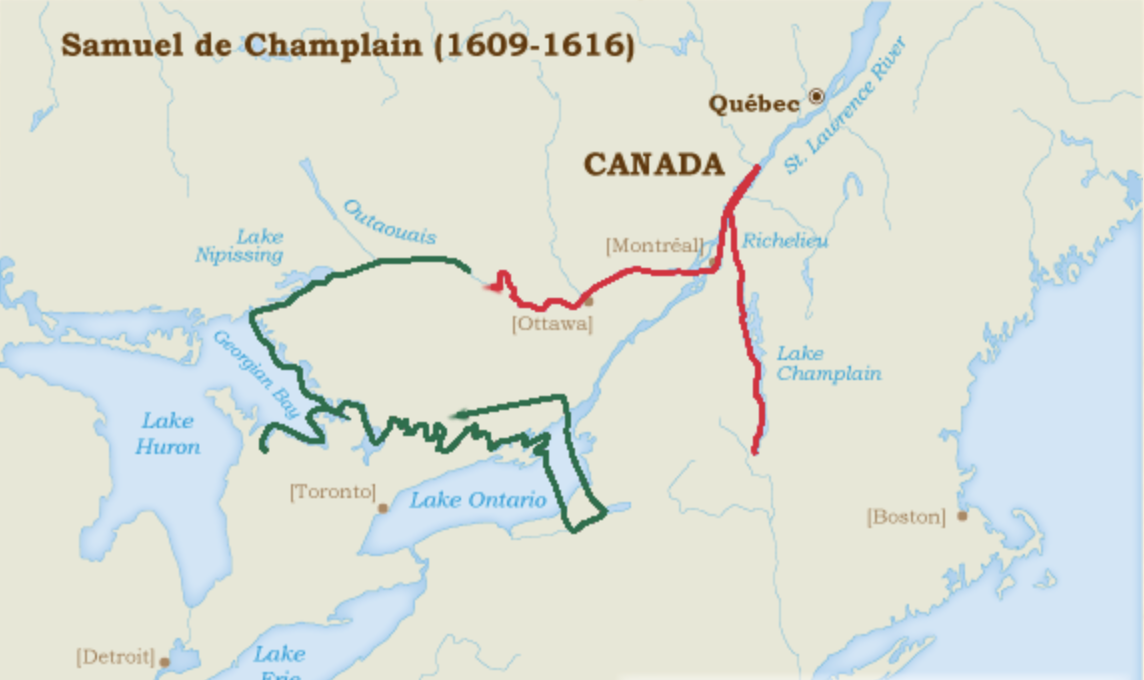
On 24 April 1615, Samuel de Champlain left the French port of Honfleur aboard the ship Saint-Ėtienne. In his journals, he writes that he had a “very favourable wind” which transported him across the Atlantic in 31 days without incident. Upon his arrival in Quebec, Champlain was informed of increased tensions between his Anishinaabe and Wendat allies with their traditional enemy the Haudenosaunee. Champlain decided that it was prudent to travel further inland to Huronia in what is now the Province of Ontario.
His writings from this time give an illustrative account of his diplomatic visit to several villages, the manner of the indigenous peoples and the countryside which he later describes as “very fine and of pleasing character. Along the shores one would think that the tress had been planted for ornament in most places.” His primary destination during this time would be the grand Wendat village of Cahiagué, a settlement of over 200 longhouses and an estimated 6000 inhabitants, near the present-day city of Orillia.
In October, Champlain with a mixed force of 400 to 500 Anishinaabe and Wendat warriors travelled south, near us along the Trent River system, crossed Lake Ontario and attacked the fortified village of their rivals, the Haudenosaunee, near what is now Syracuse, New York. During the battle, Champlain was injured in the leg. Without reinforcements and facing the prospect of increasingly poor weather, a retreat was made transporting Champlain back to Cahiagué. During his recovery he made diplomatic visits to the neighbouring First Nations, including the Petun peoples. He left Huronia in the spring for Quebec. In August 1616, he sailed back to Honfleur and while his adventures in New France would continue for another fifteen years, he and would never to return to the region of Ontario.
In nineteenth and early-twentieth century Ontario, Champlain was a symbol of what many people believed to be the European origins of the region. Legends of his lost (and later found) swords and astrolabe further bolstered the idea of the early European pedigree of the province. By the second half of the twentieth century, Champlain became seen as less of a founder and more of an interlocutor with First Nations peoples negotiating within their complex social, commercial, and political networks. Throughout North America, his name can be found on geographic features, high schools, a CEGEP in Québec, an American university, and Trent’s own Champlain College. Today, the legacy of Champlain is not always seen in such a positive light. Indeed, some view him as ushering in an era of reckless and relentless colonizers. His ill-fated raid on the Haudenosaunee, the unflattering commentary of his First Nations allies, and foes alike, found in his journals are offered as proof of his cultural insensitivities and arrogance. On the other hand, Champlain’s cartography and written accounts have also assisted in the better understanding of the territories and interactions of various First Nations across northeastern Canada. In spite of Champlain’s prominence, it may come as a surprise that (outside of his writings and maps) the specific details of his life and influence are opaque. How he spelled his name, or what he actually looked like, continues to be a subject of academic debate. For over 400 years, Samuel de Champlain has been an enigma and his legacy remains complex.
Accordion Title
Video on Samuel Champlain
This documentary, publicly posted on the website of the Alliance des Producteurs Francophone du Canada, interviews a series of experts with views into the history and impact of Samuel de Champlain. Included among them is Jérémie Giles, the artist who donated the Samuel de Champlain bust currently housed in the Trent University Archives.
Accordion Title
Students Consider and Reflect on the Legacy of Champlain
The Champlain Committee hosted “Who Was This Samuel de Champlain Guy Anyway?,” a student-led review and debate on the legacy of Samuel de Champlain on Wednesday, March 2.
Read on for a student perspective from Gracie Crafts of Peter Gzowski College, a fourth-year Indigenous Environmental Studies and Sciences student and member of the Champlain Committee.
Reflecting on Legacy
At the end of 2021, Trent University pulled together a committee to address the legacy of Samuel de Champlain and his namesake at Trent University.
The committee has been tasked with investigating and considering all information about Champlain to prepare a final report for the University’s president about how to move forward. With reconciliation and the recent news throughout the summer of 2021 in mind, consultation with surrounding First Nations and Indigenous communities, as well as the inclusion of Indigenous knowledge in the committee’s decision-making, is necessary.
My Representation on the Committee
I am sitting on the committee as an Indigenous (Anishinaabe) student representative and as a member of the Trent University Native Association (TUNA).
As an Anishinaabe student, I feel that being on this committee is important. Guidance from Elders, Chiefs and Knowledge Keepers is always a priority in my mind. A student perspective is invaluable in all issues happening at Trent University because current students will be the ones most affected by any changes.
This issue can also be considered an Indigenous issue, as Champlain is considered a colonizer and caused harm among many First Nations. However, he also played a crucial role in Canadian history.
Importance in a Name
We are seeing changes to, and inquiries into, names at colleges and universities across North America. I feel that, with the pandemic, students are more aware of and talking more about current issues and acknowledging changes they would like to see. The name, artwork and figure of Samuel de Champlain have been topics of conversation among Trent University students. I think this conversation has been a long time coming, but we as a Trent community, and even as Canadians, have to be ready to tackle it.
Whatever the final report from the committee recommends, my hope is that students are aware of the namesakes of buildings and the history at Trent University. I think it is important to be educated about the names you may say every day while on campus and to be able to form your own opinions. With reconciliation in mind, I hope Indigenous students, communities, Elders and Knowledge Keepers continue to be involved in all decisions surrounding issues and possible changes at Trent University.
An Opportunity to Participate
On Wednesday, March 2, the committee hosted a student-led review and debate of select scholarly works addressing the legacy of Samuel de Champlain. We would love to see more students getting involved. Visit the Champlain Committee website (you are currently on this site) to learn more about Champlain and the process the committee is working through. You can also share your thoughts.
— Gracie Crafts
Accordion Title
Readings and Background
Champlain’s legacy is complicated. In general, historians have traditionally seen his efforts as instrumental in establishing France’s dominance in the New World and he has the title of the “Father of New France.” Anthropologist Bruce Trigger (1971) was one of the first modern scholars to question Champlain’s skill as an explorer and diplomat. He found Champlain arrogant and demonstrating little sensitivity for Indigenous culture and politics. More recently, David Hackett Fischer (2008) has argued the opposite; that Champlain was a humanist whose “dream” was to create a multi-ethic region where different peoples could live harmoniously.
Today, Champlain is often seen as a colonizer whose actions in establishing a French presence in North America mark the beginning of centuries of tumultuous settler-Indigenous relations. His raids against the Haudenosaunee (Iroquois) are often provided as evidence of disrespectful and destructive behaviour. On the other hand, he was also a strong ally of the Anishinaabe (Algonquian), Wendat (Huron), and Tionontati (Petun) who entreated him to move into the interior where he joined them in their disputes against their enemies.
This list (below in the next accordion) offers various scholarly perspectives on Champlain, his era, and his legacy.
Accordion Title
A Bibliography of Readings
The following are among the readings and references being reviewed by the Champlain Committee. We hope that you will join us in reviewing the variety of perspectives to form your own view of Champlain’s legacy.
Scholarly Publications
Buisseret, David. “The Cartographic Technique of Samuel de Champlain.” Imago Mundi 61,2 (2009): 256-259.
Cole, A. O. C. Trent: The Making of a University, 1957-1987. Peterborough: Trent University, 1992.
Fischer, David Hackett. Champlain’s Dream. Toronto: Alfred A. Knopf Canada, 2008.
Fryer, Mary Beacock. Champlain: Peacemaker and Explorer. Toronto: Dundurn Press, 2011.
Gonthier, Ursula Haskins. “Postcolonial Perspectives on Early Modern Canada: Champlain’s Voyages de la Nouvelle France (1632).” French Studies 66,2 (2012): 145-162.
Heidenreich, Conrad E. Explorations and Mapping of Samuel de Champlain, 1603-1632. Toronto: B. V. Gutsell, 1976.
Hermann, M., & Pearce, M. “Travel Journals of Samuel de Champlain.” Cartographic Perspectives 62 (2009): 55–57.
Hunter, Douglas. “The Mystery of Champlain’s Astrolabe.” The Beaver 84,6: 14-23.
Jenish, D. Trent University: Celebrating 50 Years of Excellence. Toronto: ECW Press, 2014.
Jones, Elwood, Peter Adams and Al Brunger, eds. Finding Champlain’s Dream: Champlain, First Nations, and French Culture in Peterborough and the Kawarthas. Peterborough: Trent Valley Archives, 2015.
Manning, Sturt W. et al. “Contact-Era Chronology Building in Iroquoia: Age Estimates for Arendarhonon Sites and Implications for Identifying Champlain’s Cahiagué.” American Antiquity 84,4 (2019): 684-707.
Montgomery, David. “The Lost Seven Leagues: Samuel de Champlain’s Landfall in Huronia.” Ontario Archaeology 52 (1991): 3-14.
Neatby, Nicole and Peter Hodgins. Settling and Unsettling Memories: Essays in Canadian Public History. Toronto: University of Toronto Press, 2012.
Peace, Thomas G.M. “Deconstructing the Sauvage/Savage in the Writing of Samuel de Champlain and Captain John Smith.” French Colonial History 7 (2006): 1-20.
Pentland, C.J. “Commemoration as Reconciliation: Indigenous History and Canada’s Heritage Designation System.” iJournal 6,2 (2021): 1-13.
Rodgers, Edward and Donald B. Smith, eds. Aboriginal Ontario: Historical Perspectives on the First Nations. Toronto: Dundurn Press, 1994.
Stevenson, Michael D. “‘Free from All Possibility of Error’: Orillia’s Champlain Monument, French-English Relations, and Indigenous (Mis)Representation in Commemorative Sculpture.” Ontario History 109,1 (2017): 214-237.
They Would Not Take Me There: People, Places, and Stories from Champlain’s Travels in Canada, 1603-1616. Colour map. University of Maine, 2008.
Trigger, Bruce G. “Champlain Judged by His Indian Policy: A Different View of Early Canadian History.” Anthropologies 13,1/2 (1971): 85-114.
Original Sources
Biggar, H.P., ed. The Works of Samuel de Champlain, 1608-1620. Volume IV. Toronto: The Champlain Society, 1932.
Biggar, H.P., ed. The Works of Samuel de Champlain, 1615-1618 (Voyages). Volume III. Toronto: The Champlain Society, 1929.
Grant, W.L., ed. Lescarbot: The History of New France. Volume II. Toronto: The Champlain Society, 1911.
Heidenreich, Conrad E. and Janet K. Ritch, eds. Samuel de Champlain Before 1604: Des Sauvages and Other Documents Related to the Period. Toronto: Champlain Society, 2010.
Library and Archives Canada (LAC). Les voyages du sieur de Champlain, Xaintongeois, capitaine ordinaire pour le Roy en la marine, “Abitation du port royal,” 1613, e010764747; and “Abitation de Quebecq,” 1613, e010774131.
LAC, Alexander E. MacDonald fonds. “Carte de la Nouvelle France…faicte [sic]... par le sieur Champlain.” 1632. NMC 51970.
Trent University Library and Archives (TULA), Board of Governors Minutes, September 1963-November 1964.
TULA, Campus Planning Committee Minutes, 1962-1965.
TULA, Champlain College: Coat of Arms Committee.
TULA, Trent University Art Committee Records.
Further Reading and Resources
City of Kingston. “Alderville First Nation Commemoration Project.” City of Kingston website. Accessed October 15, 2022.
City of Toronto. “A New Commemorative Framework for the City of Toronto’s Public Spaces.” Internal report, June 27, 2022, pp. 1-18. View the report. Accessed October 15, 2022.
Groat, Cody and Kim Anderson. “Holding Place: Resistance, Reframing, and Relationality in the Representation of Indigenous History.” Canadian Historical Review 102,3 (2021): 465-484. DOI: 10.3138/chr-2020-0045.
Pentland, C.J. “Commemoration as Reconciliation: Indigenous History and Canada’s Heritage Designation System.” iJournal 6,2 (2021): 1-13. DOI: 10.33137/ijournal.v6i2.36456.
Sentance, Nathan. “Whose History: The Role of Statues and Monuments in Australia.” Australian Museum, July 12, 2022. View the resource. Accessed October 15, 2022.
University of Melbourne. “Counter Monuments: Challenging Distorted Colonial Histories Through Contemporary Art and Memorial Practices.” Webinar, Undoing Australia series, 2022. View the webinar resource. Accessed October 15, 2022.
Accordion Title
Archival Documents
The following documents, provided by Trent University Archives, offer historical perspective on the rationale behind the naming of Champlain College, the people involved and the considerations at the time.
- Architect Plan News Release
- Champlain’s Name Shames Trent — Nick Taylor
- Champlain’s Name — Harvey McCue
- Champlain Brand Positioning
- Champlain College Contract
- Champlain Cornerstone News Release 2
- Champlain Cornerstone News Release
- Trent and Champlain — Brunger and Adams
- First Building: Champlain News Release
- Trent University and Samuel de Champlain
- Laying the Cornerstone of Champlain College
- Report of the Committee on Names: Champlain
- Second Report of the Committee on Names: Champlain
- Summary of Champlain College Concerns — Principal Tina Fridgen
- Artist Jérémie Giles’ Statement — Creator of the Champlain Bust
- A Small Man with a Big Gun? — Doug Williams