
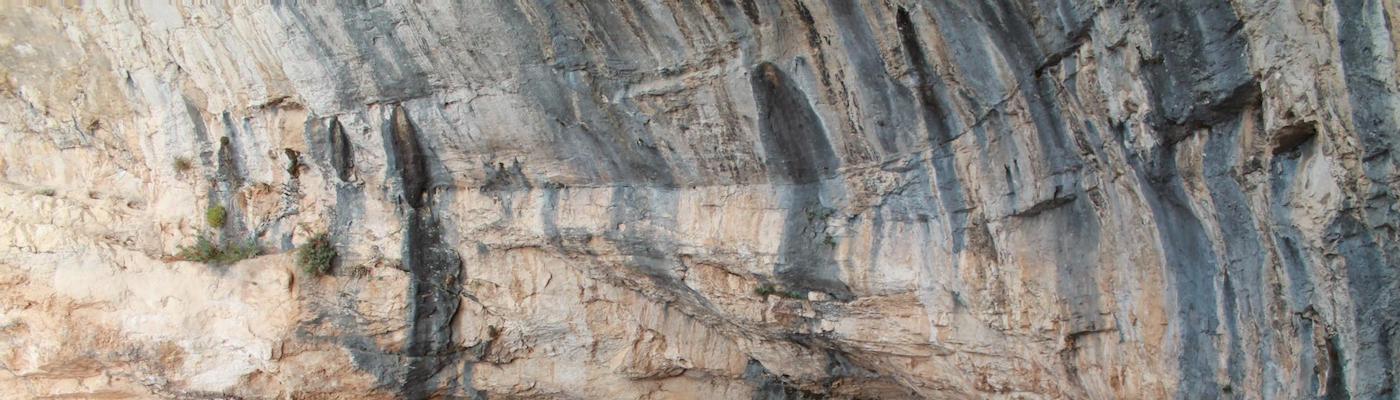
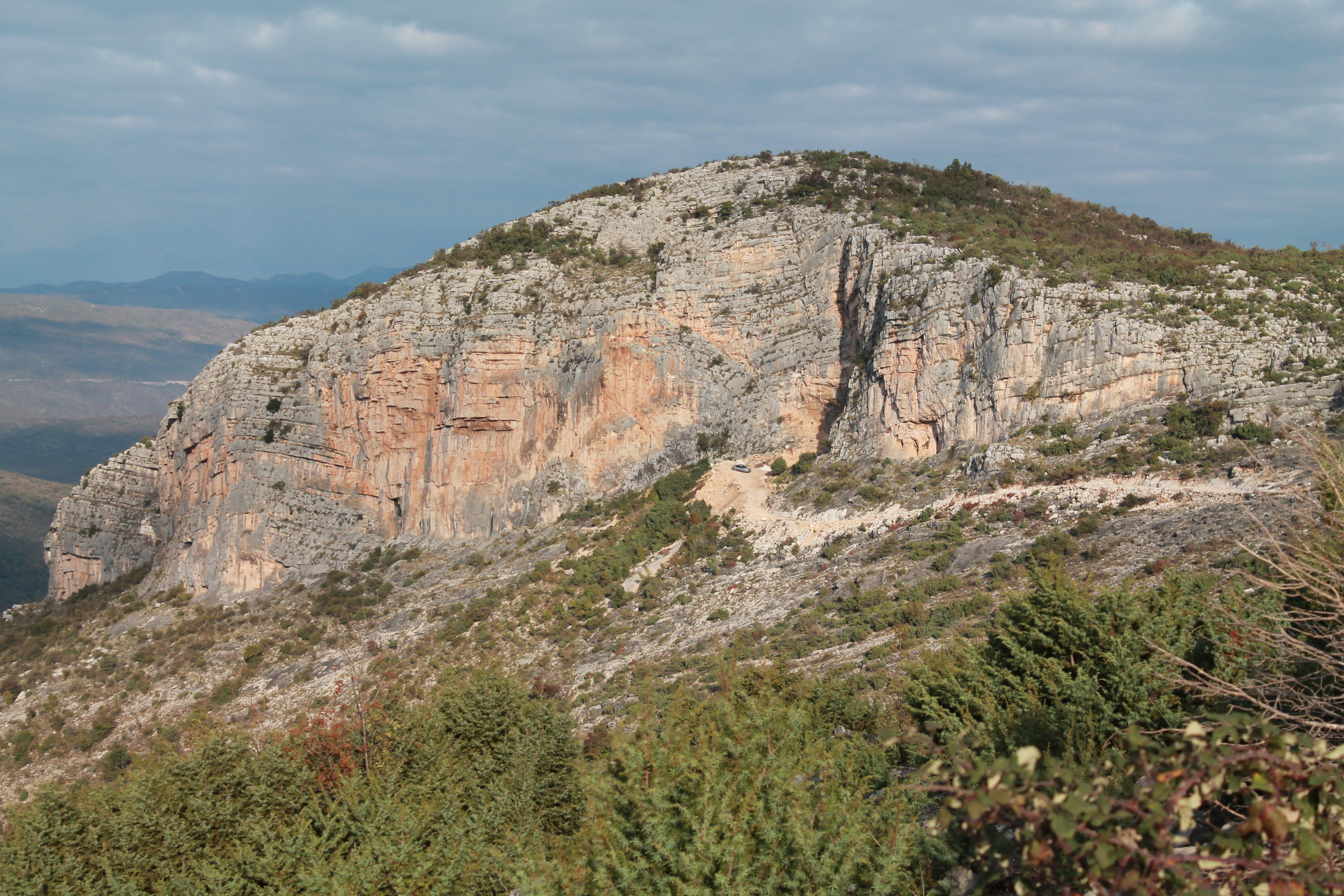
Crvena Stijena is a large cave site located near the village of Petrovici near the border of Montenegro and Bosnia and Herzegovina. The site is at moderate altitude (800m) and today overlooks an artificial lake created by damming the Trebišnjica River.
Excavations at Crvena Stijena
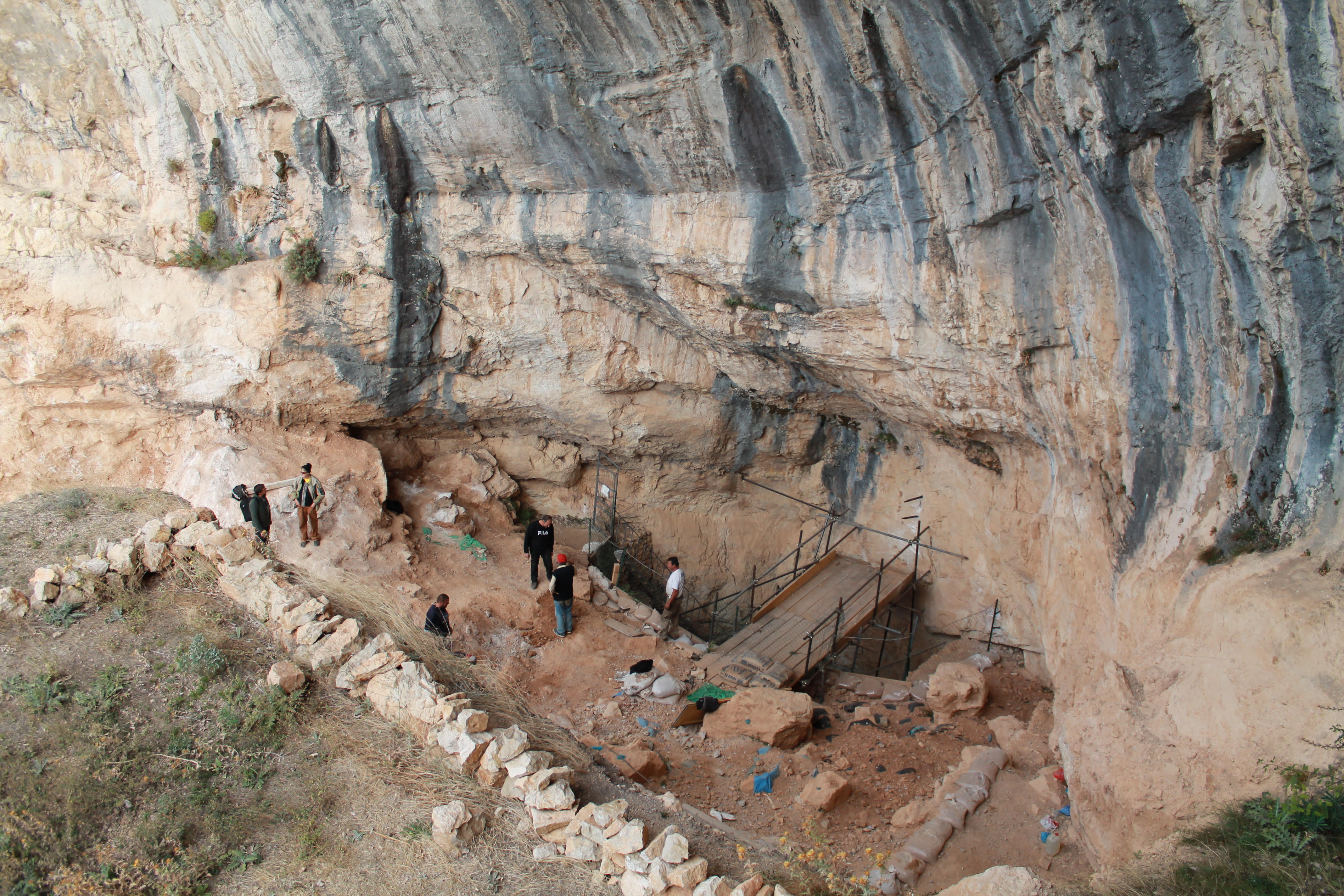
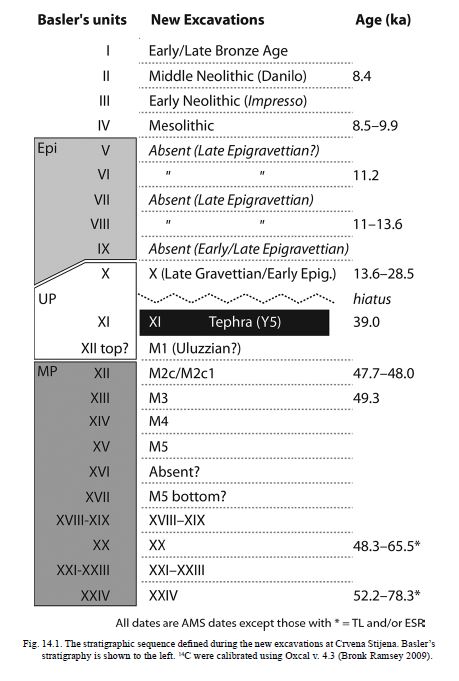
The site was originally discovered in 1954 and has a very rich stratigraphic sequence spanning from the Paleolithic through to the Bronze Age. These excavations uncovered faunal and lithic remains spreading across 31 levels. The site was re-opened in 2005 by Mile Bakovic (Centar za konzervaciju i arheologiju Crne Gore, Montenegro) and Robert Whallon (University of Michigan) and since then has been regularly excavated by a team of multi-disciplinary researchers headed by Gilbert Tostevin (University of Minnesota).
Current Research
Goals
The three main goals of the current research program at Crvena Stijena are to:
- build a solid chronology of the human occupations and to better understand the paleo-environmental (past environments) contexts
- to identify the function of the site
- to evaluate the hypothesis that Neandertals relied on the preservation of foodstuffs (drying and smoking of meat)
Chronology and Paleo-environments
A first striking pattern at Crvena Stijena is the small changes in the representation of red deer (Cervus elaphus), the most common species at the site. This continuity suggests that the environmental conditions remained relatively stable during the Late Pleistocene (130,000 to 10,000 years ago) in the Balkans. However, based on the intensity of marrow processing on the site, it is likely that the inhabitants were experiencing seasonal food stress or at least that they were trying to maximize fat intake.
In addition to red deer, the faunal collections include ibex (Capra ibex) and/or Caucasian tur (Capra caucasica), two species that are difficult to distinguish using skeletal fragments. Fallow deer and marmot were also identified. Faunal remains suggest that occupations mostly occurred during the mid through late winter, spring and summer. The discovery of remains from very young animals (bones from fetuses) also suggests that the site was located within close proximity to calving areas of various herbivores.
In addition, the faunal analysis shows evidence of differences in the intensity of occupations throughout the site's history. The more recent occupations seem to have been less intensely occupied than level XXIV (a level close to the bottom of the sequence), as indicated by numerous combustion features, high frequency of burned bones and an absence of carnivore remains (carnivores frequently den in unoccupied caves).
Site Function
The Middle Paleolithic occupations from Crvena Stijena contain large numbers of faunal remains, whereas stone tools are rare. Given this pattern, it seems likely that the inhabitants of the site were primarily focused on the processing and consumption of large game. Carnivores, such as the cave hyena, are uncommon at the site, suggesting that they did not occupy the cave on a regular basis. Evidence of their ravaging activities, however, is slightly more common on ibex/Caucasian tur than on red deer, as indicated by the presence of many gnawed bones attributed to the former species.
Interestingly, cutmarks were observed on bear and marmots at the site. These species rarely show evidence of human activities in other sites occupied by Neandertals.
Meat Drying and Food Preservation
Some of the human-generated modifications that have been identified at Crvena Stijena include:
- cutmarks (slicing marks left by stone tools on bone): were observed on all of the main species, but are most commonly found on red deer bones
- when compared to ethnographic (study of current hunters-gatherers) and experimental (experiment in which slicing marks are replicated) data, the orientation and length of some cutmarks are consistent with meat filleting, and possibly drying or smoking
- burning: burned bones are very common in the earlier Middle Paleolithic levels (level XXIV in particular)
- marrow extraction activities: was extensive at the site, as the bones frequently show marks of percussion. Bones were probably marrow-cracked using pebbles.
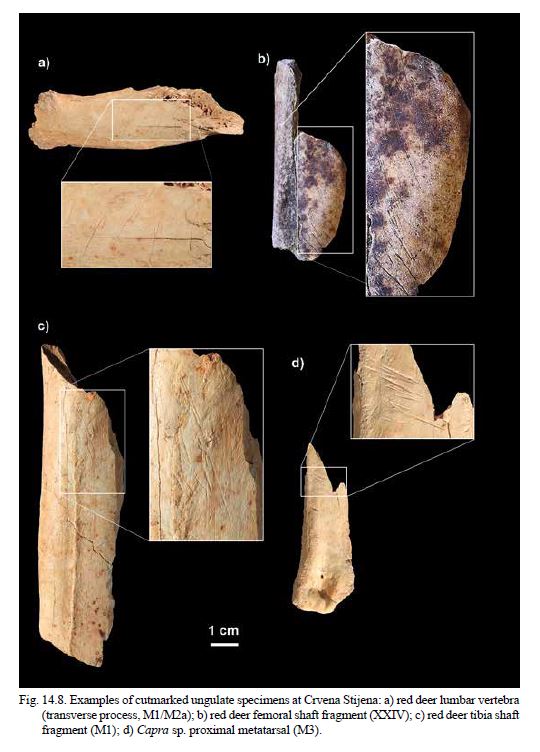
Examples of elements with cutmarks (Morin and Soulier 2017)
There are several large massively accumulated fire structures at Crvena Stijena. These fire structures were documented in several layers of the site during the earlier excavations. These structures are much larger than the typical campfire hearths, but their use still remains uncertain. One hypothesis is that these structures were used for large scale drying and/or smoking of meat to provide a source of stored/preserved foods. Unfortunately, the new excavations have not yet reached the layers with the largest fire structures. While the cut marks do suggest the drying and/or smoking of meat, to date the overall evidence remains inconclusive on the function of these structures.
For more information:
The Paleolithic Faunal Remains from Crvena Stijena
Eleven Years of Research at Crvena Stijena Synthesis of the Results