

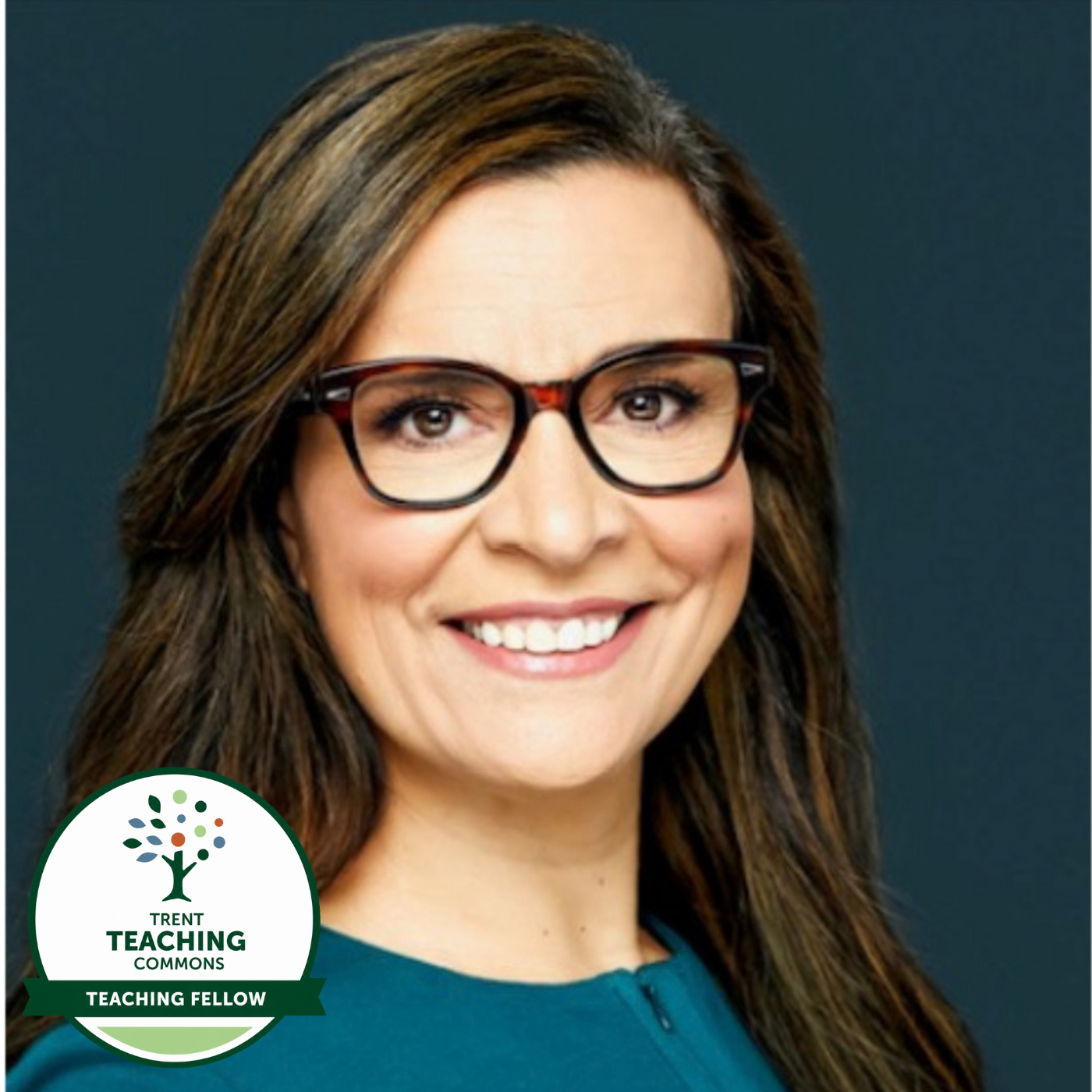
Rasha Wahid
rashawahid@trentu.ca
Nursing – Assistant Professor TFSON and Compressed Program Coordinator
How did you become interested in the Scholarship of Teaching and Learning?
I am the curriculum committee chair and the lead of the curriculum redesign at the Trent-Fleming School of Nursing (TFSON). Taking on this role, I assumed greater responsibilities in curriculum development, course design, program evaluation, and educational leadership. These experiences highlighted the importance of moving beyond intuition and tradition to make educational decisions informed by evidence and scholarship. Engaging with SoTL exposed me to theories such as relational inquiry, transformative learning, Trauma-Informed Pedagogy, and constructivist approaches to learning, all of which resonated with my experiences as a mental health practitioner and educator. I became increasingly interested in understanding how these frameworks could inform teaching practices that promote critical thinking, professional formation, inclusivity, and student success.
What keeps you engaged or motivates you in the Scholarship of Teaching and Learning?
As both a nurse and educator, I am drawn to the continuous process of examining, evaluating, and improving teaching practices in ways that are informed by evidence rather than assumption. SoTL provides an opportunity to systematically explore questions about student engagement, learning outcomes, assessment practices, curriculum design, and educational innovation, while contributing to broader conversations about excellence in higher education. I am particularly motivated by the potential of SoTL to bridge theory and practice. Just as evidence-informed practice is fundamental to nursing, evidence-informed teaching is essential to effective education. Engaging in SoTL allows me to critically examine the impact of my teaching approaches, identify opportunities for improvement, and implement strategies that enhance student learning and success. It also enables me to contribute to the advancement of nursing education by generating knowledge that can inform teaching practices beyond my own classroom.
What projects are you currently working on or hope to work on in the near future?
My current project explores relational inquiry (RI) as a curriculum conceptual framework.
SoTL publications or presentations:
Wahid, R. (2026). The development of a relational inquiry framework: Guiding the decolonization of undergraduate nursing curriculum. Teaching and Learning in Nursing. Advance online publication. https://doi.org/10.1016/j.teln.2026.02.014
Cearns, K., Lazarus, E. R., & Wahid, R. (2026). Factors influencing nursing students' attitudes and career interests in mental health nursing: An integrative review. Canadian Journal of Nursing Research. Advance online publication. https://doi.org/10.1177/08445621261447369
Wahid, R., & English, K. (2024, May). Relational Inquiry Framework: A Pathway to Decolonizing Nursing Education. Canadian Nursing Education Conference (CASN), Calgary, Alberta.
Wahid, R. (2024, November). Transforming Nursing Education: Decolonizing Practices through Relational Inquiry Framework. Great Lakes Biennial Nursing Conference, University of Windsor.
Wahid, R., & English, K. (2025, March). Decolonization of Nursing Education Using Relational Inquiry Framework. Annual Nursing Theory Conference.
SoTL interests:
- Qualitative methods
- Artificial intelligence
- Indigenous pedagogies
- Trauma-Informed Pedagogy
- Course or curriculum revision