
Graduate
Environmental & Life Sciences
-
- Master of Science (M.Sc.)
-
- Peterborough
-
- Fall & Winter & Summer
At a glance:
- Degree Master of Science (M.Sc.)
- Campus Peterborough
- Program is Offered Fall & Winter & Summer
- Study Options Part time/Full time
- Length Thesis: 24 months
- Guaranteed Funding Yes (for eligible students)
- Applications Open Fall intake: September 11 Winter intake: February 1 Spring intake: June 1
- Application Deadline Fall intake: February 1 Winter intake: June 1 Spring intake: October 1
- Deposit Required No
- Graduate Studies Contact enlsgrad@trentu.ca
- Apply Now Stay in Touch
The Trent Advantage
Sharpen your research expertise and create innovative solutions to environmental challenges through hands-on research with globally recognized experts, world-class research facilities and leading government and industry connections.
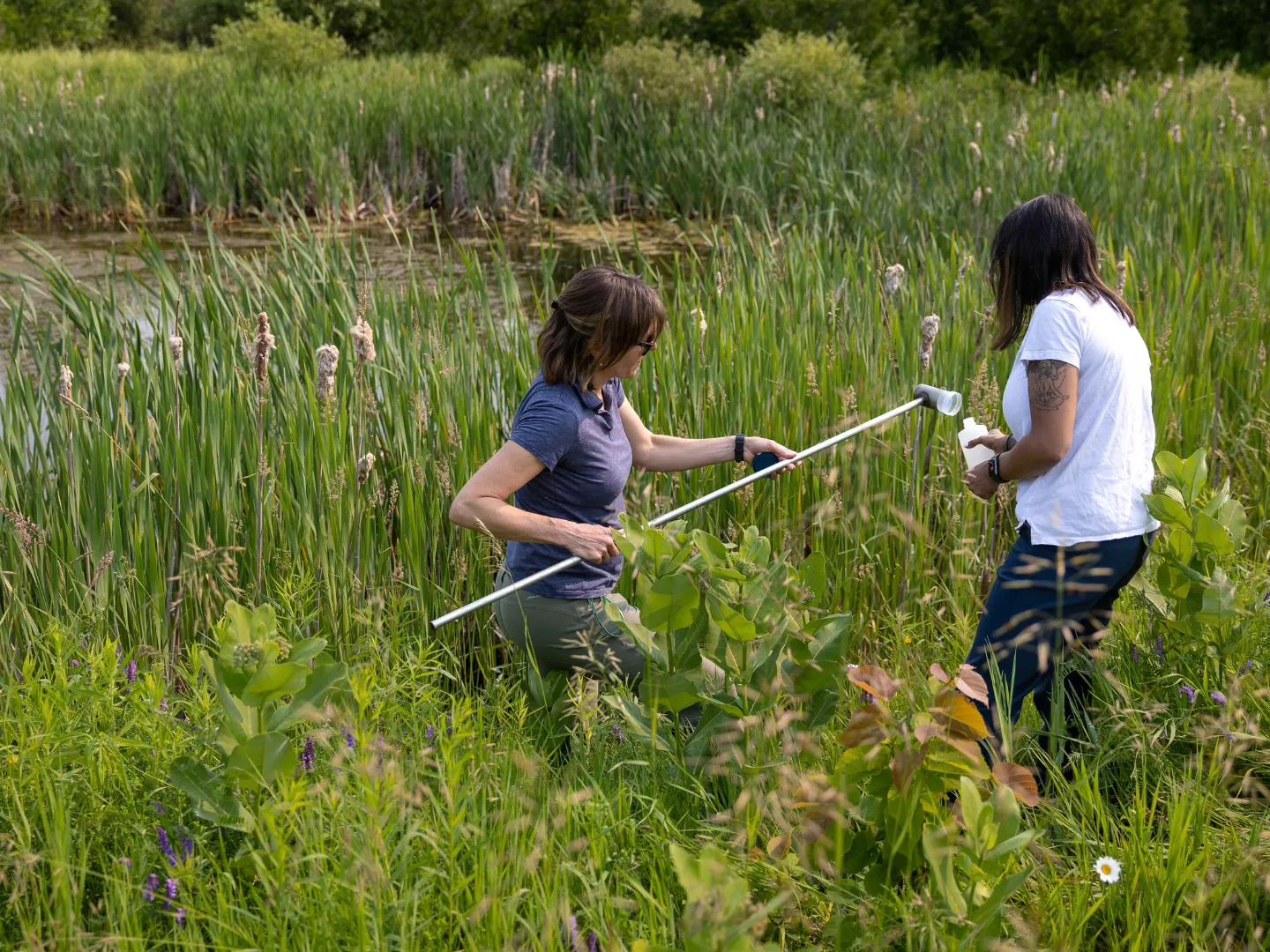
Put scientific theory into ecological practice as you undertake and lead research addressing current challenges in key sectors, including biodiversity conservation, contaminant spread and infectious diseases, sustainability, and water quality. In this collaborative, interdisciplinary program, you will work alongside expert faculty across the sciences at Trent as well as affiliated government and non-governmental organizations (NGOs). You will also build scientific and communication skills through high-quality laboratory and field research, generating original knowledge while preparing for purposeful careers in government, NGOs, or future doctoral study.
- Put your skills into practice through research workshops, teaching and mentoring, conferences, and research exchanges.
- Learn from faculty across Biology, Chemistry, Forensic Science, and the School of the Environment, including Canada Research Chairs and an NSERC Senior Industrial Research Chair.
- Partner with industry professionals, international collaborators, and government scientists, including researchers from the Ministry of Natural Resources.
World Class Facilities
Get hands-on experience with research equipment in Trent’s world-class instrumentation and research facilities including the Trent Water Quality Centre, the Institute for Watershed Science, and the Natural Resources DNA Profiling & Forensic Centre.
Accelerated Master’s
An accelerated Master’s option is available for eligible Trent University undergraduate students. If you are currently studying at Trent and are interested, please visit the program department website for more details and information on how to apply.
Program Types
-
Thesis
Complete a two-year, research-intensive M.Sc. degree that combines focused coursework with a supervised thesis based on original research. Students develop their research expertise within one of four interdisciplinary fields of study, working closely with faculty whose expertise aligns with their academic interests.
Research Areas
Areas of academic research focus and faculty expertise
Trent's ENLS M.Sc. program offers an interdisciplinary research environment that brings together diverse perspectives and expertise across the environmental and life sciences. The program offers four fields of study:
- Earth Sciences, Natural Resources, and Agriculture
- Ecosystem Biogeochemistry and Trace Contaminants
- Ecology, Evolution, and Conservation
- Genes, Cells, and Physiological Systems
Career Paths
In Their Own Words
I learned a lot during my time in the Environmental and Life Sciences Program, from the chemical and biological characterization of lakes and related impact assessment to thinking independently and writing clearly. Those skills and more were integral to my journey in environmental consulting where I’m now fortunate to lead a team of talented environmental scientists help make science-based decisions across Canada.
Brent Parsons
Alumni M.Sc., Principal and Senior Aquatic Scientist

Faculty Spotlight
Meet some of Trent's world-class professors and researchers.

Dr. Huy Dang
Associate Professor, Chemistry and School of the Environment
Dr. Dang's research lab, EnIGMA (Environmental Isotope Geochemistry & Mass spectrometry Applications) investigates interactions between the environment and Humankind, focusing on environmental pollution, climate change, and biodiversity loss through environmental and analytical chemistry. Using cutting-edge techniques, including ICP-MS for elemental and isotopic composition and SEM for microscopic morphology, our research addresses complex environmental dynamics in various ecosystems globally, e.g., the St. Lawrence Seaways, mangrove forests in Brazil and Vietnam, and the Mediterranean coastal regions.

Dr. Amy Greer
Associate Professor, Biology
Dr. Greer is a member of the College of the Royal Society of Canada and is internationally recognized as a scholar dedicated to improving global infectious disease preparedness and response. Her research focuses on the intersection of epidemiology, ecology, and mathematics. The impact of her work is felt across sectors and borders preparing governments and industry to act quickly and decisively when the next outbreak hits human or animal populations.
Admissions
Trent has clear pathways for graduate students to apply and be admitted to study for their master's or doctorate at either of our campuses. Please review admission requirements for your program before applying.
Eligibility Requirements
- B.Sc. honours degree (a four-year undergraduate bachelor's degree) in Biology, Environmental Chemistry, Geography, Environmental Science or a related discipline
- Minimum B+ (77%) or equivalent in the last two years of full-time study, or last ten full academic credits
Eligibility Requirements
- B.Sc. honours degree (a four-year undergraduate bachelor's degree) in Biology, Environmental Chemistry, Geography, Environmental Science or a related discipline
- Minimum B+ (77%) or equivalent in the last two years of full-time study, or last ten full academic credits
- Proof of English Proficiency: All international applicants must provide proof of an adequate level of English proficiency regardless of their citizenship status or country of origin. Please visit our International Applicant Resource page for details on English Language Proficiency requirements.
- A GRE test score is not required for admission into this program
All applicants, domestic and international, must submit the following documents to complete their application:
- Transcripts: Unofficial copies of all post-secondary transcripts
- 2 letters of reference: Academic references are preferred; however, professional references will be accepted. Reference forms will be emailed to the referees that you have appointed on OUAC
- Plan of Study/Personal Statement: 1-2 pages outlining your objectives in a graduate program. Any specific research interests, relevant experiences, and/or career aspirations can be included
- Detailed Resume or Curriculum Vitae
- Proof of Citizenship (i.e. copy of passport or birth certificate)
- Supervisor: A confirmed supervisor must be selected as an admissions requirement for the program. Applicants must communicate with and confirm that the listed supervisor will supervise their graduate research. Please list your confirmed supervisor on your OUAC application and discuss this in your plan of study. Please visit the program’s Faculty and Research page for a listing of faculty and areas of research. Applicants are responsible for reaching out to a faculty member and confirming supervision.
For more information on submitting transcripts, re-sending reference links and other application questions, please visit our How to Apply page and review Step 4, as well as review our Frequently Asked Questions (FAQ).
Tuition Estimate
Estimate your tuition, ancillary fees, and potential entrance scholarships based on your program, residency status, and academic average.
Tuition Fees
Base tuition fee for the Environmental & Life Sciences (M.Sc.) and Materials Science (M.Sc.) programs
$8,252.00
Funding Package
Minimum funding package for eligible Environmental & Life Sciences (M.Sc.) and Materials Science (M.Sc.) students
$-23,000.00
Ancillary Fees
Mandatory ancillary fees
$1,329.00
Total:
$ -13,419.00
* The tuition details and scholarships listed are for domestic students only.
Learn more about tuition cost and potential awards.Financial Matters
Eligible full-time students are offered minimum funding packages during their funded period of $23,000 annually. This includes a Graduate Teaching Assistantship employment offer valued at approximately $13,000 annually. Specific funding details are included in individual admission letters.
Students are supported in competing for external awards during their studies, such as the Ontario Graduate Scholarship. A full list of external awards is available on our Scholarships & Awards page.