Named in honour of W.L. Morton, the Canadian historian and former Master of Trent's Champlain College, in 2025-26, this prestigious lecture will feature Dr. Jocelyn Thorpe (University of Manitoba) in conversation with Victoria Grant, O.C, ICD.D., Loon Clan for a public talk, free and open to all:
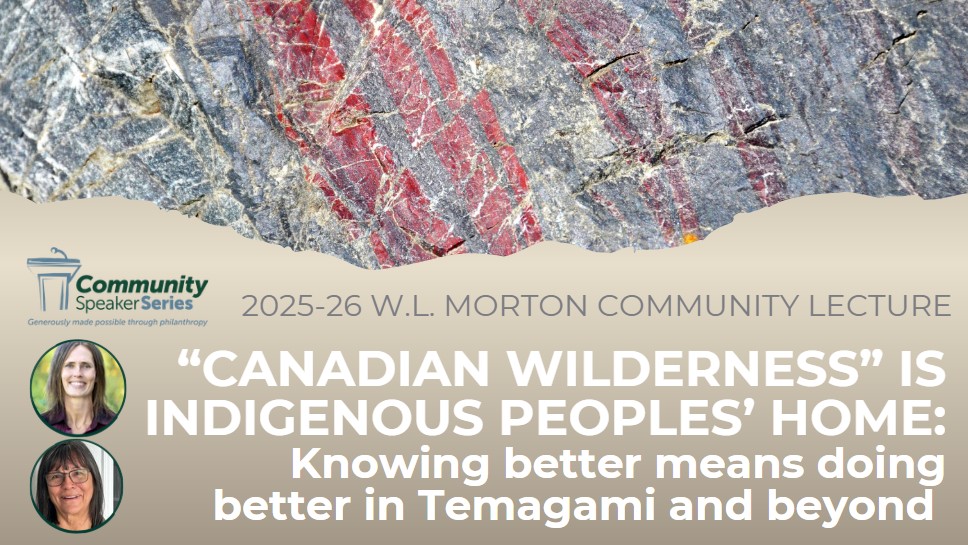 “Canadian wilderness” is Indigenous Peoples’ home:
Knowing better means doing better in Temagami and beyond
Thursday April 23, 2026 5 pm
Bagnani Hall, Traill College.
Register today to receive a discounted admission to the Canadian Canoe Museum April 23 / 24 2026.
In this talk, Dr. Jocelyn Thorpe, author of Temagami’s Tangled Wild, will be joined by Victoria Grant, O.C., Loon Clan and member of the Teme-Augama Anishnabek. The two will discuss the history of n’Daki Menan—the territory of the Teme-Augama Anishnabai—and how it became famous among non-Indigenous people as part of the vast Canadian wilderness. They will also examine the Teme-Augama Anishnabai’s longstanding claim to territory and recognition, and consider responsibilities in the present that accompany learning about the past. None of us can choose where we come from, but all of us can play a role in creating a just and sustainable future.
Victoria Grant, O.C, ICD.D., Loon Clan, is Teme-Augama Anishnabai-kwe (Woman of the Deep-Water People) and a member of the Teme-Augama Anishnabek (formerly known as Temagami First Nation). Victoria has served as a director of several philanthropic boards and is current chair of the Board of Directors of The Counselling Foundation of Canada, and member of the Board of Directors of the Canadian Canoe Museum.
Dr. Jocelyn Thorpe is a settler of European origin who has lived in Treaty One Territory since 2012. At the University of Manitoba, she is a professor in History and Women’s and Gender Studies, and she directs the Centre for Creative Writing and Oral Culture.
The W.L. Morton Community Lecture is in honour of W.L. Morton, the Canadian historian and former Master of Trent's Champlain College. This year’s talk is presented through the collaboration of The School for the Study of Canada / École d’études canadiennes, Champlain College, Catharine Parr Traill College, The Frost Centre for Canadian Studies and Indigenous Studies , The School of the Environment and The Canadian Canoe Museum.