
Indigenous Environmental Studies/Science
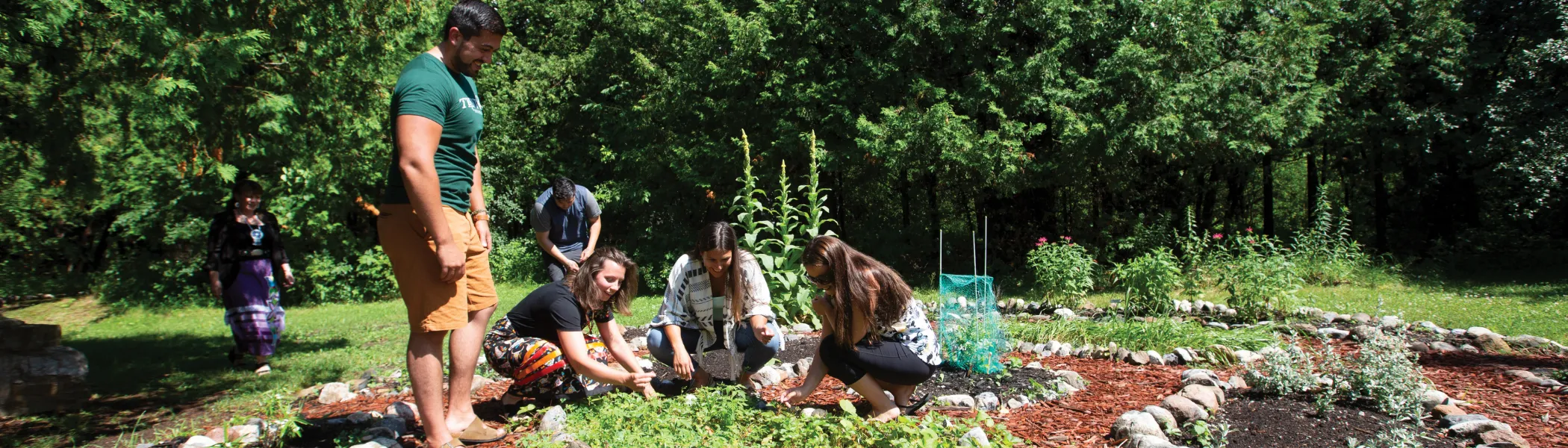
Trent’s groundbreaking Indigenous Environmental Studies/Science (IESS) degree program, offered jointly with the School of the Environment, is the first program of its kind in North America. This degree focuses on the interaction and collaboration of Indigenous Knowledge Systems and Euro-centric Knowledge Systems and offers two study pathways.
Choose to complete a Bachelor of Arts (Studies) and gain an understanding of the social, cultural, and human experiences with the environment through an Indigenous perspective. Choose the Bachelor of Science (Sciences) pathway and gain the theory and skills to analyze the natural world, from Indigenous and Western perspectives.
With guidance and support from leading Indigenous and non-Indigenous faculty, Elders, guest speakers, and scholars, you’ll learn to apply critical, creative and innovative thinking to address climate change, sustainability, health, food security, and other complex issues affecting Indigenous and all peoples around the world.
Accelerated Masters
Fast-track your education, by earning your M.Sc. in Environmental & Life Sciences in only 12-20 months of graduating from your Honours B.Sc.
In this program – the first of its kind anywhere in North America – you’ll study a unique mix of Indigenous knowledges and teachings and Western sciences, learning from Indigenous and non-Indigenous faculty, elders, guest speakers and other scholars.
Trent's paid co-op is an opportunity for you to gain work-integrated experiential learning that will help you get a head start on your career. The Indigenous Environmental Studies/Science co-op assists graduating students in achieving a competitive edge while generating experience within a wide range of sectors.
Specifically, paid co-op gives you a chance to obtain 12 months of practical experience on the job, develop or enhance technical skills, explore career options, network with a variety of individuals and organizations, learn from mentors, enhance communication and presentation skills, and develop technical writing skills.
Traditionally there are three co-op work terms of paid employment, each four months long, 35 hours/week, giving students the opportunity to manage well-defined special projects at an organization. With the Indigenous Environmental Studies/Science co-op, students are encouraged to combine two work terms back-to-back creating an eight-month opportunity with one employer.
Note: Paid co-op is only available to students in the Bachelor of Arts IESS program , not the Bachelor of Science IESS program.
- Gain 12 months of paid work experience across three work terms as part of the four-year co-op stream (B.A. pathway only), with student placements ranging from environmental planning and community education to research and policy analysis
- Apply your knowledge to a community-based research project assisting a local or national organization, including Curve Lake First Nation Band Council, Chiefs of Ontario, The Ayalik Fund, Inuit Tapiriit Kanatami, or Ontario Public Interest Research Group (OPIRG)
- Volunteer with the Trent Aboriginal Cultural Knowledge and Science youth outreach program through their in-school or summer camp programming
#1 undergraduate university in Ontario
92% Trent Grads employed within six months
#1 undergrad university in Ontario for student services and student awards
Requirements
If you are coming straight from high school in Ontario or are a recent grad, the general admission requirements are:
- Ontario Secondary School Diploma (OSSD)
- A minimum of six Grade 12 4U or 4M courses, including program specific prerequisites
- A minimum 70% overall final average
- ENG 4U with a minimum of 60%
Program requirements and admittance into co-op:
- A minimum 80% overall final average
Requirements
Students from across Canada can use their grades from their home province to apply to Trent.
Requirements
International students from outside Canada can apply based on the curriculum of their home country.
Requirements
Mature students can apply to Trent based on previous education and professional or volunteer experience.
Requirements
With many transfer agreements and flexible pathway options, Trent University makes it easy for students to make the most of the credits you have already earned.
Whether you're graduating from an Ontario high school, looking to study in Canada, or training for a second career, Trent has clear pathways for students to apply and be admitted to study at either of our campuses.
- Community Education
- Environmental Planning
- Evaluation & Research
- Policy Analysis