
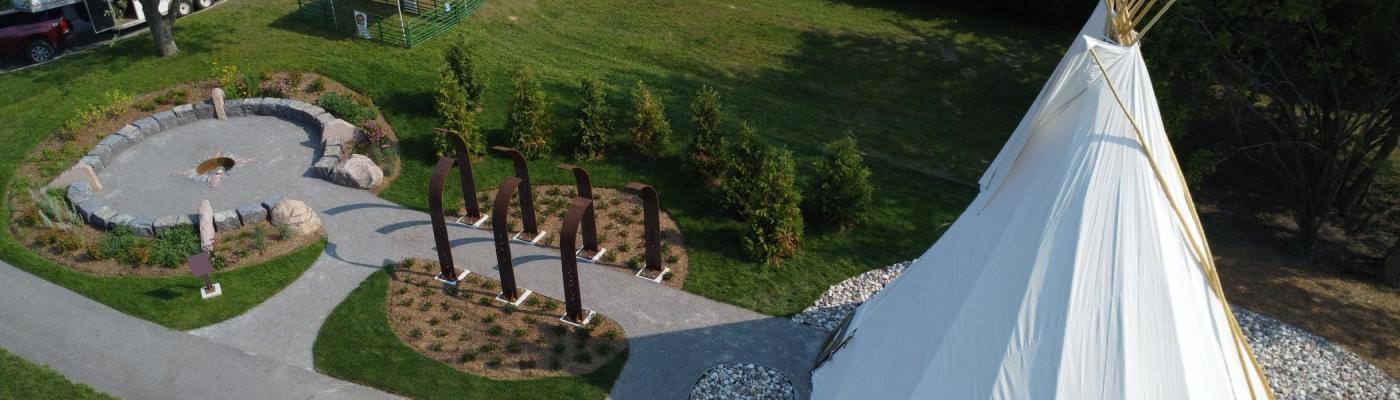
There are over 600 recognized First Nations communities across Canada representing more than 50 Nations and 50 Indigenous languages. Trent University’s Peterborough and Durham campuses are located on the treaty and traditional territory of the Michi Saagiig Anishnaabeg, and are home to students, employees and alumni who hail from many different Indigenous nations from across the country and around the world.
Territory Acknowledgement
We respectfully acknowledge that we are on the treaty and traditional territory of the Mississauga Anishnaabeg. We offer our gratitude to the First Nations for their care for, and teachings about, our earth and our relations. May we honour those teachings.
Trent University, in Peterborough and Durham, is located on the treaty and traditional territory of the Mississauga (Michi Saagiig) Anishnaabeg, home to Curve Lake First Nation, Alderville First Nation, Hiawatha First Nation, and the Mississaugas of Scugog Island First Nation.
What is a Land Acknowledgement?
A land acknowledgement recognizes the specific Indigenous Peoples who are original caretakers of the land and waters on which we work, learn and live as uninvited guests. It is an appropriate way to respectfully recognize the local Indigenous People, their Ancestors, and communities. Land acknowledgements emphasize relationship building – relationship to the land and waters and with the local Indigenous Peoples – and a commitment to honour the teachings, language and self-determination of the local Indigenous Peoples.
Treaties
Trent sits on the homeland of the Michi Saagiig Anishnaabeg who have lived in this territory for thousands of years. The arrival of Europeans led to a number of agreements or treaties which saw Indigenous lands transferred to the British Crown. These agreements were the way in which Britain, and later Canada, acquired land for European settlers.
Based on the Royal Proclamation of 1763, the Crown began to enter into treaties with Indigenous nations to transfer lands from Indigenous ownership to Crown. This process started before the establishment of Canada in 1867, continues into the 21st century.
After the War of 1812, in order to accommodate a growing European settler population, Upper Canada, as this area was known before Confederation, entered into a series of treaties with Indigenous Nations. In this area, they treated with the Rice Lake Mississauga.
Treaty 20 – The Rice Lake Purchase was signed on November 5, 1818, conveyed 1.952 million acres to the Crown in return for an annuity of 740 pounds per year.
After Confederation in 1867, Canada entered into a half-century of treaty-making with Indigenous peoples. The 11 numbered treaties were intended to open up the west for settlement and make way for a railway. In return, Indigenous nations were promised annuities, schools, health care and other forms of assistance. These treaties, seen as land cessions by Canada, were seen as land-sharing agreements by Indigenous leaders.
The signing of the Williams Treaties of 1923 marks the end of a fifty-year period of treaty-making between the new country called Canada and Indigenous nations.