
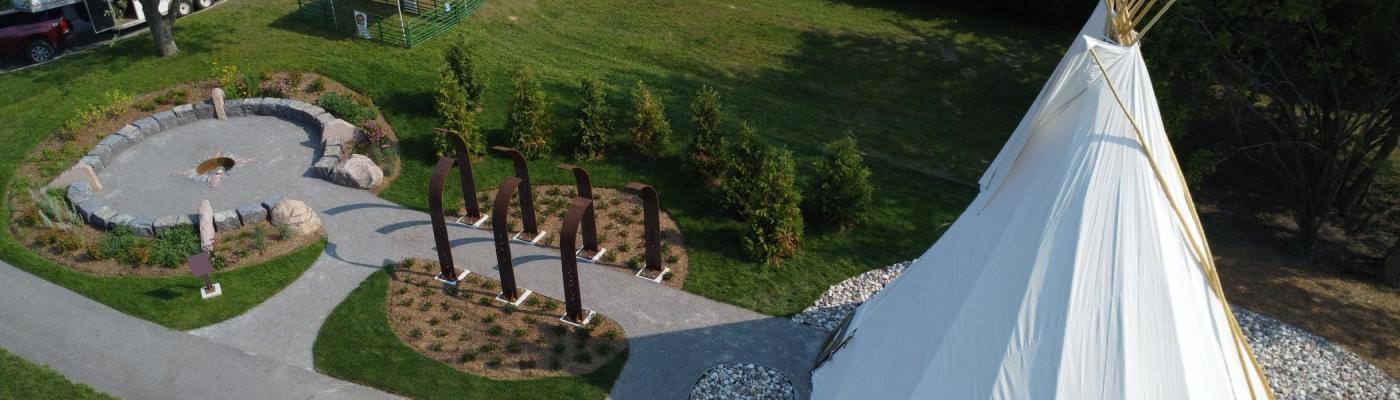
Ceremony is essential in building authentic relationship with and connection to the land and waters and the more than human beings of Creation. Ceremony transmits knowledges through teachings, storytelling and song, as well as practices. Ceremony is unique to the hosting Indigenous nation, community, and the specific practices vary between knowledge holders/ceremony facilitators. You may be invited to participate in ceremonies at Trent University. We ask that you do so open mindedly with respect and humility.
Indigenous ceremonies may include the practices of smudging, offering tobacco and sharing of thoughts and intentions. The length of ceremonies varies widely and is dependent on the context, purpose and number of participants. We share below some interpretations of ceremonial practices that you might encounter here at Trent University.
Typical Ceremonies at Trent
Tobacco Offerings
Tobacco or semaa leads the way. Anishinaabe teachings tell us that semaa is the first medicine given to humans by the Creator. Semaa is used in prayer, making offerings of gratitude or when asking things of others. Loose tobacco may be offered by placing it on the earth, beside the water, burned in a fire, or smoked in a ceremonial or personal pipe. Tobacco may be placed in cloth to create a tobacco tie that can then be tied to a tree, or passed to a knowledge holder with a request.
Smudging
The practice of smudging is intended to cleanse our mind, body and spirit prior to engaging in special events and ceremony. Smudging uses various medicinal plants to create smoke that is offered to someone to draw over their body for cleansing, or used to cleanse a room, food, and/or sacred ceremonial objects. As the smoke rises negative energy and feelings are lifted away to create a clarity and connection of mind and heart.
You may be given the choice to engage in this practice. If you don’t give your consent to participate in smudging, simply step back from the offering.
Sacred Fire
A sacred fire is a common and essential element of ceremony. Specific practices are followed in the building and lighting of a sacred fire. Engaging with a sacred fire includes formal practices dependent on local Indigenous Nation. It’s important to acknowledge that sacred fires are different from social fires.
Feast
Feasts may take place during or at the end of various ceremonies. Traditional and other foods may be included in the feast. The sharing of food begins after the food has been spoken for in prayer or thanksgiving, and a spirit plate has been prepared. Elders and children are fed first, you may be asked to serve Elders and children as well as the firekeepers and ceremony conductors and their helper before preparing your own plate.
Sunrise Ceremony
Sunrise ceremonies begin before the sun rises. Start times are synchronized with the seasonal variation of sunrise and not a specific hour of the morning. Sunrise ceremonies acknowledge the gift of a new day and can be a time for setting intention and giving thanks. Sunrise ceremonies may include tobacco offerings, and pipe and water ceremonies.
Pipe Ceremony
Pipe ceremony may take place in association with other ceremonies. Personal or collective prayers are offered in the ceremony as a pipe carrier fills, lifts and smokes a ceremonial pipe.