
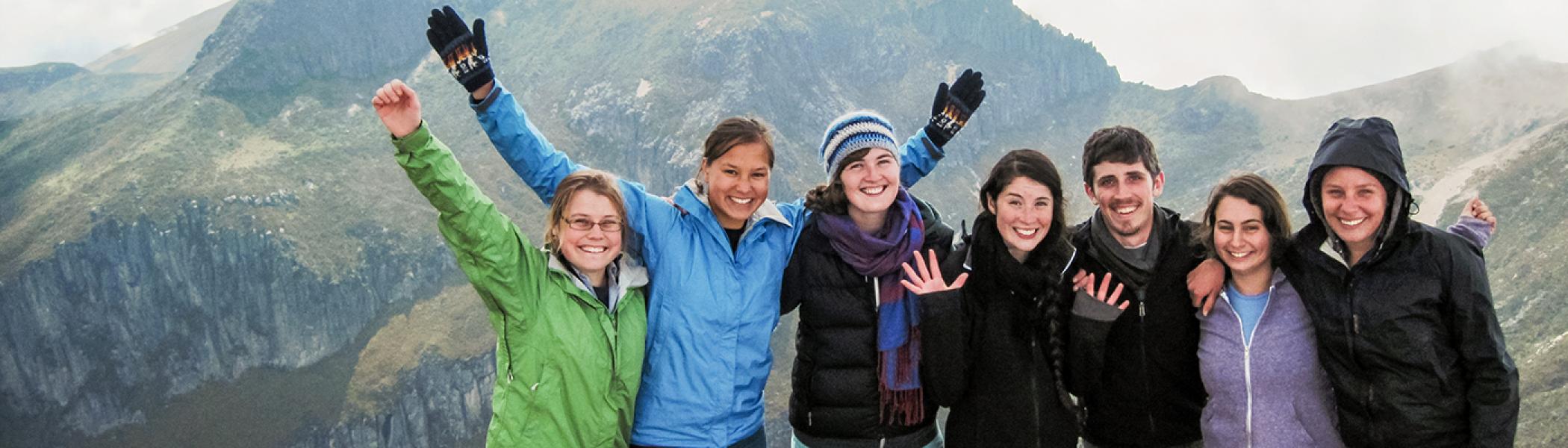
Jake Wilson
Trent-in-Ecuador Participant 1998-1999
Why did I go?
I actually switched schools (from King’s College in Halifax) after first year so I could take IDS at Trent and then go on either the Trent-in-Ecuador or Trent-in-Ghana programmes, and since I also wanted to pick up a new language, one which would open up a large part of the world to me, I ended up taking a year of introductory Spanish before going to Ecuador, with no prior connection to the country or that part of the world. It was a decision that I’m still very glad to have made. Unlike undergrad life at home in Canada, the experience of being abroad in a developing country, with a different language, culture, and standard of living, forced me to use my brain and learn things all day long – not only at school or work but also at home, in the streets, on the bus, at the dinner table, in the shower (they’re electric), or out with friends. I felt like I had to learn anew literally every aspect of living – an experience which has been tremendously rewarding, even if at the time it was often exhausting or even frustrating. In the particular year that I was there, happily for us if not for our hosts, the Sucre (the old Ecuadorian currency – now replaced by the US dollar) was so worthless that I actually spent significantly less that school year than any other – tuition, programme fee, flight, and all expenses included. So it was worth it in more ways than one.
The host family
After a week of orientation in Quito (to tell the truth, I remember best the feeling of near complete disorientation – spurred by a powerful mix of altitude, culture, pollution, bustle, language, indigestion, and excitement), we moved to our nice little host town of Sangolqui, just outside Quito, for the next four months, and I met my wonderful host family – mother, father, three brothers, Fabricio, Carlos Andres, and Juan Sebastian (Gordo to his friends and brothers), all about my own age, and a five-year-old host sister, Maria Teresa (la sorpreza, as her parents would endearingly refer to her). Like many TIE host families, they were quite well off by Ecuadorian standards, with a maid, all the kids in private schools and universities, two cars, and a well-protected apartment in downtown Sangolqui, about a half-hour walk from school.
The first term
I and the other participants (a fun bunch from across Canada, 17 girls and 2 guys) all got settled into a comfortable routine at home and at school in Sangolqui pretty quickly, and within a few weeks we felt we knew the way things worked well enough to go (either on our own or with our host families) on short trips on weekends to visit other cities, on overnight hikes in the mountains, to various festivals and carnivals as they occurred across the country, and to start visiting some of the development projects and community organizations we were thinking about working with a few months down the road. At school we had two classes together, one on Andean Society with Dr. Leslie Jermyn, then in her first year as Academic Coordinator, and one on Ecuadorian Economic History with Dr. Carlos Larrea and a few guest lecturers, and then we were split for the third class, so that those who spoke Spanish well could study Quichua, and people like me could brush up on their Spanish. We used the fairly well-stocked school library as well as the library at the Universidad Catolica in Quito for research materials, which worked out fairly well. Meanwhile Programme Coordinator Maria Larrea, who had just finished arranging our host families, began working with us to set up appropriate volunteer placements for the second term.
Finding projects
By the time we had returned from our incredible ten-day trip to the Amazon region, or Oriente (I could write a whole book about that trip – I won’t ruin it here), most of us had a good sense of what part of the country we wanted to work in – on the coast, in the mountains, in one of the cities, or in the Amazon – and what kind of project we thought we’d be most interested in, including work with women’s organizations; educational programmes for street kids, orphans, or other underprivileged children; environmental projects in the Amazon rainforest, Andean cloud forests, or coastal mangrove forests; rural development projects; or indigenous artisanal/handicraft workshops. On our travels over the course of the year and in our chats with each other, we all learnt a great deal about the huge number of NGOs, community organizations, and development projects going on in the country at the time, and how they functioned in practical terms. We ended up scattered across the whole country, on a huge variety of projects.
A little travel
Before we actually made the moves out to our work placements, however, we had about a one-month break at Christmas. Some of us went home, while I and others took the opportunity to travel around the country. One of the great attractions of Ecuador, of all Latin American countries, is the fact that all within a six hour bus ride of Quito, you can go to the most incredible variety of places: the coastal region, with beautiful beaches, mangrove forests, and fields of banana plantations (though the cities on the Coast are fairly awful); the Amazon – and some of its most diverse and pristine parts (just steer clear of the polluted oilfields of the northern Oriente, an area which also happens to be influenced by drug traffickers and Colombian guerrillas); a number of beautiful old colonial cities in the major valley between the two main mountain ranges of the Andes – Tulcan, Ibarra, Otavalo, Quito, Latacunga, Ambato, Riobamba, Alausi, Cuenca, Loja, Vilcabamba; or some of the beautiful (and quite accessible for hikers/climbers) volcanoes and mountains which overlook these towns. If you have some cash to spare (which I didn’t) you can also fly to the Galapagos Islands. Ecuador is a pretty good place to get a taste for the various major regions of South America – coast, Andes, rainforest – and the cultures that go with them. It’s also quite safe by Latin American standards – which is not to minimize the risks to foreigners, especially women traveling alone. The risks are real but it doesn’t mean that one can’t take effective steps to avoid harm, and it doesn’t mean that the risks that exist aren’t worth taking. The rewards are pretty considerable. (At least that’s my personal view).
Off to Pungala
Although it took me a little longer than some of the other participants to find a project I felt comfortable with and commit to working for it, eventually Maria managed to hook me up with the Fondacion Pueblo Indio del Ecuador (FPIE), a charitable foundation linked to the Catholic Church based in Quito. The organization’s director, Nidia Arrobo, had a friend working in the field, a Catholic priest by the name of Padre Gabriel (Gabicho) Barriga, who needed some help attracting funds for local development projects from Catholic donors abroad. And so Nidia sent me off to live with Padre Gabicho in the rural and overwhelmingly indigenous parish of Pungala, pop. 10,000, high up in the mountains of Chimborazo province in central Ecuador. My task was to complete a socioeconomic survey of the poverty conditions in the parish and write a comprehensive report, in Spanish and English, which would explain to potential benefactors the horrific poverty conditions in the area as well as the villages’ self-defined development priorities, and support FPIE’s call for funds. I was pretty skeptical I’d pull any of it off, as I had now real organization behind me, no Spanish, no practical training, and I was a 21-year old white kid from Canada. I would rather have been a Martian. Things somehow worked out in the end, amazingly.
The parish of Pungala is on a good day a one to four hour drive from the province’s main city of Riobamba (pop. 150,000), depending on the roads, weather, state of repair of your vehicle, the whims of local police officers, and the mood of the local campesino unions (which twice during my stay cut off the roads to vehicular traffic during nationwide strikes). The parish has 26 small communities, ranging in size from 11 to 166 families, scattered along the slopes of three major river gorges flanked by steep grassy mountains. If you were to climb to the top of the mountains in the parish, to a height of about 4200m, you could see about 40km to the southwest the snowcapped peak and plume of steam and ash periodically emanating from the peak of Sangay, Latin America’s most active volcano. From other parts of the parish you could see the majestic bulk of Chimborazo, the highest mountain in Ecuador at 6300m, dominating the skyline of the whole province which bears its name. In short, it’s totally spectacular, not unlike most of the country.
Poverty and Inequality
After its physical beauty the next continually striking thing about Ecuador, and Pungala in particular, is the poverty and inequality. In Pungala, a handful of major haciendas owned by absentee landlords or foreigners occupied all the best lands in the plains in the bottom of the river valleys, and employed a few locals to raise beef and dairy cattle for export and urban markets; the bulk of the Quichua-speaking indigenous campesino population (most men and young women spoke some Spanish too) was thus left to cultivate eroded, infertile, and largely unirrigated land on the valley slopes, in parcels of a few acres per family, and herd sheep in the communal grassland paramo at the mountaintops; and a small minority of Spanish-speaking mestizo (métis) shopkeepers, government employees, and truck drivers based in the three main villages dominated parish commerce, transport, politics, and religion.
As I eventually discovered in the course of my socioeconomic survey research and from assisting a French doctor who came to work in the parish towards the end of my placement, this unequal distribution of land – a product of the country’s colonial history – was the basis for fairly extreme, endemic poverty in the parish. For example, the life expectancy in the parish was in the low forties (the cemetery records for the most prosperous part of the parish showed an average age of death of 35.7 years); in an area with abundant water and hydroelectric resources a third of homes lacked piped water (never mind potable water), a third lacked latrines, and a quarter of parish homes lacked electricity; tuberculosis was endemic to the population, cholera outbreaks were frequent, easily preventable diseases such as bronchopneumonia were the leading causes of death, most children had multiple cavities, decalcified teeth, and were chronically malnourished; nominal literacy was about 60%, functional literacy much lower, and the average community resident had a mere 3 years of formal education, while as little as 1% of the population had entered secondary school.
It took me some time to comprehend the poverty in terms of statistics, however. While it was obvious that poverty in the parish was quite extreme right from the beginning, there were some things that took time to realize, such as the fact that the child who you think is 5 is actually 9, for example, or that the quiet kid who wouldn’t play football with the rest of the kids is mentally disabled, and has two lower rows of teeth – the sad result of centuries of breeding within the small genetic pool of a rural village, which until recently would have almost cut off from other communities under colonial systems of debt bondage and indentured servitude. But other things struck me right from the start all the same. When I took my first visit to the parish to meet Padre Gabicho, two days before Christmas, we visited a number of local villages where the Padre gave mass, and more importantly alms, to the many villagers – mostly women, children, and the elderly, since most working-age men spend much of their time in the cities working as construction workers or small-scale vendors. After each service (I think we went to five villages that day), Gabicho and I would be fed a massive meal of habas (big green beans), cheese, potatoes, fried onions, and roasted cuy (guinea pig, a delicious Ecuadorian specialty). We would eat as much as we could out of politeness (the fact that we had already eaten four full meals was irrelevant to the cooks), and take every unwatched moment to pass our plates to the nearest hungry-eyed child. Upon leaving the village chapel, the Padre would hand out large bags of candies and vitaminized animal crackers to the local kids, who followed us in throngs. It made me feel absolutely horrible and horrified at first, but I slowly got a bit more used to it over time. It was a real eye-opener, however I felt.
My project
In the four-month placement, I spent the first six weeks feeling fairly unproductive, trying to set up meetings with a number of unconvinced local community leaders, meeting local development workers and asking them to teach me how to conduct a participatory socio-economic survey, finding out what NGOs, government, and community organizations operated in the parish and what they did, getting a hold of key documents such as lists of community members and maps, trying to put together the basic materials I would need to actually conduct a survey, and driving Padre Gabicho around the parish to work on some of his own projects – a new schoolhouse here, a lunch programme in a local nursery there, or some wooden floorboards to warm up classrooms in winter. It was amazing how much time any of this took, but gradually I got over my frustration and settled into the slower pace of activity that I would have to take. After a few weeks I finally managed to get a mite of credibility with some local community leaders, I got a few surveys completed in several communities, and I started getting some stats together about the situation in various communities. And now that I wasn’t hanging out so much with the other Canadians, my Spanish was really taking off.
But with about six weeks to go, my project changed tracks altogether, as a physician from Aix-en-Provence, France, Monique Mallet, who was also connected to Padre Gabicho through FPIE, came to stay with us (Padre Gabicho now had me, his maid and her young boy, as well as an orphan boy who took care of the cattle all under his roof – a funny family of sorts) while she conducted a 2-month medical research survey of the health conditions in the parish, with a mind to setting up a health facility in the long term and coming to visit once a year for the next several years. She had 20 years of experience working with Medecins Sans Frontieres under her belt, and a lot of energy and dedication, but since she didn’t speak Spanish and had never been to Latin America before, it turned out that I was of real assistance to her in a number of ways – driving Gabicho’s jeep, interpreting, dealing with the local community leaders who by now knew me well, scheduling school visits, and otherwise helping her feel her way in the parish. By the last week of the placement, I was scrambling to finish up my socio-economic survey for FPIE, trying to hand off what I hadn’t done myself to some of the community leaders to do themselves (which in retrospect should have been the whole point of the project all along), trying to help Monique as much as possible, writing up my report for Trent, tying up loose ends, and saying goodbye. I accomplished as much in the last 2 weeks in Pungala as I had in the first two months, and wish I could have stayed. I then only had about a week in Ecuador before heading back to a summer job in Canada, which was also hardly enough to say goodbye to Sangolqui, Leslie, Maria, and the other TIE folk. My head was still back in Pungala two months later. And the funny thing is that coming home was actually harder to get used to than going to Ecuador, which seems to be everyone’s experience, even if you’re warned that will be the case.
After the Programme
The next year at Trent I finished my honours BA, single major in Comparative Development Studies, and went right back to Latin America for another blast the next year, this time to Bolivia, where I worked on an internship with Habitat for Humanity. It seems like most TIE participants go back for more as soon as possible, or in the case of two people from my year just down there, running travel businesses or getting married to Ecuadorians (there’s a marriage every year or two – kind of crazy). It really stays in your blood. I’m waiting to hear about a job at CIDA at the moment, and I’ll almost definitely spend a good chunk of my career in development, as far as I can tell at the moment.
Questions? E-mail Jake Wilson.