
Graduate
Canadian Studies & Indigenous Studies
-
- Master of Arts (M.A.)
-
- Peterborough
-
- Fall
At a glance:
- Degree Master of Arts (M.A.)
- Campus Peterborough
- Program is Offered Fall
- Study Options Part time/Full time
- Length Thesis: 24 months Major Research Paper: 12 months
- Guaranteed Funding Yes (for eligible students)
- Applications Open September 11
- Application Deadline February 1
-
Notice
*Domestic applications remain open
- Deposit Required No
- Graduate Studies Contact frostcentre@trentu.ca
- Apply Now Stay in Touch
The Trent Advantage
Explore our nation's past, present and future through one of Canada’s first Canadian Studies and Indigenous Studies graduate programs, with mentorship from leading humanities and social sciences scholars.
Fuel your curiosity and contribute to contemporary scholarship as you examine critical issues and debates in Canadian Studies and Indigenous Studies. Develop a strong foundation in methodological and theoretical approaches to current scholarly research and writing while pursuing a project spanning humanities, social sciences, and other interdisciplinary fields. Trent’s Frost Centre provides a vibrant space for scholarly research, writing, and discussion about issues central to a critical understanding of Canada.
- Choose a thesis or major research paper to pursue studies aligned with your academic interests and goals
- Explore experiential learning opportunities through a Humanities-wide co-op or work closely with a community partner on a community-based research project
- Build your professional network with opportunities to attend conferences and workshops, present your research, and collaborate with peers on academic and professional workshops
- Graduate prepared for careers in education, social services, not-for-profit, and advocacy sectors or pursue doctoral study
World Class Facilities
Frost Centre for Canadian & Indigenous Studies
Grounded in Trent’s deep roots in Canadian and Indigenous Studies, the Frost Centre brings together students and scholars across disciplines in a supportive, globally engaged academic community.
Program Types
-
Thesis
Complete your M.A. in two years while developing an original thesis with guidance from a Frost Centre faculty supervisor and supported by interdisciplinary coursework.
-
Major Research Paper
Complete your M.A. in one year through a major research paper alongside graduate coursework, exploring topics such as Indigenous thought, settler relations, policy, culture, environment and community-based research.
Research Areas
Areas of academic research focus and faculty expertise
Frost Centre fields of study include (but are not limited to):
- Canada in the global context
- Cultural heritage, literature, theory and the arts
- Environmental politics, policy and natural heritage
- Indigenous Peoples in Canada
- Political economy, labour and community development
- Women and gender
- Identities and difference in Canada (includes the study of 'race', ethnicity, multiculturalism, sexual difference, disabilities, as well as region and place)
Career Paths
In Their Own Words
I am enjoying the small community feelings in my program. In my research I am embodying a compare and contrast of Classical Ballet and Pow Wow dances with the intention of discovering similarities in the practices and if the pedagogy of ballet can become more inclusive through an indigenous lens. Trent feels like a space where I am accepted and my ideas are valid. That is a great way to facilitate growth and knowledge. This program has allowed me to create deeper connections to my community while continuing to maintain my position at Canada's National Ballet School.
Caitlin Marziali
Canadian Studies & Indigenous Studies M.A. Student

Faculty Spotlight
Meet some of Trent's world-class professors and researchers.
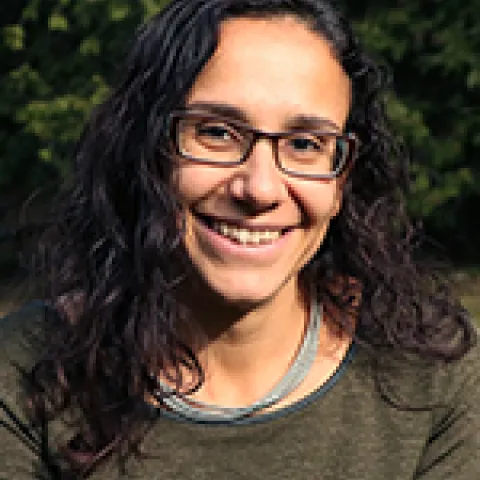
Dr. Denise Handlarski
Associate Professor, School of Education
Dr. Handlarski teaches courses in history and social justice education, particularly gender studies and anti-racist education, for the B.Ed. and M.Ed. programs. Her research areas include spirituality and community in education, sex education, well-being and education, Jewish studies, and birth/motherhood studies. Denise supervises graduate students in the Canadian Studies & Indigenous Studies program who have related interests.

Dr. Jackson Pind
Assistant Professor, Chanie Wenjack School of Indigenous Studies
Dr. Pind is an assistant professor of Indigenous Methodologies in the Chanie Wenjack School for Indigenous Studies and is appointed to the Canadian Studies and Indigenous Studies M.A. Program at Trent. His research is focused on the Anishinaabeg including the history of education particularly the legacy of the Indian Day School system. His recent book, Students by Day: Colonialism and Resistance at the Curve Lake Indian Day School and co-authored article with Jack Hoggarth, Pyroepistemology Along the Northern Shores of Lake Ontario: Reinterpreting the Hopewell Tradition and Moundbuilders Theory through Anishinaabeg Perspectives, combines oral history with archival analysis to uncover overlooked histories of the Michi Saagiig Anishinaabeg.
Admissions
Trent has clear pathways for graduate students to apply and be admitted to study for their master's or doctorate at either of our campuses. Please review admission requirements for your program before applying.
Eligibility Requirements
- Honours degree (a four-year undergraduate bachelor's degree)
- Minimum B+ (77%) or equivalent in the last two years of full-time study, or last ten full academic credits
- Candidates should have a clear interest in an interdisciplinary graduate experience, and have undergraduate courses relating to Canada, or a willingness to take such courses as make-up, typically before admission
Eligibility Requirements
- Honours degree (a four-year undergraduate bachelor's degree)
- Minimum B+ (77%) or equivalent in the last two years of full-time study, or last ten full academic credits
- Candidates should have a clear interest in an interdisciplinary graduate experience, and have undergraduate courses relating to Canada, or a willingness to take such courses as make-up, typically before admission
- Proof of English Proficiency: All international applicants must provide proof of an adequate level of English proficiency regardless of their citizenship status or country of origin. Please visit our International Applicant Resource page for details on English Language Proficiency requirements.
- A GRE test score is not required for admission into this program
All applicants, domestic and international, must submit the following documents to complete their application:
- Transcripts: Unofficial copies of all post-secondary transcripts
- 2 letters of reference: Academic references are required. Reference forms will be emailed to the referees that you have appointed on OUAC
- Plan of Study/Personal Statement: 1-2 pages outlining your objectives in a graduate program. Any specific research interests, relevant experiences, and/or career aspirations can be included
- Writing Sample: A sample of your writing of about 20 pages or less. The preferred submission format is PDF. Good choices for writing samples include: an undergraduate essay, lab report, research report, journal article, a chapter from a master's thesis, or a published article.
- Proof of Citizenship (i.e. copy of passport or birth certificate)
- Supervisor: Identifying a potential supervisor is recommended for this program. Please list your supervisor on your OUAC application and discuss this in your plan of study. Please visit the program's Faculty and Research page for a listing of faculty and areas of research. Applicants are responsible for reaching out to a faculty member
For more information on submitting transcripts, re-sending reference links and other application questions, please visit our How to Apply page and review Step 4, as well as review our Frequently Asked Questions (FAQ).
Tuition Estimate
Estimate your tuition, ancillary fees, and potential entrance scholarships based on your program, residency status, and academic average.
Tuition Fees
Base tuition fees apply to the following programs: Applied Modeling and Quantitative Methods (thesis/research-based; M.A. and M.Sc.), Anthropology (M.A. and M.Sc.), Canadian Studies and Indigenous Studies (M.A.), Cultural Studies (M.A.), Computer Science (M.Sc.), English (Public Texts) (M.A.), History (M.A.), Interdisciplinary Aging Studies (M.A.), Psychology (M.Sc.), and Sustainability Studies (M.A.). $750 (one-time) co-op fee for Sustainability Studies (Co-op Stream) not included in Estimator.
$8,252.00
Funding Package
Minimum funding package for eligible students in the following programs: Applied Modeling and Quantitative Methods (thesis/research-based; M.A. and M.Sc.), Anthropology (M.A. and M.Sc.), Canadian Studies and Indigenous Studies (M.A.), Computer Science (M.Sc.), Cultural Studies (M.A.), English (Public Texts) (M.A.), History (M.A.), Interdisciplinary Aging Studies (M.A.), Psychology (M.Sc.), and Sustainability Studies (M.A.)
$-18,000.00
Ancillary Fees
Mandatory ancillary fees
$1,329.00
Total:
$ -8,419.00
* The tuition details and scholarships listed are for domestic students only. International applicants should contact the financial aid office directly for equivalent guidance.
Financial Matters
Eligible full-time students are offered minimum funding packages during their funded period of $18,000 annually. This includes a Graduate Teaching Assistantship employment offer valued at approximately $13,000 annually. Specific funding details are included in individual admission letters.
Students are supported in competing for external awards during their studies, such as the Ontario Graduate Scholarship. A full list of external awards is available on our Scholarships & Awards page.
This program also offers unique funding opportunities for its students, such as program-specific entrance awards that may be automatically assigned at the time of admission, and competitive funding available throughout their studies.