
Graduate
Applied Modelling & Quantitative Methods
-
- Master of Arts (M.A.)
- Master of Science (M.Sc.)
-
- Peterborough
-
- Fall & Winter & Summer

At a glance:
- Degree Master of Arts (M.A.) Master of Science (M.Sc.)
- Campus Peterborough
- Program is Offered Fall & Winter & Summer
- Study Options Part time/Full time
- Length Thesis: 24 months Course-based stream: Data Science and Analytics: 12 months Course-based stream: Big Data Financial Analytics: 16 months Course-based stream: Big Data Analytics: 16 months
- Guaranteed Funding Thesis stream: Yes (for eligible students) Course-based streams: No
- Applications Open Fall intake: September 11 Winter intake: February 1 Spring intake: June 1
- Application Deadline Fall intake: February 1 Winter intake: June 1 Spring intake: October 1
-
Notice
*International application deadline for January 2027 extended to July 1, 2026
- Deposit Required Thesis stream: No Course-based streams: Yes
- Graduate Studies Contact amod@trentu.ca
- Apply Now Stay in Touch
The Trent Advantage
Build in-demand skills and advanced modelling expertise through flexible study and hands-on research that connects data science and analytics to real-world applications.
Learn at one of Canada’s top research universities in a hands-on, collaborative environment where you gain specialized skills in data analysis, statistical modelling, and computational techniques. Whether your interests lie in research, data-driven discovery, or the financial sector, you can shape your graduate experience around your goals with four specialized program options. Gain practical experience by applying modelling techniques to real-world problems, preparing you for high-impact careers in science, business, finance, and technology.
- Choose from three professional course-based streams including Data Science & Analytics, Big Data Analytics, or Big Data Financial Analytics to develop targeted expertise for your career
- Work with expert faculty across disciplines through the thesis-based option, conducting individualized research that can prepare you for Ph.D. studies
- Gain practical experience through research practicums, capstone projects and industry or community sponsored research projects that apply data and modelling techniques to real-world challenges
World Class Facilities
Financial Intelligence & Innovation Hub
Graduate students gain hands-on financial analytics training in Trent’s Financial Intelligence & Innovation Hub, featuring 12 state-of-the-art Bloomberg terminals and direct access to global markets, including the New York Stock Exchange.
Program Types
-
Thesis: M.A. or M.Sc.
Develop advanced modelling and research skills through individualized, collaborative research with close faculty mentorship. This 24-month thesis-based option connects scholars across economics, computer science, math, and psychology to exchange ideas and share knowledge, preparing you for research or Ph.D. study.
-
Course-Based Stream: Big Data Analytics M.Sc.
Gain in-demand data science skills in data visualization, data mining, cloud-based approaches, and parallel programming. This 16-month professional course-based stream provides practical training for careers in data science, with opportunities to apply your knowledge through a research paper and seminar presentation.
-
Course-Based Stream: Big Data Financial Analytics M.Sc.
Build the theoretical knowledge and practical skills needed for a career in the financial sector. This 16-month professional course-based stream offers an in-depth study of mathematical finance, portfolio and risk management, financial econometrics, and financial management. Apply your knowledge through a research paper and seminar presentation, and graduate career ready.
-
Course-Based Stream: Data Science & Analytics M.Sc.
Develop the tools and techniques to handle and analyze complex datasets across scientific and social science fields. This 12-month professional course-based stream covers a wide array of data science topics. Complete a research practicum in your final term and gain practical experience for academic and professional development.
Research Areas
Areas of academic research focus and faculty expertise
Thesis students collaborate on interdisciplinary research with faculty members in a wide range of disciplines, including: Anthropology, Biology, Business Administration, Chemistry, Computer Science, Economics, Geography, Humanities, Mathematics, Physics & Astronomy, Philosophy, and Psychology.
Career Paths
In Their Own Words
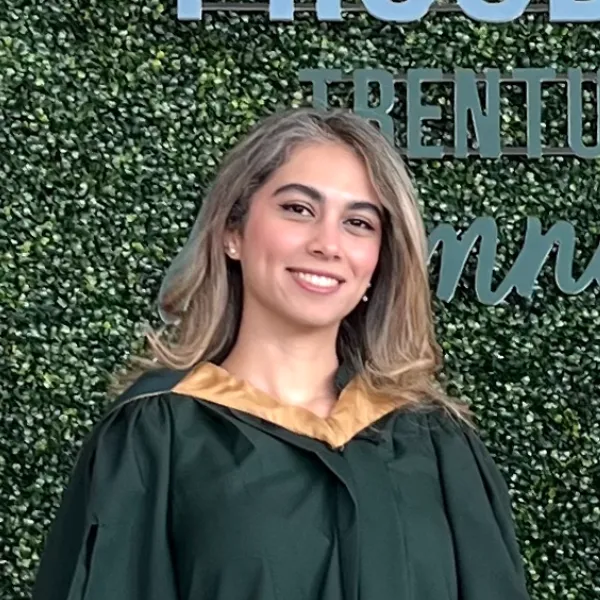
The Big Data Analytics stream at Trent helped me to understand that clean and meaningful data only exists when you know what problem you’re using the data to solve. Connecting the dots between theory and applied analytics, this program teaches the fundamentals of working with big data, while also preparing you for the evolution of data analytics alongside artificial intelligence. The learning environment is genuinely supportive, respectful, and friendly, which I found incredibly valuable for my learning process.
Nasim Dadgar
AMOD Big Data Analytics alum
Faculty Spotlight
Meet some of Trent's world-class professors and researchers.

Dr. James D. A. Parker
Director of AMOD, Professor of Psychology
Dr. Jim Parker is a leading expert in psychometrics and test development, with a particular focus on emotional and social competencies, such as emotional intelligence. His recent work explores leveraging large language models to create computational representations of personality constructs using natural language processing. These innovative machine learning techniques provide objective and complementary information to the findings offered by traditional psychometric tools.
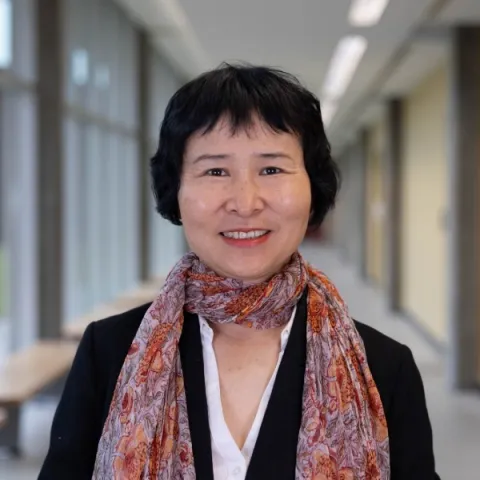
Dr. Jie Zhang
Associate Professor of Finance, Trent School of Business
Dr. Jie Zhang’s research focuses on corporate finance, investments, and financial institutions. She has published work in corporate misconduct, currency hedging, bank liquidity creation, non-performing loans, corporate innovation, and share repurchases in finance journals such as British Accounting Review, Accounting and Finance, Finance Research Letters, International Review of Finance, Asia-Pacific Journal of Financial Studies, and Applied Economics. Her recent interests include climate finance, generative AI in Finance, and indigenous study in finance.
Admissions
Trent has clear pathways for graduate students to apply and be admitted to study for their master's or doctorate at either of our campuses. Please review admission requirements for your program before applying.
Eligibility Requirements
- Honours bachelor degree (a four-year undergraduate bachelor’s degree) in a traditional discipline
- Minimum B+ (77%) or equivalent in the last two years of full-time study, or last ten full academic credits
- A university course in differential and integral calculus, and one in probability and statistics or equivalent
- Some familiarity with linear algebra, and capabilities in programming at an elementary level in at least one computational language
- A course in either differential equations or advanced statistics is required, depending on whether the student’s area of research will be mathematics or statistics based
Eligibility Requirements
- Eligibility Requirements
- Honours bachelor's degree (a four-year undergraduate bachelor’s degree) in a traditional discipline
- Minimum B+ (77%) or equivalent in the last two years of full-time study, or last ten full academic credits
- A university course in differential and integral calculus, and one in probability and statistics or equivalent
- Some familiarity with linear algebra, and capabilities in programming at an elementary level in at least one computational language
- A course in either differential equations or advanced statistics is required, depending on whether the student’s area of research will be mathematics, or statistics based
- Proof of English Proficiency: All international applicants must provide proof of an adequate level of English proficiency regardless of their citizenship status or country of origin. Please visit our International Applicant Resource page for details on English Language Proficiency requirements.
- A GRE test score is not required for admission into this program
All applicants, domestic and international, must submit the following documents to complete their application:
- Transcripts: Unofficial copies of all post-secondary transcripts
- 2 letters of reference: Academic references are preferred; however, professional references will be accepted. Reference forms will be emailed to the referees that you have appointed on OUAC
- Plan of Study/Personal Statement: 1-2 pages outlining your objectives in a graduate program. Any specific research interests, relevant experiences, and/or career aspirations can be included
- Detailed Resume or Curriculum Vitae (course-based streams only)
- Proof of Citizenship (ie. copy of passport or birth certificate)
- Supervisor (thesis-stream only): A potential supervisor must be chosen as an admission requirement for this program. Please list your supervisor on your OUAC application and discuss this in your plan of study. Please visit the program's Faculty and Research page for a listing of faculty and areas of research. Applicants are responsible for reaching out to a faculty member
For more information on submitting transcripts, re-sending reference links and other application questions, please visit our How to Apply: Domestic or International pages and review Step 4, as well as review our Frequently Asked Questions (FAQ).
Tuition Estimate
Estimate your tuition, ancillary fees, and potential entrance scholarships based on your program, residency status, and academic average.
Tuition Fees
Base tuition fees
$11,003.00
Ancillary Fees
Mandatory ancillary fees
$1,329.00
Total:
$ 12,332.00
Tuition Fees
Base tuition fees
$8,252.00
Ancillary Fees
Mandatory ancillary fees
$1,329.00
Total:
$ 9,581.00
Tuition Fees
Base tuition fees apply to the following programs: Applied Modeling and Quantitative Methods (thesis/research-based; M.A. and M.Sc.), Anthropology (M.A. and M.Sc.), Canadian Studies and Indigenous Studies (M.A.), Cultural Studies (M.A.), Computer Science (M.Sc.), English (Public Texts) (M.A.), History (M.A.), Interdisciplinary Aging Studies (M.A.), Psychology (M.Sc.), and Sustainability Studies (M.A.). $750 (one-time) co-op fee for Sustainability Studies (Co-op Stream) not included in Estimator.
$8,252.00
Funding Package
Minimum funding package for eligible students in the following programs: Applied Modeling and Quantitative Methods (thesis/research-based; M.A. and M.Sc.), Anthropology (M.A. and M.Sc.), Canadian Studies and Indigenous Studies (M.A.), Computer Science (M.Sc.), Cultural Studies (M.A.), English (Public Texts) (M.A.), History (M.A.), Interdisciplinary Aging Studies (M.A.), Psychology (M.Sc.), and Sustainability Studies (M.A.)
$-18,000.00
Ancillary Fees
Mandatory ancillary fees
$1,329.00
Total:
$ -8,419.00
* The tuition details and scholarships listed are for domestic students only. International applicants should contact the financial aid office directly for equivalent guidance.
Financial Matters
Learn more about graduate studies tuition and fees
Thesis stream
Eligible full-time students are offered minimum funding packages during their funded period of $18,000 annually, which includes a Graduate Teaching Assistantship employment offer valued at approximately $13,000 annually. Specific funding details are included in individual admission letters.
Students are supported in competing for external awards during their studies, such as the Ontario Graduate Scholarship. A full list of external awards is available on our Scholarships and Awards page.
Course-based streams
Funding is not included in offers of admission to professional course-based programs. Students entering these programs should plan to have sufficient funds in place to support themselves throughout their studies.
Connect with Financial Aid at Trent for more information about provincial loan programs for domestic students, as well as bursary opportunities for both domestic and international students.