
Build the scientific and technical foundation for a career as a professional geoscientist. Trent’s Environmental Geoscience B.Sc. degree meets the knowledge requirements of Professional Geoscientists Ontario (PGO), preparing you for the pathway toward P.Geo. accreditation. Drawing on geology, biology, chemistry, mathematics and geography, this program explores mineralogy, petrology, geophysics, hydrology and environmental geology. Students tackle and study challenges such as groundwater contamination, climate change and responsible resource development.
- Build hands-on experience through multiple field courses, developing practical skills in geological mapping, field methods, environmental assessment, and geophysical techniques.
- Develop technical expertise in the lab through hands-on training in mineralogy, petrology, instrumentation, and the analysis of geological and environmental materials.
- Gain professional experience through a fourth-year placement with a government agency, consulting firm or industry partner, applying your skills in a workplace setting.
- Learn alongside leading researchers, including Trent’s Canada Research Chair in Environmental Geoscience, whose research is advancing more sustainable approaches to mining.
Accelerated Masters
Fast-track your education, by earning your M.Sc. in Environmental & Life Sciences in only 12-20 months of graduating from your Honours B.Sc.
Prepare for Professional Geoscientist (P.Geo.) accreditation through a P.Geo.-aligned degree combining specialized field training, geotechnical investigation techniques, and applied environmental research.
Gain valuable career experience while earning academic credit.
Requirements
If you are coming straight from high school in Ontario or are a recent grad, the general admission requirements are:
- Ontario Secondary School Diploma (OSSD)
- A minimum of six Grade 12 4U or 4M courses, including program-specific prerequisites
- ENG4U with a minimum of 60%
| Admission Requirements | Recommended Admission Requirements | Estimated Admission Average | Co-op Admission Average |
|---|---|---|---|
| ENG4U, SCH4U, and MHF4U or MCV4U | SPH4U and SES4U | 75-80% | 80-85% |
Requirements
Students from across Canada can use their grades from their home province to apply to Trent.
Requirements
International students from outside Canada can apply based on the curriculum of their home country.
Requirements
Mature students can apply to Trent based on previous education and professional or volunteer experience.
Requirements
With many transfer agreements and flexible pathway options, Trent University makes it easy for students to make the most of the credits you have already earned.
- .J.P. Bickell Foundation Mining Scholarships
- Stantec Prize
Whether you're graduating from an Ontario high school, looking to study in Canada, or training for a second career, Trent has clear pathways for students to apply and be admitted to study at either of our campuses.
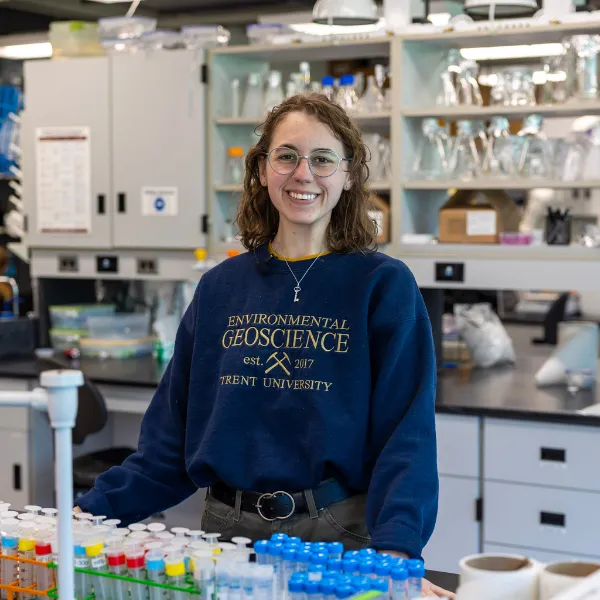
I realized pretty quickly that environmental geoscience was something I was interested in and a field I could see myself working in to make the kind of positive impact I always hoped to. At Trent, I really found my environmental people.
- Put your skills and knowledge to work in a paid co-op stream, launching fall 2027. You’ll graduate with a distinct career advantage – building valuable connections, gaining hands-on work experience all as part of your Trent degree.
- Learn alongside expert faculty, including the Canada Research Chair in Environmental Geoscience who is advancing knowledge on sustainable mining practices
- Conduct an honours thesis research, designing and carrying out a project in mineralogy, geochemistry, sedimentary processes, hydrology or soil science.
- Learn to identify specimens of minerals and rocks in nature and build skills in instrumentation, mapping, and measurement through practical laboratory courses and field studies.
- Take your Trent education global. Spend a semester or year studying at one of Trent’s 50+ international partner universities, participate in a summer field course, or gain international experience through a placement or internship.
- With opportunities in more than 35 countries, you can broaden your academic perspective, experience new cultures, and build skills that prepare you for a global career.
- Complete a fourth-year placement course and work as a geoscientist for a government agency, school, industry, NGO, laboratory or consulting and engineering firm
- Gain experience in fieldwork, report writing, and professional networking working alongside a professional geoscientist.
- Gain professional workplace experience by working within a business or organization on a paid internship, building career-ready skills, making industry connections, and exploring potential career paths.