
Trent Scientist Believes Arctic Ice Shelf Break-Off May Not be the Last
Dr. Derek Mueller States Irreversible Arctic Ice Shelf Loss will continue due to Global Warming
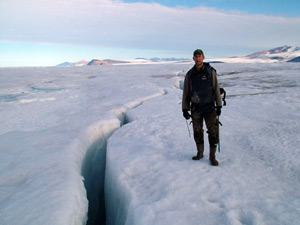 “It’s definitely a wake-up call,” says polar scientist and Trent University research fellow, Dr. Derek Mueller, in regards to two pieces totaling almost 20 square kilometres that recently broke off an ice shelf in the Canadian Arctic. According to Dr. Mueller, this calving of the Ward Hunt Ice Shelf and other losses of ice along this coast can be linked to the fact that temperatures in large parts of the Arctic have risen far faster than the global average in recent decades.
The chunks of ice broke away from an ice shelf surrounding Ward Hunt Island, a small island just off large Ellesmere Island in one of the northernmost parts of Canada. Dr. Mueller and fellow polar scientists believe that more breaks could follow this year.
"Whatever kept this ice shelf in balance for 3,000 years is no longer keeping it in balance," Dr. Mueller said. “As a result of a gradual weakening over time due to warming temperatures, I wouldn’t be surprised to see more ice breaking away this summer.”
Dr. Mueller, a Trent alumnus who was appointed the University’s inaugural Roberta Bondar Fellow in Northern and Polar Studies in 2008, has been described as "the pre-eminent expert on the Ward Hunt Ice Shelf." In 2002, he was part of the team of polar researchers that first discovered a large central crack in the ice shelf, which had occurred between 2000 and 2002. More fissures were discovered during his trip to the region this spring with the Canadian Rangers. These cracks weakened the ice shelf and likely led to the detachments observed last week.
Despite a period of relative stability between the late 1960s and 2000 the ice shelves along the northern coast of Ellesmere Island have been declining sporadically since the early 1900s. Over time, the ice shelves have lost over 90 per cent of their area.