
Revealing the Ocean’s Layers at the Top of the World
While most of us were basking in summer’s heat this past July, Professor Céline Guéguen, Canada Research Chair in Aquatic Sciences and Biogeochemistry at Trent, was boarding the Louis S. St. Laurent, Canada’s largest icebreaker
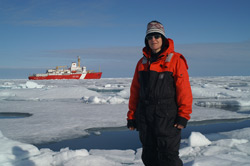 While most of us were basking in summer’s heat this past July, Professor Céline Guéguen, Canada Research Chair in Aquatic Sciences and Biogeochemistry at Trent, was boarding the Louis S. St. Laurent, Canada’s largest icebreaker, to make her way to the Arctic Ocean.
Along with 25 other researchers from Canada, the United States and Japan, Prof. Guéguen was participating in a series of intensive polar research expeditions as part of the International Polar Year (IPY). Organized through the International Council for Science and the World Meteorological Organization every 50 years or so since the 1880s, the IPY is a massive global scientific program focused on expanding human understanding of the Arctic and Antarctic. “We know more about the moon than we know about the poles,” said Prof. Guéguen.
Prof. Guéguen has been drawn to learn more about the impacts of pollution in the environment ever since witnessing a terrible oil spill off the coast of Western Brittany when she was a young girl where she grew up in France. Seeing the struggling animals and sea birds contend with the sticky substance left an impression that guided her research career into the aquatic sciences.
Her primary objective during this six-week research mission was to determine if dissolved organic matter could be used as a tracer for water masses, or layers in the ocean. “Dissolved organic material from Arctic river water reacts with heavy metals like mercury, released into the water by melting permafrost. A river with high levels of dissolved organic material quickly absorbs these heavy metals, and that means trouble for creatures living in that river and the northern communities who depends on it,” she explained.
Since the Arctic Ocean is a meeting point of waters from the Pacific and Atlantic, it forms layers of materials from waters of different origins. Each ocean has a different temperature and salinity, causing the water to stratify with the Pacific on top, and Atlantic Ocean waters on the bottom. Within these layers, there is a special water mass called the halocline, which is formed on the continental shelf and is high in nutrients and dissolved organic matter.
Using a deep-sea sampling device called a rosette, Prof. Guéguen took numerous samples from various depths in the ocean and measured the water’s chemical make up to identify the characteristics of the halocline layer and if it can be tracked. “A weakening of the halocline won’t be able to stop the warmer Atlantic water from melting the sea ice,” noted Prof. Guéguen. “What we found was that the halocline is significantly different from the Atlantic layer which means we can track water masses in the Canada Basin.” This ability to trace the movement of water masses provides scientists with a greatly improved capacity to monitor and predict changes in polar ice due to global warming.
“Ten percent of the world’s rivers discharge into Arctic Ocean so tracking the flow of freshwaters is critical to global climate. Indeed, changes in arctic river runoff may freshen the North Atlantic and weaken the Gulf Stream,” said Prof. Guéguen, adding, “Without the Gulf Stream we won’t have warmth in Europe.”
By solving this environmental puzzle, Prof. Guéguen will an immediate impact on Canada's North, allowing the government to better protect its many rivers, and the thousands of plants and animals that depend on that water for survival.