
Trent Research Results in Protected Status for Rare Pink Dolphins
Research of Drs. John Wang, Tim Frasier and Brad White Support Taiwan Dolphins as a Distinct Population
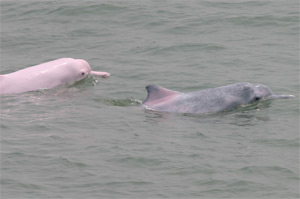 Thanks to research conducted by Trent University conservation biologists in the Biology Department, a small group of pink dolphins on the west coast of Taiwan are now recognized as a critically endangered population by the International Union for the Conservation of Nature (IUCN).
The 60 to 100 Indo-Pacific humpback dolphins on the industrialized west coast of Taiwan are considered “critically endangered” – the most serious category of threat to a population – this new status is seen as a crucial step in the crusade to protect these beautiful animals.
“I am pleased that the diligent field research of Dr. John Wang provided important information enabling the international scientific community to conclude these dolphins were a distinct population,” said Professor White, who is also director of the Trent-based Natural Resources DNA Profiling and Forensic Centre. “Adding these dolphins to the critically endangered list was a key step in the Conservation Action Plan drafted by Taiwanese and international scientists last September in hopes of improving habitat protection measures in Taiwan.”
On August 12, the IUCN officially added the dolphins to their 2008 list of threatened cetaceans, which covers whales, dolphins, and porpoises. The chair of the IUCN’s Cetacean Red List Authority, Dr. William Perrin, says, “Taiwan’s humpback dolphins have been listed as Critically Endangered because this distinct, isolated population is already dangerously small (less than 100), faces multiple serious threats, and will likely be driven to extinction if effective conservation measures are not taken quickly.”
Unique for their pink skin colouring, Indo-Pacific humpback dolphins were discovered in 2002 living in the Taiwan Strait by Dr. John Wang, a biologist with the National Museum of Marine Biology and Aquarium of Taiwan and the Biology Department of Trent University. The dolphins’ preferred habitat is the warm shallow waters along Taiwan’s west coast, which brings them into close range of one of the region’s most seriously polluted areas. According to Dr. Wang, proposed large-scale plastics and petrochemical development projects within the small distributional area of these dolphins “is incredibly concerning.” The main threats to the population have been identified as:
- reduced river flow into estuaries;
- habitat loss (e.g. through land reclamation);
- entanglement in fishing gear;
- industrial, agricultural and municipal pollutant discharges; and
- underwater noise.
Drs. Wang, White and Frasier see their DNA research on these animals as part of the broader conservation issue of assessing who is ultimately responsible for the environmental degradation of this critically endangered population. “I am deeply concerned about the pollutants and levels of carbon dioxide emitted from the coal-fired electrical generating plants and factories in the production of plastics. Southeast Asia is home to some of the world’s largest plastic factories supplying many of the consumer goods sold here in Canada,” said Dr. White. “The next time you go to a store and buy a plastic product, think about where it originated and the impact the production of these products have on the coastal habitat of this critically endangered humpback dolphin.”
For more information about Prof. White’s research, please visit his website.
For more information about Prof. White’s research, please visit his website.