
Trent University Research Fellow Interviewed by CBC's Quirks & Quarks
Dr. Amanda Sparkman's groundbreaking research to be featured
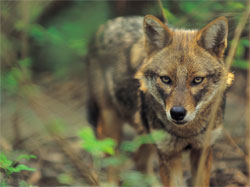 Trent University post-doctoral research fellow Dr. Amanda Sparkman shared her research on cooperative breeding in red wolf packs with Bob MacDonald of CBC Radio’s Quirks & Quarks recently.
Dr. Sparkman’s research was based on a dataset made available through her work with Trent University’s Dr. Dennis L. Murray, associate professor in the Department of Biology and Canada research chair in terrestrial ecology. As a member of the red wolf recovery team, Prof. Murray has access to some very rare data which Dr. Sparkman used to conduct her cutting-edge research. Her work has unearthed new information about lifetime reproduction in the red wolf.
“Nearly 30 years ago, the red wolf went extinct in the wild,” Dr. Sparkman explains. “Right before this extinction a captive breeding program was initiated in the United States. The wolves from this program were reintroduced into the wild in 1987 and the majority of individuals in the population have been tracked with radio collars since that time. This provides us with more than 20 years of data on the red wolf – complete lifetime data. It’s the first time we have been able to study the lifetime reproductive success of cooperatively breeding animals.”
Cooperatively breeding species like the red wolf often live in family groups with one breeding male and one breeding female. Young born to this male and female will continue to live in the pack and may help rear their younger siblings. The older siblings will eventually leave the pack, usually at two years of age, to begin breeding in their own pack and the younger pups will take on the role of older sibling, or helper. With only three percent of mammals and birds and a few fish species practicing cooperative breeding, this social system is uncommon in the animal kingdom.
Lifetime data on these species is quite rare and Dr. Sparkman’s paper is the first to examine the lifetime costs and benefits of having helpers for pups, revealing some unexpected and interesting findings.
Dr. Sparkman’s paper, published in Proceedings of the Royal Society B in October of this year, found that helpers contributed positively to the size of wolves. Males and females raised with helpers were larger in size than those raised without helpers and had a better chance of survival until the population of the red wolf became more crowded. At high density, male pups reared under the watchful eye of older siblings were the same size as those without helpers, while females with helpers were smaller in size. There was no difference in survival at high density between pups raised with and without helpers.
“Males are generally larger than females, but may be especially large in the presences of helpers,” Dr. Sparkman suggests. “In contrast,“ she says, “females with helpers seem to struggle at high population density perhaps because their smaller size makes them more vulnerable to competition with their older siblings for resources.”
The study also found that males reared with helpers experienced a shortened reproductive lifespan, while females reared with helpers experienced a longer reproductive life span and more reproductive events, which means more pups produced over their lifetimes.
“More research is needed,” Dr. Sparkman says, “but one potential explanation for the different responses to having helpers for males in females is that increased size leads to advanced rate of aging in males, resulting in a shortened reproductive lifespan and reduced number of reproductive events. Another explanation may be that the competition for resources with older siblings results in only the strongest females coming out of the pack to reproduce,” she continues to explain. “The highest quality females may experience a better reproductive future.”
As the first paper to examine the costs and benefits of cooperative breeding on lifetime reproduction, Dr. Sparkman’s study will positively affect future efforts to manage the red wolf population and prevent extinction. “Any understanding of the basic biology of the red wolf, especially social behaviour, can contribute to managing the system,” she says. “With this knowledge we can take care not to disrupt their family group and the positive roles helpers play in their reproductive lives.”
Dr. Sparkman hails from California and completed an undergraduate degree at Westmont College in Santa Barbara and a Ph.D. at Iowa State University. She was attracted to Trent’s reputation for excellence in wildlife research. “Trent is a great centre for wolf research in North America,” she says. “I have an excellent job. I really appreciate being able to work with this red wolf data set and with Dr. Murray. Having access to twenty years of data means you can ask a lot of questions.” Her study has garnered national and international media attention.
Journal reference: Proceedings of the Royal Society B, DOI: 10.1098/rspb.2010.1921