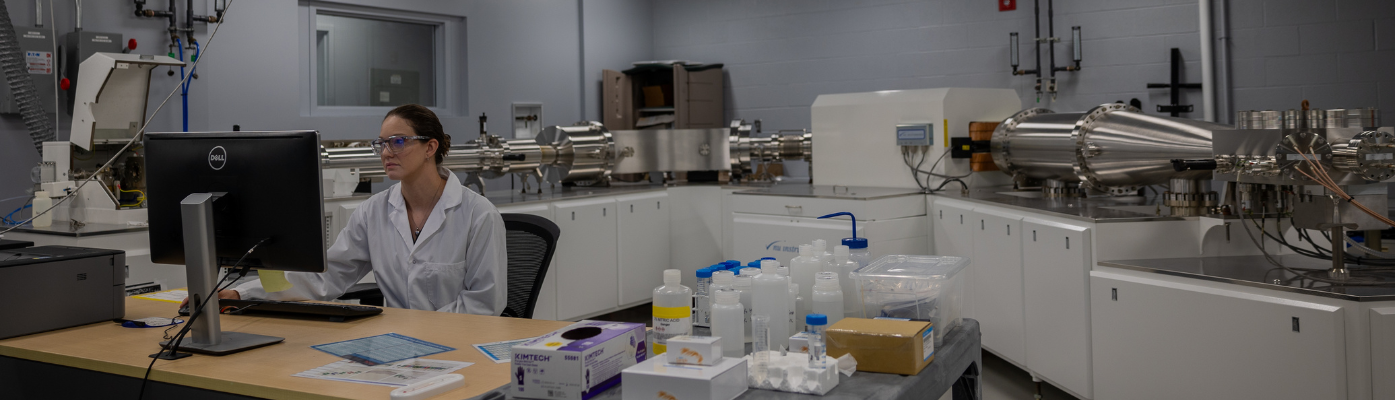
Combine an in-depth understanding of how modern analytical instruments work with the practical skills to operate them, in this first-of-its-kind program
M.ICA
In one year you can gain significant knowledge as well as hands-on experience in instrumental chemical analysis, and be highly employable in positions in government and industry around the world. This stream is aimed primarily at recent graduates without extensive laboratory experience. A paid placement in the third term provides you with the opportunity to collaborate with government, industry, or another academic institution.
When students have completed two terms of course instruction, they will have approximately four months of full-time placement experience in a laboratory. Below is a listing of where some of our cohorts have completed placements with the following partners:
- The National Research Council (Ottawa, ON)
- Health Canada (Ottawa, ON)
- Trent University (Peterborough, ON)
G.Dip
This eight-month course-based graduate diploma is for students who have practical experience with the operation of analytical equipment in a laboratory setting. This stream is aimed primarily at practicing professionals who want to update their theoretical foundations of modern instrumentation developments. You will build a uniform understanding of good laboratory practice, introductory service and maintenance procedures, and a sound understanding of the theoretical underpinnings of modern mass spectrometric and chromatographic instruments.
Admission Requirements
The application portal opens mid-October each year, and the deadline is February 1st for first round of offers. Please check the Graduate Studies page for updates on extensions.
The general regulations and requirements of Trent University apply to the Instrumental Chemical Analysis graduate program. The Instrumental Chemical Analysis program accepts students in to the program once a year in September. Applicants to either the M.ICA degree or the Graduate Diploma are required to hold a four year Bachelors of Science degree in any relevant science including biology, chemistry, environmental science, forensic science, physics, or health science. Applicants must have achieved an average of at least B+ (77%) in the work of the last 10 full academic credits or the last two undergraduate years (full time equivalent). Practical or theoretical experience with instrumental chemical analysis, especially chromatography and mass spectrometry, is considered an asset for this program. There is no requirement to contact a potential Supervisor, as this is a course-based graduate program.
Please visit the Graduate Studies webpage for more information on How To Apply, including details on the Admissions Process and International Applicant details, as well as Tuition, Awards and Funding.
Course Listing
Please visit the Graduate Academic Timetable to see which courses are presently being offered. For specific details about program requirements and degree regulations, please refer to the Academic Calendar.
Fall Term
ICAN 5001 Principles of Mass spectrometry
ICAN 5002 Advanced Analytical Separation Techniques
ICAN 5004 Statistical Analysis and Data Processing
ICAN 5120 Sample Preparation
COOP 5000 Professional Foundations*
Winter Term
ICAN 5003 Accreditation and Quality Management Systems
ICAN 5005 Instrument Maintenance and Repair
ICAN 5110 Troubleshooting Analytical Methods & Instruments
ICAN 5121 Advanced Spectrometry: ICP-MS and LC-MS-MS
ICAN 5122 Other Analytical Methods Overview
Spring/Summer
ICAN 5200 Practicum*
*G.Dip is not required to take noted course(s)
Academic Calendar Course Description:
| ICAN 5002H: Advanced Analytical Separation Techniques | This course will consist of three blocks of material. In the first, students will learn about modern separation techniques that are not taught in the undergraduate Chromatography course (CHEM 3400) at Trent. In the second, students will become familiar with common problems encountered in routine chromatographic applications, and how to solve them. In the third block, students will be trained in the development and modification of routine chromatographic techniques. |
| ICAN 5003H: Accreditation and Quality Management Systems | This course will be focused on a broad understanding of related quality management systems (QMS) in chemical laboratory operations. The course is intentionally designed to introduce current concepts and knowledge of QMS to ensure quality laboratory practices. Upon the completion of this course, students should be equipped with competence and tools that are expected to be applied by quality officers and laboratory professionals working in laboratories or testing centres. |
| ICAN 5004H: Statiscal Analysis and Data Processing | The course has a comprehensive coverage of the important topic in quality assurance and quality control (QA&QC). It explains how QA&QC concepts are applied to quantitative laboratory examinations, and how to organize a quality control program for quantitative tests. |
| ICAN 5005H: Instrument Maintenance and Repairs | In this course, students will be taught the basic aspects of routine instrument maintenance, and learn simple types of common repairs required for chromatographic and mass spectrometric instrumentation. Students will be familiarized with the fundamentals of several main relevant areas, including vacuum technology, ion optics, gas and liquid handling, instrumental electronics, and computer control of instrumentation. They will also learn how to assess the operational state of different parts of analytical instrumentation, and how to perform routine measures that maintain or restore this operational state. By the end of this course, successful students will be competent at performing routine maintenance tasks for chromatographic and mass spectrometric instrumentation, and will be able to attempt simple common repairs under the supervision of more experienced personnel (e.g. service technicians). |
| ICAN 5110H: Troubleshooting Analytical Methods and Instruments | In this course, students will be introduced to the fundamental approaches involved in troubleshooting complex analytical instrumentation and methods. Students will learn fundamental strategies, such as problem isolation, and how to apply these spectroscopic, chromatographic, and mass spectrometric instrumentation and methods. They will also learn how to collect and interpret appropriate data/ information and incorporate quality control and quality assurance information into the troubleshooting process. By the end of this course, successful students will be able to approach complex instrumental or methodological problems in a systemic manner, and identify and resolve the underlying issues in a timely and effective manner. |
| ICAN 5120H: Sample Preparation | This course introduces students to the methods for collection and preparation of samples for the analysis of organic and inorganic contaminants. Through a series of lectures, tutorials and laboratory exercises, students will learn how to sample and how to prepare water, soil/ sediments and biota samples for analysis. |
| ICAN 5121H: ICP-MS & LC-MS/MS | In this course, students will be taught the theory and practical application of Inductively Coupled Plasma-Mass Spectrometry (ICP-MS) and Liquid Chromatography Tandem Mass Spectrometry (LC-MS/MS). Students will cover several key areas of each technique. For LC-MS/ MS, this will include electrospray ionization, optimization of ionization and chromatography parameters, fragmentation, quantitation techniques and quality assurance. For ICP-MS, this will include plasma generation, choice of sampler and skimmer cones, liquid sample introduction, calibration strategies and collision/ reaction cells. By the end of this course, successful students will be competent in the operation of a commercial ICP-MS and LC-MS/MS instrument and have experience of analytical method development for real world samples. |
| ICAN 5122H: Other Analytical Methods Overview | This advanced course has been designed to study modern techniques commonly applied in qualitative analysis and chemical structure characterization of organic and inorganic substances. Several techniques will be discussed, and namely IR spectroscopy, Raman spectroscopy, NMR spectroscopy, X-Ray spectroscopy, thermal analytics, and surface analysis. Mass spectrometry is a unique technique has two dedicated courses in the MICA program (ICAN 5001 and ICAN 5121H), and therefore it is not discussed in this course. This course will provide students with an overview of the theory, instrumentation, and operating practice of each technique. Special emphasis will be given to the practical applications, and hands-on experience in operating each technique. Upon completion of the course, successful students will be familiar with the discussed techniques, and be able to apply their knowledge and skills to organic and inorganic qualitative analysis and chemical structure elucidation. |