
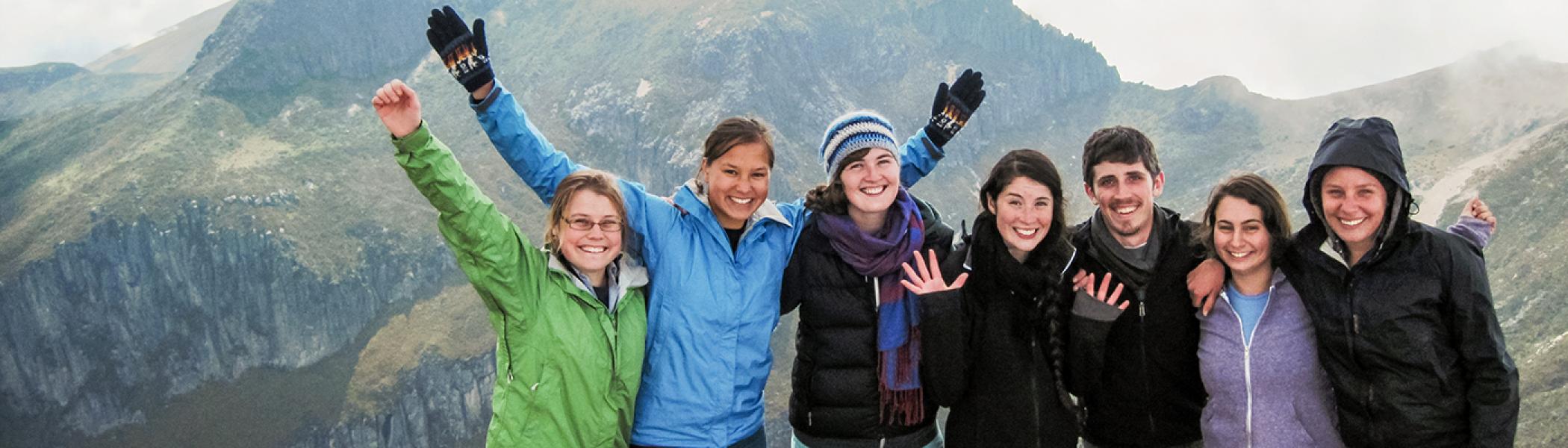
 Students gain invaluable experiential knowledge through their 10-12-week placement with a development organization in Term 2.
2014-15
Boisvert, Henry
Mangrove Heat: The Lives of Refugees and Outside Forces Affecting Them.
Organization: HIAS San Lorenzo . Location: San Lorenzo, Esmeraldas.
Burton, Harry
CMT's "fight against poverty" - The Colonialism of Development.
Organization: El Centro del Muchacho Trabajador (CMT). Location: Quito, Pichincha.
Cronkite, Lindsay
Descolonizacion desde los Bases: "Sarayaku, somos la luz de los pueblos indígenas".
Organization: Sarayaku. Location: Puyo, Pastaza (Amazon).
Fearman, Leah
Variations in Development Practices: The Development Approaches of Asociación Cristiana de Jóvenes.
Organization: Asociación Cristiana de Jóvenes Location: Quito, Pichincha.
Fischer, Nicholas
Crossing the Poverty Line: Poverty and Development Alternatives within the Kallari
Cooperative. Organization: The Kallari Cooperative. Location: Tena, Napo.
Fortin, Alicia
Dichotomous ways of life and GAMMA: A closer look at the gender and human-nature binaries and their decolonization in Ecuadorian society.
Organization: Grupo Apoyo al Movimiento de Mujeres del Azuay (GAMMA). Location: Cuenca and Saraguro, Azuay.
Przybylowski, Leanne
Care, Community, and Casa Linda: Determining their Interconnectivity.
Organization: Foundation Casa Linda. Location: Machala, El Oro.
Schaffel, Jaime
Decolonizing Through Art and Theatre.
Organization: Quito Eterno. Location: El Centro Historico de Quito, Pichincha.
Sindayigaya, Jade
Single Mothers and Children refugees' challenges on Northern Border of Ecuador: Misión Scalabriniana, Lago Agrio.
Organization:Misión Scalabriniana. Location: Lago Agrio, Sucumbíos.
Vanderhoek, Allie
Living in a Sea of Debris; The Roots and Routes of Marine Debris in Puerto Lopez.
Organization: Parque Nacional Machalilla. Location: Puerto Lopez, Manabi.
West, Maegan
Education and Development: Researching Popular and Alternative Education In Quito, Ecuador
Organization: Instituto de Investigación, Educación y Promoción Popular de Ecuador (INEPE). Location: South of Quito, Pichincha (School).
Past placements
Jatun Sacha
Muyuna, Napo. *Rural Amazon region.
Jatun Sacha focuses on the conservation of biological and cultural diversity through different models of private conservation, and the promotion of research and productive projects that help improve the quality of life of people living in surrounding areas. They promote the conservation of Ecuador’s biodiversity through technical training, scientific research, environmental education programs at the national and international level, community development, sustainable management of natural resources, and the training of community leaders in increasing ethnic and gender participation in community affairs.
Jambi Kiwa. Association of Medicinal Plant Producers of Chimborazo (AMPPC)
Santa Cruz, Chimborazo, Riobamba. *Urban Sierra region.
http://www.redindigena.net/organinteg/jambi.html
Jambi Kiwa works with medicinal plant producers as a means of motivating indigenous women in order to improve social and economic life. They produce high quality herbal teas, medicinal teas, coffee, medicinal herbs, shampoos, and tinctures, all organic and fair trade, and they mobilize women to collect medicinal plants and rediscover ancestral knowledge. Their main projects are aimed to improve the quality of life for communities. They provide raised wood stoves with chimneys, which improve air quality and make cooking easier, and natural water filtration systems that provide clean water. They conduct workshops on organic livestock rearing and organic farming, and introduce processes to improve the quality of hand-made crafts. They also produce 100% natural shampoos, soaps, and creams, and participate in agro-forestry projects, gender equality programs, leadership and self-esteem workshops, and finally an Andean School of Medicine.
INEPE (Instituto de Investigación, Educación y Promoción Popular de Ecuador).
Quito, Pichincha. *Urban Sierra region.
INEPE promotes holistic popular education in marginalized areas of south Quito. They work to build participatory processes in local development, communication and research, education, teacher training college, a school of music, and community health. The INEPE vision is to contribute to creating a world of solidarity, fraternity, and fairness, in which all people have the opportunity to fulfill their potential.
HIAS, (Hebrew Immigrant Aid Society).
San Lorenzo, Esmeraldas, Ibarra, Quito, Lago Agrio, Santo Domingo, Tulcán and Manabí. *Urban sierra, Coastal and Amazonian regions.
HIAS is a refugee aid organization guided by a Jewish value system, and is funded by UNHCR to process refugee claims and provide support to this vulnerable population. HIAS rescues people whose lives are in danger and provides them with protection. It helps refugees build new lives and reunite with their families in safety and security. HIAS facilitates the transfer of refugees to supporting countries, and offers support services such as a day care and a job bank with database of organizations that hire refugees. HIAS also hosts workshops to teach job skills and promote community activities.
Frente de Defensa de la Amazonia.
Shushufindi, and Lago Agrio, Nueva Loja, Sucumbíos. *Urban and rural northern amazon region.
FDA is a social non-profit organization that consists of twenty organizations and grassroots communities that are united in a struggle to defend and fight for human rights and environmental preservation in the Ecuadorian Amazon Region. These organizations focus on petroleum resistance and defending the livelihoods of local communities affected by the Chevron Texaco Company. They attempt to address the negative effects of the oil industry through advocacy and by carrying out actions aimed at restoring the social and natural environment.
Sumak Allpa,
Environmental Interpretation Center and Biodiversity Management.
Coca, Orellana. *Rural northern Amazon region.
Sumak Allpa is a non-profit foundation based in the Northern Amazon rainforest in Ecuador. It is working to preserve and support endangered indigenous peoples and their culture, language, and traditional way of life in the Ecuadorian Amazon region, and is also dedicated to restoring the environmental health of the jungle ecosystem and the wildlife that depends on it. There is a strong focus on eco-tourism and environmental education in order to raise awareness about the issues that plague the rainforests.
Proyecto Salesiano Mi Caleta. (Chicos de la Calle)
Quito, Esmeraldas, Santo Domingo. *Urban sierra and coastal regions.
Proyecto Salesiano Mi Caleta is a religious missionary organization committed to poverty reduction. It focuses specifically on youth at risk, or street kids. It promotes Catholic education, training for work, and after school programs such as teaching youth how to be equitable, dignified and responsible, in order to prepare them for independence and solidarity in society. There is also a shelter that offers guidance, leadership, food, and protection.
Individual Small Initiative Projects financed by the UNDP Office:
“Alternative association for ecological and sustainable community tourism development in the corridor Bio-corridor Yaku Samay ".
Communities of: Talag: Alukus , Cando, San Vicente, Shandia, Wasila, Napo province. *Rural Amazon region.
The Communities involved in the project are seated next to the river Jatun Yaku, the Sub-basin of greater importance within the bio-corridor Yaku Samay. The project aims to contribute to the conservation of the tropical rainforest in the Llanganates National Park buffer zone to consolidate and disseminate the accumulated knowledge of communities that make up the Sinchipura Association. It engages in capacity-building and promotes sustainable tourism development in the parish of Talag. It promotes environmental alternatives uses of natural and sustainable resources that will improve the productive landscapes in the area. Some of these communities are also involved in other networks such as the KALLARI association of Producers of organic cocoa and vanilla pod.
“Kawsaypak chakra (Chakra for life)”.
Communities of Santo Domingo and San Jose, Waysa Yaku, Mariposa, San Francisco Ruminawi, Napo Province. *Rural and semi-rural Amazon regions.
The project was developed in the parishes St. Pablo of Ushpayaku and Cotundo Canton Archidona, Napo province, areas linked to the Antisana ecological reserve and the National Park Sumaco Napo - Galeras. This project contributes to the construction of the bio-corredor Yaku Samay through the conservation of the estero Waysayaku on Río Misahuallí watershed. The project focuses on the reforestation of the land connecting to the stream with native species in the area throughout the settlements of the communities of San Jose and Waysa Yaku, as part of an effort to conserve and manage the water source supplying these communities. The purpose is to consolidate and replicate the production system of ancestral chakras, fish farming, sustainable tourism, safety and food sovereignty-oriented marketing.
“Cloud forest conservation and promotion/innovation of family farming in the buffer zone of the ecological reserve Cotacachi Cayapas RECCS Association of agro-ecological farmers of Intag "ACAI""
Parrishes of Cotacachi, Peñaherrera y García Moreno, Imbabura province. *Rural and urban sierra region.
The project contributes to the conservation of forests and biodiversity through concrete actions of environmental education/interpretation, identification and definition of priority areas for conservation, reforestation, establishment of local conservation regulations, radio broadcasting, and facilitation of ecological connectivity. It supports building, upgrading and innovating of family farming by means of visits/tours, learning successful experiences, training in conservation and composting of soils, preparation/implementation of fermented manures, and the utilization of bio-fertilizers, mineral wines, mineral salts and nutritional blocks for cattle. The project additionally focuses on building a network of peasant farms incorporating alternative irrigation systems and biodiversity farming.
“Conservation of micro basins and forests of the García Moreno parish, as support for the consolidation of the buffer zone of the Ecological Reserve Cotacachi Cayapas”.
Los Cedros, Cebu, Chontal and Pajas de Oro and micro watershed of Intag, Magdalena, Manduriacos and Rio Verde. *Rural and semi-rural Sierra region.
The project seeks to create continuity between the protected forests of Los Cedros, Cebu, Chontal and Pajas de Oro. In particular, it supports the conservation micro-watersheds of Intag, Magdalena, Manduriacos and Rio Verde. Conservation activities are oriented towards: a) the consolidation of connectivity between the protective forests; (b) the control of illegal logging of forests through the establishment of a model of public/community co-management, led by women's organizations and other local organizations; (c) the implementation of productive and tourist initiatives as a strategy to reduce the pressure on forests, (d) the reduction of the pressure of cattle ranching on forests, and (e) the strengthening of women and the population in general by implementing sustainable pilot farms, community tourism, sustainable usage of non-timber forest products of forests, conservation and environmental management of the territory.
"Favoring ecological connectivity through development of appropriate technologies to improve microbiological sustainable productive models".
Cotacachi,Otavalo Apuela, García Moreno,Peñaherrera, Selva Alegre, Plaza Gutiérrez, Cuellaje,Vacas Galindo, San José de Minas Asociación Agroartesanal de Caficultores Río Intag – AACRI. *Rural sierra region.
The Rio Intag coffee growers association has undertaken the development of Microbiology for the increase of the productivity and the profitability of organic coffee cultivation. The project will enhance the agroforestry systems and strengthen the connectivity between remnants of forests in the area. A local team of researchers will develop a range of microbiological inputs, which will be validated through a rapid process of testing in the field. At the same time the project will prepare the farmers in the management and adoption of technology. There will be a systematic process of monitoring, follow-up, evaluation and systematization of implemented models. The products will be listed for commercial distribution, and to ensure the sustainability of the bio-factory and laboratory as a local business association.