

Featured Publication
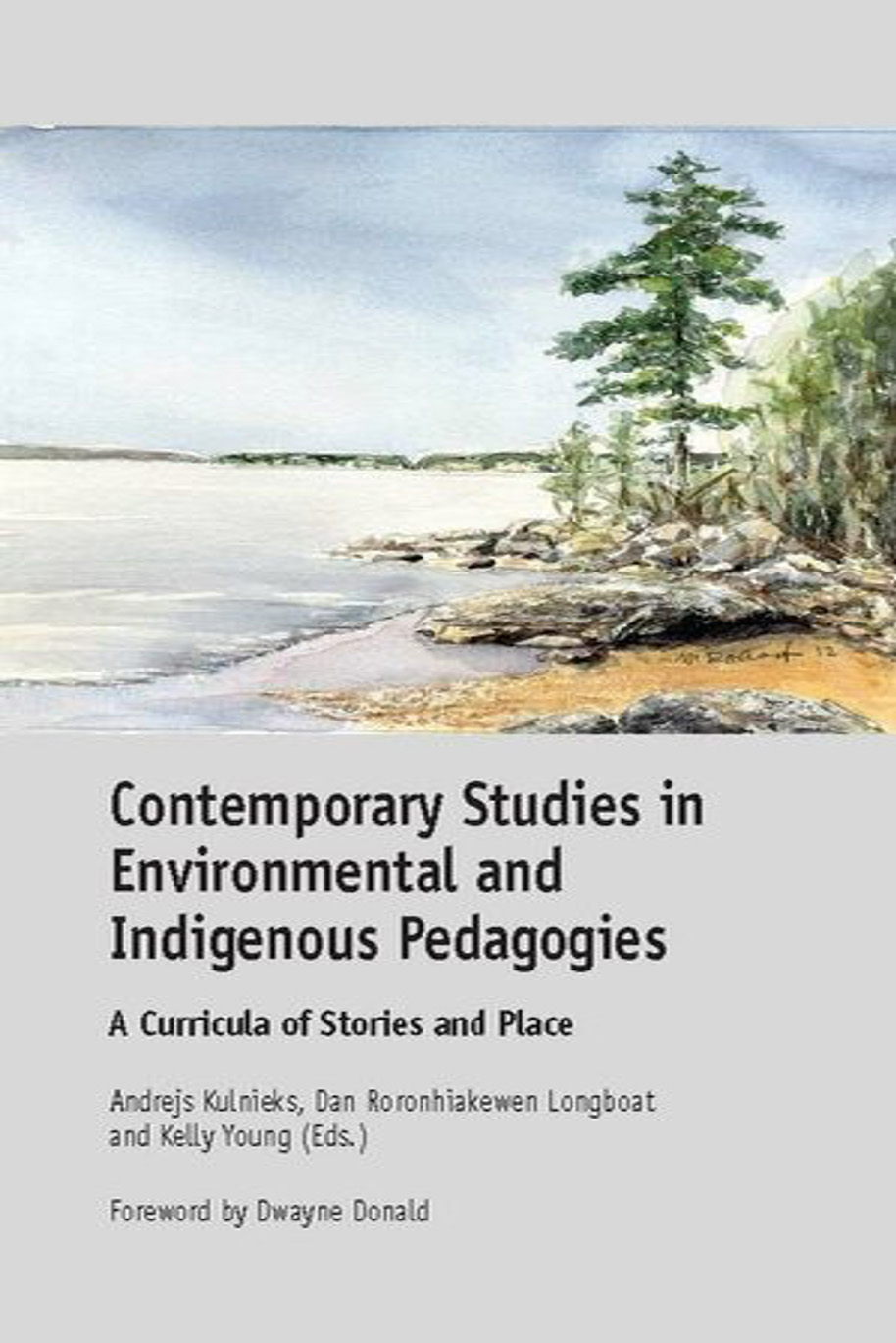
Contemporary Studies in Environmental and Indigenous Studies: A Curricula of Stories and Place
Volume Editors: Andrejs Kulnieks, Dan Roronhiakewen Longboat, and Kelly Young
Our book is a compilation of the work of experienced educational researchers and practitioners, all of whom currently work in educational settings across North America. Contributors bring to this discussion, an enriched view of diverse ecological perspectives regarding when and how contemporary environmental and Indigenous curriculum figures into the experiences of curricular theories and practices. This work brings together theorists that inform a cultural ecological analysis of the environmental crisis by exploring the ways in which language informs ways of knowing and being as they outline how metaphor plays a major role in human relationships with natural and reconstructed environments.
Selected Publications
Handlarski, D., Hill, L., Pendleton Jiménez, K., & Young, K. (2025). Forest walking: Exploring arts & the environment. In K. Kiers & T. Buttler (Eds.), Outdoor experiential learning in Canada (pp. 107-10). Canadian Scholars’ Press.
Young, K. & Pendleton Jiménez, K. (2024). An invitation to the Learning Garden: Green lessons from a school of education. In S. Hillock (Ed.), Greening social work education (pp. 100-113). University of Toronto Press.
Young, K. & Pendleton Jimenez, K. (June 2023). In Early Spring: A Curriculum of Awakening. NICHE Network in Canadian History & Environment. https://niche-canada.org/2023/06/30/in-early-spring-a-curriculum-of-awakening/
Young, K. (2023). The Learning Garden: Alternative Settings Placement A teacher education initiative at Trent University. Pathways: The Journal of Outdoor Education, 35(3), 26-28.
Gosselin, J., gwynn, a., Hill, L. Newman-Still, D., Pendleton Jiménez, K., Prince, C., Trefzger Clarke, L., & Young, K. (2023). Improv walk. Nature is a part of me. T. Gonzalez Kane & J Cole (Eds). The Canadian Theatre Review CTR: Sustaining the Stage [Special Issue], 194, 13-18.
Pendleton, K. & Young, K. (2022). “Country” is my gender, the good girl, and eco-justice education. In A. Farrell, C. Skyhar & M. Lam (Eds.), Teaching in the Anthropocene (pp. 44-56) Canadian Scholars and Women’s Press.
Young, K. & Kulnieks A. (2022). Leadership in eco-Justice environmental educational practice: A case for climate change curricula through poetic inquiry that involves storytelling and walking the land. In E. Walsh (Ed.), Justice and Equity in Climate Change Education: Exploring Social and Ethical Dimensions of Environmental Education (pp. 198-213). Routledge.
Bell, N., Handlarski, D., Mooney, C., Niblett, B., Pendleton Jiménez, K., & Young, K. (2022). Progressive, passionate, and well-versed in the complexities: The Trent University School of Education and Professional Learning. Kitchen, J., & Petrarca, D. (Eds.), Initial teacher education in Ontario: The four-semester teacher education programs after five years. In Canadian research in teacher education: A polygraph series (Vol. 12) [eBook] (pp. 313-325). Canadian Association for Teacher Education/Canadian Society for the Study of Education. http://dx.doi.org/10.11575/PRISM/39656
Young, K. (2021). Developing eco-literacy as a habit of mind in teacher education through eco-justice progressive curricula. In A. Dentith, D. Flinders, J. Lupinacci, & J. Thom (Eds.), Curriculum, Environment, and the work of C.A. Bowers: Ecological and Cultural Perspectives (pp. 148-167). Routledge.
Longboat, D., Kulnieks, A., & Young, K. (2020). Developing curriculum through engaging oral histories: A pedagogy for reconciliation and eco-justice-oriented education. In K. Llewellyn & N. Ng-A-Fook (Eds.), Oral History, Education, and Justice: Possibilities and Limitations for Redress and Reconciliation (pp. 183- 196). Routledge.
Young, K. (2019). Exploring a curricula of visual and poetic aesthetics. Canadian Review of Art Education: Research and Issues, 46(1), 44-59.
Young, K. (2018). The character of contemporary curriculum studies in Canada: A rumination of the metaphorical nature of language. In E. Hasebe-Ludt & C. Leggo (Eds.), Provoking Curriculum Studies: A Métissage of Inspiration/Imagination/Interconnection (pp. 78-84). Canadian Scholars’ Press.
Kulnieks, A., Longboat, D., & Young, K. (2018). Tramping the mobius: A curriculum of oral and literary tradition as a primer for rural education. Space and Culture, 21(1), 60-71. https://doi.org/10.1177/1206331217740819
Kulnieks, A., Longboat, D., & Young, K. (2016). Engaging eco-hermeneutical methods: Integrating indigenous curriculum through an eco-Justice-arts-informed pedagogy. AlterNative: An International Journal of Indigenous Peoples, 12(1), 43-56. https://doi.org/10.20507/alternative.2016.12.1.4
Kulnieks, A. & Young, K. (2014). Ekphrastic poetics: Fostering a curriculum of ecological awareness through poetic inquiry. in education, (20)2, 79-89.
Kulnieks, A. & Young, K. (2014). Literacies, leadership, and inclusive education: Social justice arts-informed eco-justice pedagogy. LEARNing Landscapes, 7(2), 183-194.
Kulnieks, A., Longboat, D., & Young, K. (2013). Eco-literacy development through a framework for indigenous and environmental educational leadership. Canadian Journal of Environmental Education,18, 112-126.
Kulnieks, A., Longboat, D., & Young, K. (2013). Engaging literacies through ecologically minded curriculum: Educating teachers about indigenous knowledges through an ecojustice education framework. in education,19(2), 138- 152. https://doi.org/10.37119/ojs2013.v19i2.149
Kulnieks, A., Young, K., & Longboat, D. (2013). Indigenizing environmental education: Conceptualizing curriculum that fosters educational leadership. First Nations Perspectives – The Journal of the Manitoba First Nations Education Resource Centre, 5(1), 65-81.
Stanley, D. & Young, K. (2011). Conceptualizing the complexities of curriculum: Developing a lexicon for ecojustice and the transdisciplinarity of bodies. Journal of Curriculum Theorizing, 27(1), 36-47. https://doi.org/10.63997/jct.v27i1.306
Kulnieks, A., Longboat, D., & Young, K. (2010). Re-indigenizing learning: An eco-hermeneutic approach to curriculum. AlterNative: An International Journal of Indigenous Peoples, 6(1),15-24. https://doi.org/10.1177/117718011000600102
Young, K. (2008). Ecological habits of mind and the literary imagination. Educational Insights, 12(1), 1-9. https://einsights.ogpr.educ.ubc.ca/
Young, K. (2006). The pedagogic force of ekphrastic poetics. Language and Literacy: A Canadian Educational E-Journal, 8(2), 1-18. https://doi.org/10.20360/g2d880
Young, K. (2005). Curriculum of imperialism: Good girl citizens and the making of the literary educated imagination. Journal of the Canadian Association of Curriculum Studies, 3(2), 41-54. https://doi.org/10.25071/1916-4467.16976
Young, K. (2002). Writing as possibility: Poetic practices and pedagogy. Language and Literacy: A Canadian Educational E-Journal, 4(2), 1-11. https://doi.org/10.20360/g2pw2d
Young, K. (2002). Poetic intervention in teaching and learning. Journal of Curriculum Theorizing,18(4), 159-178.