
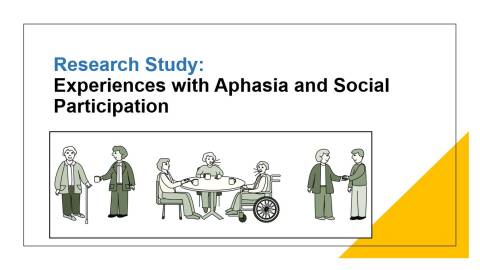
To better understand how social participation is impacted by aphasia, this honours thesis in Psychology investigated the social experiences of five adults with aphasia attending a community program in Peterborough, Ontario through aphasia-friendly interview methods. A thematic analysis revealed key themes in how participants described their social experiences: 1) living with aphasia, 2) barriers to social participation, and 3) facilitating social participation. The research found that availability of social support contributed to participants' ability to participate socially. Negative social experiences and low aphasia awareness emerged as a significant barrier to participants' social participation. The project was conducted in collaboration with March of Dimes Canada - Aphasia & Communication Disabilities Program.
Selected Outputs
Social participation experiences as shared by people living with aphasia
Authors: Erika Snowden (B.Sc.), Elizabeth Russell (Ph.D.), Tabytha Wells (M.Sc.)
Abstract:
Introduction: With stroke incidence on the rise in Canada, research that can enhance the wellbeing of people living with aphasia (PLWA) is critical. To provide insights into the day-to-day social experiences of PLWA and how these experiences relate to communicative access, this study sought to: 1) describe PLWA’s experiences with social participation, 2) identify challenges and supports to their social participation, and 3) gain their insights into improving communicative accessibility.
Methods: Five PLWA enrolled in a community aphasia group in Southern Ontario, Canada were included in this study. A series of individual, semi-structured interviews were conducted using supportive communication strategies for aphasia. Data collected from these interviews was analyzed using an iterative, collaborative qualitative analysis process.
Results: Three themes emerged during analysis: 1) coping with change, describing participants’ personal experiences adapting to life with a communication disability, 2) barriers to social participation, identifying factors that negatively impacted their opportunities for interacting with others, and 3) facilitating social participation, pertaining to ways that participants felt PLWA’s social participation could be improved.
Conclusion: Improving public knowledge and awareness of aphasia was identified as a key facilitator for increasing social participation for participants in this study. Participants with perceived social support expressed having more opportunities for social participation than those without perceived social support. Present findings suggest that creating and maintaining both in-person and virtual opportunities for social participation that are communicatively accessible can help address the diverse needs of people living with aphasia.
[ Access the article ]
Exploring the social experiences of people with aphasia: Project report
Author: Erika Snowden (B.Sc.), Elizabeth Russell (Ph.D.)
[ Access the project report ]

"I'm still the same person": Exploring the social experiences of people with aphasia
Author: Erika Snowden (B.Sc.), supervised by Elizabeth Russell (Ph.D.)
Honours thesis, Department of Psychology, Trent University.
Aphasia Resources
A key finding of this study was that people with aphasia often feel that they are negatively impacted and socially excluded due to a lack of understanding about their disorder. To address this pressing issue, we would like to share the resources below. Please consider taking the time to learn more about aphasia, and how it impacts the daily life and communication of those affected.

[ Click here to view or download the full sized poster ]
Participants in this study identified these key strategies for improving communication with people with aphasia:

What is Aphasia? - The Aphasia Institute
This page provides an overview of aphasia, its symptoms, and its impact. Understanding that aphasia masks competence is the first step towards increasing aphasia awareness and combating stigma.
[ Learn more ]
Supported Conversation for Adults With Aphasia (SCA) - The Aphasia Institute
The Aphasia Institute offers an online, self-paced training module free of charge to healthcare professionals and other individuals who wish to wish to improve their communication skills, contribute to communicative accessibility, and decrease barriers. To access the training, a free account is required.
[ Explore to learn more ]