
Knowledge Mobilization Strategy
The Rural Aging Research Program is dedicated to sharing about our research in engaging and accessible ways to a variety of audiences, including academics, community leaders, government officials, policy decision-makers, and the general public. Our unique Knowledge Mobilization Strategy ensures that our research is available to those who it impacts the most, encouraging positive outcomes for rural older adults.
About Our Knowledge Mobilization Strategy
Our Knowledge Mobilization Strategy was established by the Program's Principal Investigators to ensure that the Program's research findings are clearly and professionally communicated through accessible, digestible, and practical digital formats. Our Knowledge Mobilization Strategy includes a variety off research dissemination methods to maximize the reach of our research findings, including academic dissemination through peer-reviewed publications and academic conferences; community, government, and policy knowledge user mobilization through non-academic toolkits and reports; and general public audiences in Canada and internationally through multi-media outputs. Each output is designed to reach and support the activities of these specific audiences, drawing on professional photography, videography, and design.
Academic Dissemination
Academic dissemination involves the preparation of manuscripts for publication in leading peer-reviewed journals in the fields of psychology of aging, rural studies, aging studies, voluntary sector studies, social gerontology, educational gerontology, and scholarship of teaching and learning. In line with SSHRC’s Open Access Policy, we aim to publish our research open access wherever possible to enhance the reach of our research findings. To further share our research, the Rural Aging Research Program has a strong presence at national and international academic conferences, including the annual meetings of the Canadian Association on Gerontology, Canadian Psychological Association, International Federation on Aging, and Gerontological Society of America, as well as seminars hosted through the Trent Centre for Aging & Society, Gilbrea Centre for Studies in Aging (McMaster University), and John Richards Centre for Rural Ageing Research (La Trobe University, Australia).
Community, Government, and Policy Knowledge User Mobilization
Knowledge mobilization with community, government, and policy-decision maker audiences involves the co-creation of non-academic reports in collaboration with community members and leaders. All reports are publicly available through the Rural Aging Research Program website and are shared through rural aging social media networks in Canada and internationally. Outputs include Project Reports, Promising Practices Reports, Pedagogical Toolkits, and Policy Reports that are shared with project participants, community leaders, and local, regional, and national policy audiences.
Engagement with Older Adults, Advocates for Older Adults, and General Public Audiences
Engagement with older adults, advocates for older adults, and general public audiences in Canada and internationally are facilitated online to ensure open access to project multi-media for all audiences, via the Rural Aging Research Program's website. Online and in-person engagement is facilitated through the Trent Centre for Aging & Society's seminar series (reach of 300+ attendees) and promoted via the Centre’s social media channels (3,100+ followers). Community audience videos and social media post are often co-created with program leaders and participants to accompany reports and communicate findings (for example, see our videos in collaboration with Trent Health in Motion: Seniors in Motion and Abbeyfield House Society of Lakefield). Additionally, we author plain language rapid-release media editorials in the communities we work with (e.g., Perth County and the Greater Anprior Area) and nationally (e.g., The Conversation) to facilitate engagement with older adults, advocates who support them, and the general public in rural Canada and internationally.
Selected Outputs
Explore our various knowledge mobilization outputs below or find more on our Program webpage.
Project Reports and Toolkits
Challenging ageism & supporting equity through an intergenerational classroom: Project report
Authors: Tabytha Wells and Elizabeth Russell (2025)

Developing & implementing an intergenerational classroom: Pedagogical toolkit
Authors: Tabytha Wells and Elizabeth Russell (2025)

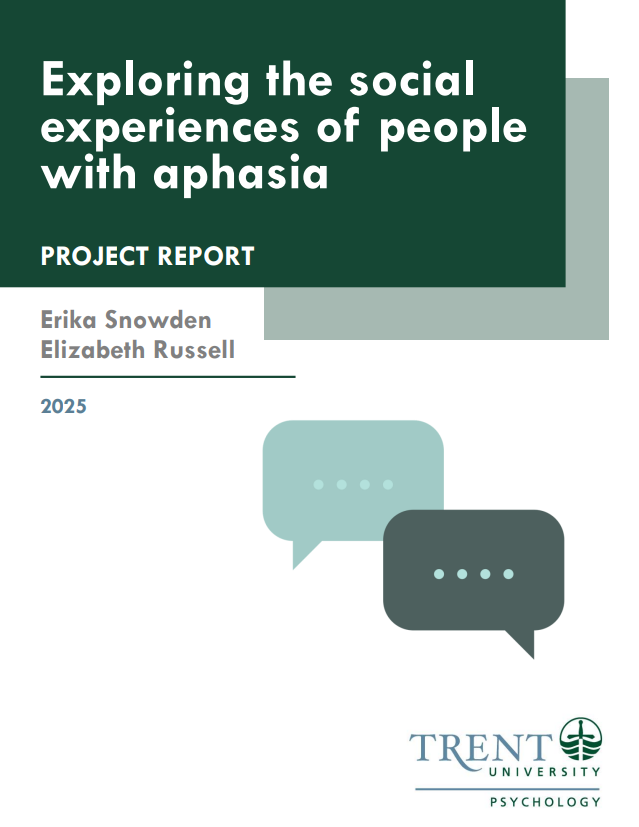
Exploring the social experiences of people with aphasia: Project Report
Authors: Erika Snowden and Elizabeth Russell (2025)
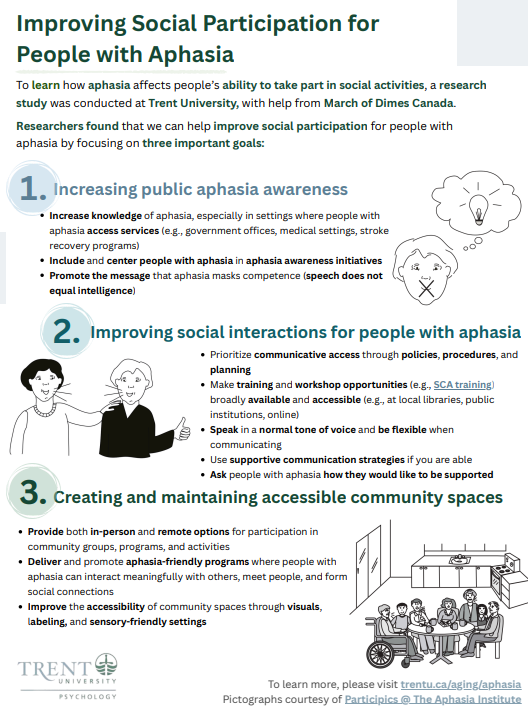
Improving social participation for people with aphasia: Recommendations poster
Authors: Erika Snowden and Elizabeth Russell (2025)
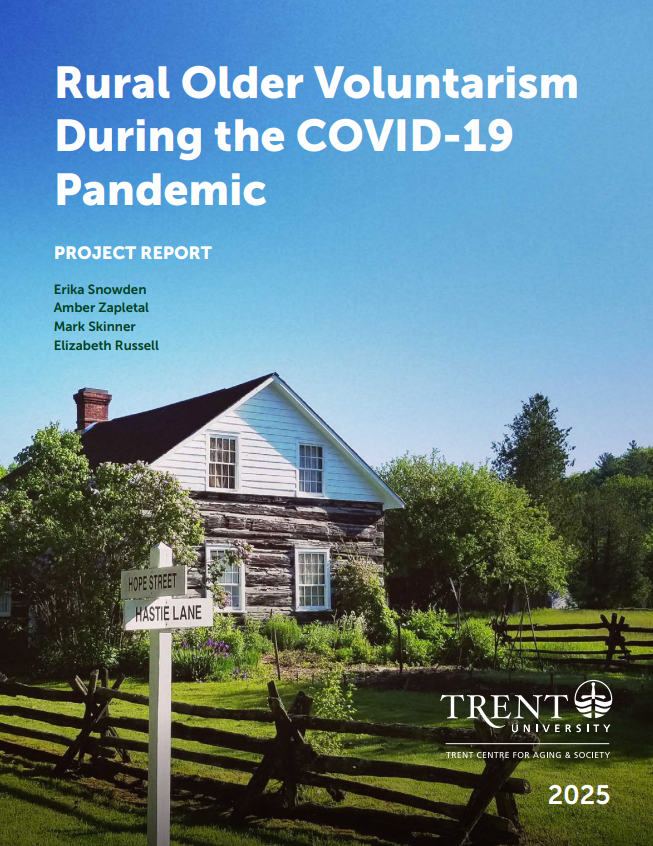
Rural older voluntarism during the COVID-19 pandemic: Project report
Authors: Erika Snowden, Amber Zapletal, Mark Skinner, Elizabeth Russell (2025)
Videos
Intergenerational classroom capstone video
Intergenerational classroom video playlist
Housing alternatives for older Canadians: Abbeyfield House Society of Lakefield
Radio Interviews
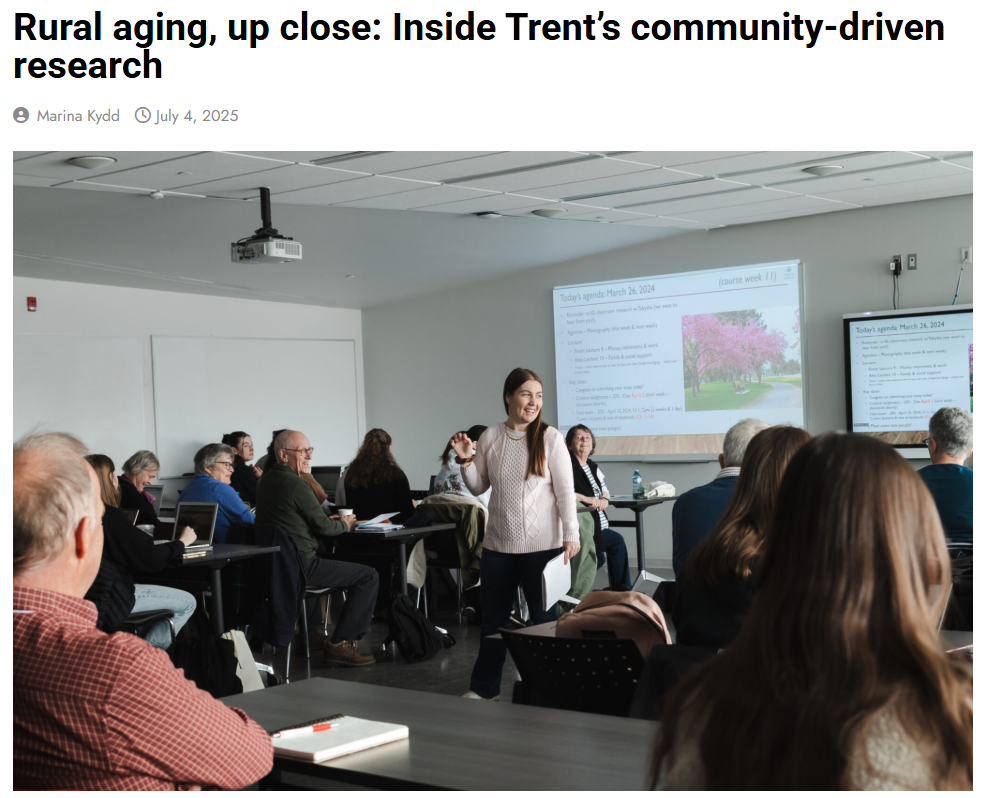
Rural aging up close: Inside Trent's community-driven research
Marina Kydd, Trent Radio | July 2025
Seniors return to the classroom at Trent University
Nav Nanwa, CBC Ontario Morning | June 2025
Peer-Reviewed Publications
Wells, T., & Russell, E. (2025). “I’ve Got a Lot of Other Things I Do”: The Nuances of Digital Engagement among Older People. Canadian Journal on Aging/La Revue canadienne du vieillissement, 44(1), 41-51. https://doi.org/10.1017/S0714980824000266
Russell, E. (2024). Rural places and aging: Between aging in place and stuck in place. In Handbook on aging and place (pp. 277-292). Edward Elgar Publishing. https://www.elgaronline.com/edcollchap/book/9781802209983/book-part-9781802209983-26.xml
Holland, M. R., & Skinner, M. W. (2025). Rural family carer health work and ageing at home in New Brunswick, Canada. Journal of Rural Studies, 114, 103541. https://doi.org/10.1016/j.jrurstud.2024.103541
Poulin, L. I., Colibaba, A., Skinner, M. W., Balfour, G., Byrne, D., & Dieleman, C. (2023). Lost in transition? Community residential facility staff and stakeholder perspectives on previously incarcerated older adults’ transitions into long-term care. BMC Geriatrics, 23(1), 180. https://doi.org/10.1186/s12877-023-03807-3
Zapletal, A., Wells, T., Russell, E., & Skinner, M. W. (2023). On the triple exclusion of older adults during COVID-19: technology, digital literacy and social isolation. Social Sciences & Humanities Open, 8(1), 100511. https://doi.org/10.1016/j.ssaho.2023.100511
Russell, E., Thériault, É. R., & Colibaba, A. (2022). Facilitating age-conscious student development through lecture-based courses on aging. Canadian Journal on Aging/La Revue canadienne du vieillissement, 41(2), 283-293. https://doi.org/10.1017/S0714980821000246
Russell, E., Skinner, M. W., & Fowler, K. (2022). Emergent challenges and opportunities to sustaining age-friendly initiatives: Qualitative findings from a Canadian age-friendly funding program. Journal of aging & social policy, 34(2), 198-217. https://doi.org/10.1080/08959420.2019.1636595
Colibaba, A., Russell, E., & Skinner, M. W. (2021). Rural volunteer fire services and the sustainability of older voluntarism in ageing rural communities. Journal of Rural Studies, 88, 289-297. https://doi.org/10.1016/j.jrurstud.2021.08.016
Colibaba, A., Skinner, M. W., & Russell, E. (2021). Rural aging during COVID-19: A case study of older voluntarism. Canadian Journal on Aging/La Revue canadienne du vieillissement, 40(4), 581-590. https://doi.org/10.1017/S0714980821000386
Russell, E., Skinner, M. W., & Colibaba, A. (2021). Did we expect too much of rural age-friendly initiatives? Studying the sustainability and scope of a rural Canadian age-friendly program. Journal of Rural and Community Development, 16(2). https://journals.brandonu.ca/jrcd/article/view/1871