
Rare Dolphins of Taiwan Get a Helping Hand from Trent Scientists
A team of Trent University scientists are part of an international effort to save the few remaining pink-coloured Indo-Pacific humpback dolphins found along coastal waters of Taiwan.
 Renowned for their illuminating work with the highly endangered North Atlantic right whale, biology professor and Canada Research Chair in Conservation Genetics and Biodiversity Dr. Bradley White, along with Ph.D student Brenna McLeod and post-doctoral fellow Dr. Tim Frasier have spent the last year studying the genetics of the dolphins in Trent’s DNA labs. Their research is essential in determining if the few animals found on the west coast of Taiwan are distinct from those found off the coast of Hong Kong and in other Chinese waters.
“The genetic data showed that these dolphins are a distinct population,” explained Dr. White. “Now the issue becomes how many there are. Present estimates indicate there are only around 100 left. This small number of a distinct and isolated population would allow designation as a highly endangered population.”
Trent’s team joined other dolphin experts from around the world in September 2007 in Taiwan to evaluate the results of recent research projects in the second International Symposium and Workshop on the Conservation and Research Needs of the Indo-Pacific Dolphins. The goal of this workshop was to scientifically evaluate the dolphins’ status as a distinct population so it can be added to the endangered list managed by the International Union for the Conservation of Nature (IUCN).
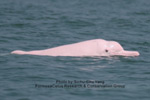 Unique for their pink skin colouring, Indo-Pacific humpback dolphins were discovered in 2002 living in the Taiwan Strait by Dr. John Wang, a biologist with the National Museum of Marine Biology and Aquarium of Taiwan. Dr. Wang has been examining their skin pigmentation to determine if the dolphins are an isolated group and will also be presenting his research at next month’s symposium.
“If the IUCN accepts our findings, then it will assemble an international group of dolphin experts to produce a conservation strategy in the hopes of pressuring the Taiwanese government to protect their habitat,” said Dr. White.
The dolphins’ preferred habitat is the warm shallow waters along Taiwan’s west coast, which brings them into close range of one of the region’s most seriously polluted areas. Scientists at the conference identified five major threats to the dolphins: reduced river flow into estuaries, habitat loss (e.g., due to land reclamation), entanglement in fishing gear, industrial, agricultural and municipal pollutant discharges, and underwater noise.
Dr. White joined the international marine science community in drafting an action plan that called for immediate measures to be taken to save the remaining dolphins and restore them to long-term viability. The action plan states that “it is important to avoid viewing the plight of these dolphins as an isolated concern of little relevance to the everyday life of the people of Taiwan. As fellow mammals, the dolphins should be regarded as sentinels of
environmental health in coastal waters and estuaries, living as they do at the interface between land and sea. Stopping environmental neglect and abuse, and indeed reversing the trend towards deterioration and loss, is as urgent for the people and other organisms living along Taiwan’s west coast and in the watersheds flowing into the Taiwan Strait as it is for the dolphins.”
Key steps in the action plan include prohibiting the use of gill nets and trammel nets in the dolphin habitat, mitigating further development projects along Taiwan’s western coast, and evaluating the impact on dolphins of water resource management projects, noise-generating activities, and pollution point-sources.
Dr. White and his team see their DNA work as part of the broader issue of determining who is ultimately responsible for the environmental degradation of threatened species. “I am deeply concerned about the level of carbon dioxide emitted in the production of plastics. Southeast Asia is home to some of the world’s largest plastic factories supplying many of the consumer goods sold here in Canada,” said Dr. White. “The next time you go to a store to buy plastic, think about where it originated and the impact these industries have on the coastal habitat of the highly threatened humpback dolphin.”
The complexities of this issue are far-reaching. “Are Canadians responsible for the plight of the dolphin? These are interesting issues in a globalized world,” noted Dr. White.
Dr. White holds a Canada Research Chair in Conservation Genetics and Biodiversity at Trent University and is the director of the Natural Resources DNA Profiling and Forensic Centre.