














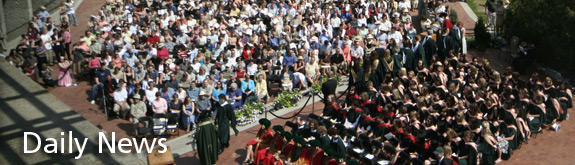

“From Indian Residential School to Truth and Reconciliation,” the two-day conference held in May 2012 at Trent University brought together residential school survivors, church representatives, and members of the Truth and Reconciliation Commission of Canada.
Keynote speaker, Mr. James Bartleman, former lieutenant governor of Ontario, linked residential schools to a systemic series of injustices towards First Nations people in his talk. He also spoke of his significant experiences travelling to native communities – and of bearing witness to the ruinous effects of the injustices on native populations. After his address, Mr. Bartleman pointed out that there is hope.
“There is a developing middle class in Native society,” he said. “And that is helping. There are success stories. When young people are given an opportunity, they do better, but these opportunities need to exist.”
Curve Lake artist and residential school survivor, Mr. Freddie Taylor, called the conference an opportunity for healing.
“People need to find ways to healing,” he explained. “We all heal in different ways and the experience that we victims have been through is painful -- traumatizing. My experiences with residential school made me sick.”
Organized by the Kawartha Truth and Reconciliation Support Group and the local non-profit Niijkiwendidaa Anishnaabekwewag Services Circle, the conference also attracted a sizeable number of church representatives – both leaders and congregation members.
United Church general council officer, Mr. James Scott, said of the conference, “This stems from years of spadework – preparatory work – of people saying that we need to know about this part of our history – that it needs to be taught and that we need to know more about the people who are living right beside us. It’s not a one-shot deal. It is part of a process.”
Truth and Reconciliation Commission of Canada Commissioner, Ms. Marie Wilson said, “During my address, I asked audience members to stand up if this was their first truth and reconciliation experience and approximately half of the people in attendance stood. I find this very encouraging. People are showing a willingness to learn. They are showing a willingness to invest in themselves and their own awareness and understanding.
“There is an interesting and important demographic mix present here,” she said. “Any event that allows and creates a safe space for people who have never met before to sit and talk to each other – and to listen to each other – is a very good step forward. I saw this happening in the larger talks, and in the smaller workshops. I’m excited and encouraged by it. These are the nuggets of hope that we need to see – and are increasingly seeing across the country.”
According to conference organizer and Niijkiwendidaa Anishnaabekwewag executive director, Ms. Liz Stone, the weekend was aimed towards a wide audience – not just residential school survivors.
“We set out to educate the public,” she explained, “to have them hear actual stories – real truths – about what happened. We wanted to present the words and memories of people who were involved, both aboriginal and non-aboriginal.”
“People need to understand that this isn’t just an Indian issue,” she stressed. “It is a community one – a Canadian one.”
Posted on Tuesday, May 15, 2012.