
















 Trent University’s Women’s Studies program hosted its fourth annual “Research Day” event on March 14 to an engaged audience of 30 guests.
Professors, associated community researchers and upper year students presented their new scholarship looking at women’s experiences from the perspectives of many different disciplines, including Canadian studies, education and sociology.
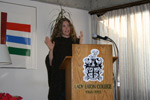
In her narrative presentation of junior high school social ritual entitled “Pretty”, Professor Karleen Jiménez explored the stressful results of systemic gender enforcement for those students with nonconforming gender expression. At an age when most children face changing hormones and accompanying social insecurities, Prof. Jiménez examined the specificity of living as a boyish girl. In addition, she addressed the perils of language and labeling through the (de)construction of the term “pretty" in the context of adolescent experience.
The event also featured Ph.D candidate Caroline Langill’s recent research into the emergence of women as new media artists in the late 1980s and early 1990s in Canada. She explained how electronic media artworks are active agents beckoning us, as viewers of art, to interact with them. They demand our attention, behaving badly in the gallery, making noise and generally causing panic for museums and their staff. Through her illustrated talk, Ms. Langill showed how women approached the field quite differently from men, using the material agents they produced to create social networks that included the artist, the artwork, and the audience.
Another highlight was Philosophy Professor Moira Howes’ presentation discussing the view held by some advocates regarding the benefits of menstrual suppression in girls and women. She explored the reasoning used by those who state that menstruation is non-functional and thus can be eliminated without causing harm. She argued that the active management of ignorance in functional analyses of menstruation is connected intimately to value-laden reasoning. In conclusion, Prof. Howes stated that in order to understand the certainty with which health professionals and scientists advocate menstrual suppression, we must first understand how ignorance is managed in value-laden biological contexts.
Rounding out the day were presentations on racism, sexism and gender discrimination in Peterborough by upper year students Linzy Bonham and Andres Salazar; Sociology Professor Momin Rahman’s reflections on migration, gender and modern Muslim identity; Sociology Professor Deborah White’s look at medical forensic evidence and sexual assault cases; and a fascinating discussion about gender segregation in beverage service by Canadian Studies Professor Melanie Buddle.
Women's Studies explores gender relations and women's lives throughout history, across cultural, religious, political and economic divides, and in every site of human interaction.
Posted on Tuesday, March 18, 2008.