
|
 |
 |
|
|
|
|
||
"How we live in the world" |
||
Trent's success in the social sciences and humanities Politics. Gender. Citizenship. Culture. Personal experience. Context. Imagination. Understanding. What would our lives be without these concepts and the discussions they inspire? "The world would be unimaginable -- and I mean this literally -- without the frameworks of thought and perspectives bestowed to us by the legions of researchers in the social sciences and humanities," says Dr. Winnie Lem, professor of International Development Studies at Trent University. Prof. Lem is one of several Trent researchers successful in attracting grants from the Social Sciences and Humanities Research Council (SSHRC) this year. In total, Trent University was the recipient of close to half a million dollars in SSHRC funding in 2004 alone, contributing to Trent's place as "Research University of the Year" for the second year in a row. This is the funding that fuels the scrupulous research behind academic papers, conferences and books, many of which might appear to remain in the academic arena but, in fact, shape everything from government policy and worldwide media commentary to dinner table discussions in the homes of average Canadians. Be they the topics of headline news or enduring metaphysical questions, these are subjects close to the heart and the intellect, and often close to the bone as well. Inquiries in the social sciences and humanities make up a significant portion of the research activities at all universities, and especially at Trent. The research of Prof. Lem provides an apt example. Her work focuses on Franco-Chinese transmigrants -- migrants from east and south-east Asia and how they make a living in Europe. With a focus on citizenship, national and transnational relations as they apply to Chinese immigrants in Europe, Prof. Lem sees her work connecting to debates the world over. "In the context of Europe and the efforts that are being made to create borderless countries within the European Union, vigorous debates exist over the kinds of policies that should be in place over admitting or excluding migrants," she says. "The research is directly connected to the many debates that are taking place over immigration both in civil society and in the circles of government."
And questioning is at the heart of the matter. Especially for Dr. Julia Harrison, Anthropology professor and chair of Women's Studies at Trent University. Her current research sees her posing a lot questions -- and doing a lot of listening -- as she gathers qualitative data on the meaning of the Ontario cottage experience. "At the broadest level, I am prompted to try to understand why one cottager would emphatically say to me, 'my cottage is everything,'" she says. Far into the future, what people come to understand about the nature of the cottage experience and its emotional context in 20th and 21st century Canada will have been informed by the work of Prof. Harrison.
If a literary work can tell us much about the morals and values of a certain time and place, Dr. Suzanne Bailey of the department of English is wondering what other secrets can be unlocked, in this case, through the poetry of nineteenth century poet Robert Browning. She is interested in exploring what the poet's later career can tell us about aging and the final stages of the creative artist's career.
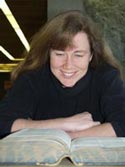
Photos below: Prof. Suzanne Bailey and Prof. Fiona Harris- Stoertz
|
||
Return to Trent
University Home |
||
 |
| |





 Another Trent professor whose work is connecting with global political
issues is Political Science professor Dr. Mark Neufeld (right). His research
investigates whether the "so-called 'anti-globalization movement' is
transforming itself into a less ad-hoc, more organized political force
for change." A hot topic, indeed. Having taught a full term on
globalization in his first-year Introduction to Politics course, Prof.
Neufeld found that discussions of the anti-globalization movement
provoked more questions than answers.
Another Trent professor whose work is connecting with global political
issues is Political Science professor Dr. Mark Neufeld (right). His research
investigates whether the "so-called 'anti-globalization movement' is
transforming itself into a less ad-hoc, more organized political force
for change." A hot topic, indeed. Having taught a full term on
globalization in his first-year Introduction to Politics course, Prof.
Neufeld found that discussions of the anti-globalization movement
provoked more questions than answers.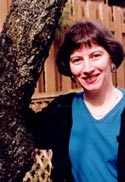 Present and future implications always have connections to the past and,
in two separate research projects, the medieval past is playing a large
role. A member of the History department at Trent, Dr. Fiona
Harris-Stoertz is looking at pregnancy and childbirth in the high Middle
Ages, a subject which touches the hot button topics of the
medicalization of pregnancy, breastfeeding, abortion, and birth control.
English professor Dr. Joanne Findon's (left) medieval focus puts her in touch
with the sometimes controversial biblical figure of Mary Magdalene.
Prof. Findon's research zeros in on a late medieval play where the
pivotal role of Mary Magdalene reflects issues around women's speech and
popular medieval romance.
Present and future implications always have connections to the past and,
in two separate research projects, the medieval past is playing a large
role. A member of the History department at Trent, Dr. Fiona
Harris-Stoertz is looking at pregnancy and childbirth in the high Middle
Ages, a subject which touches the hot button topics of the
medicalization of pregnancy, breastfeeding, abortion, and birth control.
English professor Dr. Joanne Findon's (left) medieval focus puts her in touch
with the sometimes controversial biblical figure of Mary Magdalene.
Prof. Findon's research zeros in on a late medieval play where the
pivotal role of Mary Magdalene reflects issues around women's speech and
popular medieval romance.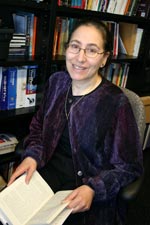 Language and culture are defining attributes of the human experience
and if anyone knows this, it's Dr. Lynne Davis (right) of Trent's Native Studies
department. As principal investigator on the Alliances Project, she is
looking at the relationships of Aboriginal peoples to social movement
organizations. With an interest in social justice, women, labour,
environmental groups and Aboriginal self-determination, the three-year
study "will examine what works well in relationships, what tensions
exist and how they are negotiated, and what lessons people have learned
from entering into coalitions and alliances," says Prof. Davis. "As the
principal investigator, it is my responsibility to ensure that what
people have shared is disseminated widely to others who can learn from
their experiences."
Language and culture are defining attributes of the human experience
and if anyone knows this, it's Dr. Lynne Davis (right) of Trent's Native Studies
department. As principal investigator on the Alliances Project, she is
looking at the relationships of Aboriginal peoples to social movement
organizations. With an interest in social justice, women, labour,
environmental groups and Aboriginal self-determination, the three-year
study "will examine what works well in relationships, what tensions
exist and how they are negotiated, and what lessons people have learned
from entering into coalitions and alliances," says Prof. Davis. "As the
principal investigator, it is my responsibility to ensure that what
people have shared is disseminated widely to others who can learn from
their experiences."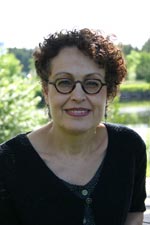 As Prof. Harrison (left) says, "Life is about what we study in the social
sciences and humanities.
To improve the world we live in requires an in-depth understanding of
how we all live in
the world." 
As Prof. Harrison (left) says, "Life is about what we study in the social
sciences and humanities.
To improve the world we live in requires an in-depth understanding of
how we all live in
the world." 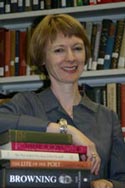
 Posted December 16, 2004