BOOKS
Argentina-Canada connection
Trent's Frost Centre and the Universidad Nacional de Mar del Plata recently published a book, Es
Igual Pero Distinto: Essays in the Histories of Argentina and Canada, co-edited by David
Sheinin (History) and Carlos A Mayo. The 324-page book is the first co-publication with an
Argentine university and explores a range of comparative themes.
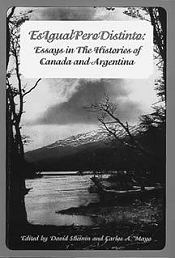 Argentina and Canada, you say? Sheinin and Mayo found fertile ground for comparison in their separate but apparently parallel histories. Central governments consolidated power in the latter 19th century to counter external economic and political threats. They began nation-building in
earnest after the First World War. Their railways transported bounties of wheat, corn and livestock
from vast plains to export markets and helped them become rich. They both conquered native
peoples to emerge rich. Their urban centres grew with a healthy middle class into thriving,
culturally rich cities with incumbent social problems. All of this, says Sheinin in his introduction,
makes the comparison intriguing and pertinent as more free trade agreements are discussed. Argentina and Canada, you say? Sheinin and Mayo found fertile ground for comparison in their separate but apparently parallel histories. Central governments consolidated power in the latter 19th century to counter external economic and political threats. They began nation-building in
earnest after the First World War. Their railways transported bounties of wheat, corn and livestock
from vast plains to export markets and helped them become rich. They both conquered native
peoples to emerge rich. Their urban centres grew with a healthy middle class into thriving,
culturally rich cities with incumbent social problems. All of this, says Sheinin in his introduction,
makes the comparison intriguing and pertinent as more free trade agreements are discussed.
Among the Trent professors and graduate students who contributed essays are James
Struthers (Canadian Studies, History), Jonathan Bordo (Cultural Studies), 1996 Governor
General's Gold Medal winner Susan Hynds, Joan Sangster (History) and retired history
professor Bruce Hodgins. The book was designed with help from Trent graphic designer
Richard Miller.
Highland history
Tuckwell Press in Edinburgh, Scotland recently published The Kingdom of the Isles: Scotland's
Western Seaboard, c.1100-c.1336, by Trent alumnus and part-time history instructor Andrew
McDonald.
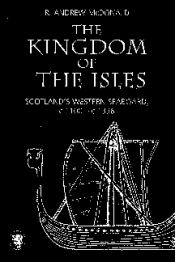 The book focuses on a period largely neglected and a region -- the Hebrides, Argyll and the
Isle of Man -- regarded as peripheral in the Scottish kingdom. It is the first survey of its type in
over 50 years, says the author, and grew out of his 1993 doctoral thesis on aristrocratic
interactions in the Anglo-Norman era. McDonald describes the formation of the area as a kingdom,
its rulers -- Somerled and his descendents, the MacDougalls, MacDonalds and MacRuairis -- and
the relations among the isles, Scotland, Norway and England. He concentrates on political and
social changes and touches upon the influence of the church and monasticism. Black and white
photos show some of the castles, monasteries and churches still standing from the era. The book focuses on a period largely neglected and a region -- the Hebrides, Argyll and the
Isle of Man -- regarded as peripheral in the Scottish kingdom. It is the first survey of its type in
over 50 years, says the author, and grew out of his 1993 doctoral thesis on aristrocratic
interactions in the Anglo-Norman era. McDonald describes the formation of the area as a kingdom,
its rulers -- Somerled and his descendents, the MacDougalls, MacDonalds and MacRuairis -- and
the relations among the isles, Scotland, Norway and England. He concentrates on political and
social changes and touches upon the influence of the church and monasticism. Black and white
photos show some of the castles, monasteries and churches still standing from the era.
This is the fourth in Tuckwell's series called Scottish Historical Review Monographs and is
listed by England's Ancient and Medieval History Book Club and in Barnes and Noble catalogue.
McDonald became interested in Scottish history during his undergraduate years, but it
wasn't until he started writing that "my captivation with the west highlands and islands was
heightened by several trips during the course of my research."
He graduated from Trent in 1988, did an MA at McMaster University and a PhD at Guelph
University. He has been teaching at Trent and the University of Toronto since 1993 and just won a
teaching excellence award from U of T's school of continuing studies. He completed the book last
year while don at Otonabee College.
Back to the Fortnightly Front Page
| 
