
















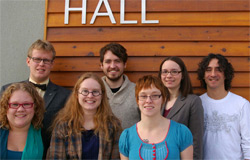
 Trent University students gathered to present and discuss works on the Bayeux Tapestry at Traill College on Friday, December 3 2010. A total of seven papers were presented by undergraduate and graduate students, each exploring an aspect of the Tapestry’s history, meaning, and cultural impact as part of Dr. Sarah Keefer’s English course entitled decoding the Bayeux Tapestry, (ENGL 5103H/41401H).
 The Bayeux is a 69-meter-long embroidered cloth depicting the lead up to the Norman invasion, as well as the invasion itself. It is an essential narrative artwork for those studying the early medieval period.
Symposium subjects ranged from the physical creation of the tapestry to its historical and thematic make-up. Presenters were made up of students in an Honours-level medieval course and M.A. students in English literature and public texts.
Professor Zailig Pollock, director of the Public Texts M.A. Program, provided a welcome for the event. “The tapestry is perfectly suited for what we should be discussing in public texts,” he said. “It is a text that has enjoyed a tremendous public life. Despite the fact that many people have no knowledge of Old English, they do find the tapestry accessible.”
Addressing the students, he showed his admiration for what they had achieved in organizing the colloquium. “I am really struck by the range of approaches, and the commitment to academics.”
Professor Sarah Keefer had been working closely with the student presenters and was also most impressed.
“Everything has been arranged for and by the students,” she said. “From the framing of ideas, to the creation of the papers, to planning of the event itself. They have taken great pride in this day and they should be very proud.”
During her introduction to the colloquium, she spoke of the students’ dedication to the project. “You have no idea how much work the students put into this,” she explained. “I cannot adequately express the pride I have in these students.”
Her pride was well placed. Each paper delivered new highlights, with speakers showing some early academic polish.
“It was nerve-wracking,” admitted Cara Moynes after her presentation on the construction of the Tapestry. “But it was great to get the opportunity to present on something I have an interest in.” As a knitter and sewer, Cara brought her real-life knowledge of textiles to her academic pursuit.
Philip Benmore also felt some nerves during his presentation, but was proud to be a part of the event. “There are some incredible papers being presented here today,” he said. “And it is incredible to see what we students were able to come up with.”
Professor Keefer summed up the value of such events: “These are important skills that the students are gaining,” she said. “Whether you are going on to further academic study or going into another area of employment, the ability to organize your thoughts and words into a formal delivery is essential.”
“I believe in putting possibilities in front of students,” she admitted. “And it is wonderful to see them actualize those possibilities."
The following papers were delivered during the colloquium:
“The Bayeux Embroidery: A Medieval Construction” by Cara Moynes, (ENGL4101H)
“One of These Things is Not Like the Other: the Politics of Facsimile in the Bayeux Tapestry” by Philip Benmore, (ENGL4101H)
“Romanesque Column Capitals and the Bayeux Tapestry's Upper Border” by Matthew Ryan, (Public Texts)
“Aesop’s Fables and The Bayeux Tapestry” by Rhiannon Wicks, (English 4101H)
“What Are You Pointing At? Hand Gestures in the Bayeux Tapestry” Sarah Miller, (Public Texts)
“You Only Die Twice: The Myth of the Twin Harolds in the Bayeux Tapestry” by Stephanie Small, (Public Texts)
“What Lies Outside” by Michael Morton, (Public Texts)
Posted on Monday, December 6, 2010.