















 Foreign affairs, fragmented narratives in Canadian fiction, and the impact of such figures as Romeo and Juliet, Pocahontas and Batman on literature and society were all topics of discussion during the inaugural Trent University in Oshawa Research Day held on April 13, 2010.
 More than 40 people, including faculty members from both the Peterborough and Oshawa campuses, along with Trent in Oshawa students and staff, and local community members, attended the dynamic event which featured presentations from Oshawa faculty and undergraduate students.
“The goal of Oshawa Research Day is for students and faculty to share their work and ideas and to celebrate faculty and student achievements,” said Dr. Rita Bode, associate dean of Trent University in Oshawa. Professor Bode said she was thrilled with the day and the positive response she received from the entire Trent in Oshawa community.
Foreign Affairs, Domestic Impacts
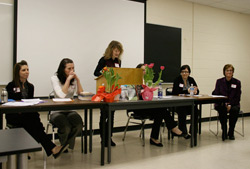
The day of presentations got underway with a panel entitled “Foreign Affairs and Other Canadian Activities.” Featured on the panel moderated by Professor Sheilagh Knight were Spanish Professor Rita Granda and renowned History professor and author Dr. Robert Wright.
Prof. Granda’s presentation focused on the lives of “two little-known western revolutionary figures” – Flora Tristan and Magda Portal – and the connections between them. Flora Tristan is described as a “utopian visionary” and is considered to be a pioneer feminist who was dedicated to fighting for social justice and the rights of the working class in the early 1800s. “She continues to influence those interested in social justice,” Prof. Granda said, explaining that one person Flora Tristan influenced most was Magda Portal, a renowned political activist in the 20th century. Magda Portal published her studies of Flora Tristan in the book Flora Tristan, Precursora. The book was published in 1944 in French and translated into Spanish in 1983. Joining Prof. Granda on the panel was Renée Castro-Pozo, editor of Flora Tristan, Precursora and a close personal friend of Magda Portal. “We feminists are very proud to have Magda as our torchbearer,” Ms. Castro-Pozo said. In 2010, Prof. Granda and Ms. Castro-Pozo join forces to introduce Flora Tristan, Precursora to an even broader audience with the release of the English translation of the book.
Continuing the foreign affairs theme, History professor Dr. Robert Wright, delivered an engaging presentation entitled “Sharing Intelligence: Canadian Diplomacy and the CIA,” in which he discussed his three books to date – the first two dealing with the relationship between Canada and Cuba and the third, Our Man in Tehran, which has garnered international attention. Our Man in Tehran, which was released in 2009, makes public for the first time that Canadian Ambassador Ken Taylor was made a CIA agent in Tehran when 63 Americans were being held hostage by students in the US Embassy. After receiving international attention for his latest book, Professor Wright is currently researching an idea for a new book that challenges previous knowledge and assumptions about the Canadian-Cuban relationship.
Fragmented Narratives and Families
Demonstrating the research of students as well as faculty in Oshawa, Research Day continued with a panel on Canadian fiction featuring four outstanding undergraduate students. During the panel, entitled “Storytelling and Writing the Absence into Presence: Fragmented Narratives and Families in Recent Canadian Fiction,” the panellists, all English majors set to graduate in June, each read from essays submitted this past semester.
Maura Taylor, who will be going on to pursue a master’s in education in the fall, and Natalie Forest, a part-time student who has been taking classes at Trent in Oshawa since 2002 and will also be pursuing a master’s degree next year, both presented their papers comparing Frances Itani's Leaning, Leaning Over Water and Miriam Toews' A Complicated Kindness. Ms. Taylor explored the relationship between mothers and daughters in the books and the theme of the female search for identity while Ms. Forest examined father-daughter relationships and the re-positioning of those traditional roles in the books.
Jennifer Falconer and Lindsay Timmons, who are also both moving on to post-graduate studies in the fall, shared their essays on Daphne Marlatt's Ana Historic and Hiromi Goto's A Chorus of Mushrooms. Ms. Falconer delved into the postmodern works and demonstrated how the books reverse cultural stereotypes, challenge expectations, and defy standard codes of identity. Also highlighting the postmodern aspects of the two novels, Ms. Timmons shared her thoughts on how the books “rewrite the dominant discourse around the female immigrant experience.”
Chaired by History professor Dr. Jennine Hurl Eamonn, the panel also featured the students’ English professor Dr. Margaret Steffler as a respondent.
Exploring Figures of an Age
The final panel of the day featured three Trent in Oshawa professors from the English Department – Drs. Tim Drake, Sara Humphreys and Joel Baetz – who kept the audience engaged with their presentations on various “Figures of their Age” including Romeo and Juliet, Pocahontas and Hannah Duston, and Batman.
Professor Drake, who studies the Renaissance and Shakespeare and is looking for what makes them both so special, found his answers in Romeo and Juliet. “My contention is that in reading Shakespeare, the new ethic of sincerity both frames and conditions the actions of Shakespeare’s arguably most famous play,” he said, highlighting how Romeo and Juliet is the first play to truly deal with the concept of sincerity and helped spark the cultural trend of speaking frankly and discussing ones feelings openly and candidly. “It is a new idiom for expressing the trues of the heart and was unlike any language that had been uttered on the stages of Renaissance literature until that time,” he said.
In her presentation, entitled “Kitschy Commemorations and Dime-a-Dozen Artifacts: Why Literary “Things” Matter,” Professor Sara Humphreys, gave the audience a glimpse into her research which combines material culture and literary study. Showing off some pieces from her collections of historical and literacy artifacts, including a 1973 whisky decanter in the form of a monument to Hannah Duston, a 17th Century captive who escaped and scalped her band of Native capturers and a small figurine of Pocahontas as fertility figure, Prof. Humphreys said that many people “underestimate the power of literary artifacts.”
Rounding out the day was Professor Joel Baetz who discussed the many lives of Batman and how “comics aren’t just for kids anymore.” Although Prof. Baetz’s specialization is in war poetry and his latest project looks at war poetry written by women, his presentation explored the lighter side of his research he started exploring while writing his dissertation. “To read American comics is to encounter American concepts of race, civilization, politics, and more,” he said, discussing how the various versions and adaptations of Batman over the years in comics have reflected trends in society at the time. Prof. Baetz focused particularly on the 1987 release of The Dark Knight Returns by Frank Miller, “a pivotal, landmark text that changed the superhero story.”
In addition to the presentations, Trent in Oshawa Research Day also featured a poster display by psychology students Paul Seli and Trista Whitehead, and a book and article display of faculty publications.
Commenting on the day of activity, community member and former Trent in Oshawa student Liz Brighton said, “I am absolutely thrilled to be here. And I’m glad to see so many other people out as well. This is important work.”
Posted on Wednesday, April 14, 2010.