















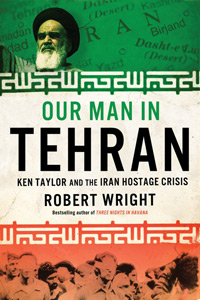
 In newspapers across the country, Trent University history professor Dr. Robert Wright is gleaning a lot of attention for his recently released book Our Man in Tehran: Ken Taylor, the CIA and the Iran Hostage Crisis.
With such headlines as “Trent Professor Blows Open Spy Secret,” “Shocking Spy Revelations” and “Hero Canadian Diplomat a CIA Spy,” no one was more surprised to see such national media attention than Professor Wright himself.
“This book was never intended as an exposé,” says the Trent University in Oshawa professor. “This is a history book.”
The “big secret” that Canadian Ambassador Ken Taylor was made a CIA agent in Tehran as a result of the seizure of the US Embassy in 1979 was not really a secret at all, says Prof. Wright. “It was kept quiet. Filmmakers and journalists more intrepid than I were onto it. Any enterprising graduate student could have picked up on this,” he adds modestly.
According to Prof. Wright, the reason he was able to access a lot of the previously unearthed information was simply that he went looking for it. It was also the right time – 30 years after the fact. “For historians, the closer to the present you get, the worse the sources are,” says Prof. Wright. “I was the first to see many newly-opened cable documents from communications between the Ottawa and Tehran embassies.”
In Our Man in Tehran, Prof. Wright details the activities of Ken Taylor during his time in Tehran when 63 Americans were being held hostage by students in the US Embassy. Six American ambassadors were hidden by Taylor and an immigration counsellor in their residences. These were known as “The Houseguests.”
As the de facto CIA station chief, Taylor sent intelligence cables to the US Ambassador via the Canadian External Affairs Office in Ottawa. This was instrumental in aiding the Americans’ rescue plans in a Pentagon operation called Eagle Claw. After 30 months, and having expedited the Houseguests to safety, Taylor and his team closed the Canadian embassy and left the premises. The 63 hostages were released after a total of 444 days. An Excerpt from the book gives an idea of the circumstances:
Taylor's daily intel cables continued to stream into Ottawa and Washington until the day he left Tehran. It was extremely dangerous work – far more risky than passing information to Bruce Laingen [imprisoned U.S. chargé d'affaires in Iran] or even harbouring the fugitive American diplomats. If at any point in the first three months of the hostage crisis the houseguests had been discovered, Taylor and his staff would likely have been pronounced personae non gratae by the Iranian government and expelled from the country. If, on the other hand, the ambassador had been found running a CIA operation out of the Canadian embassy – in aid of a planned U.S. military strike against Iran – the consequences would have been incalculably worse.
Canadian diplomatic history in the 1970s is the primary area of interest in Prof. Wright’s research. His last book, the national bestseller Three Nights in Havana, which provides commentary around a visit Prime Minister Pierre Trudeau paid to Cuban President Fidel Castro in 1976, won the 2008 Canadian Author’s Association Lela Common Award for Canadian History.
As an associate professor of History at Trent in Oshawa, Prof. Wright also specializes in Canadian history, and foreign policy and sovereignty issues. One of Prof. Wright’s courses, Canada, the United States and the National Security State, emphasizes how the gathering and sharing of domestic and foreign intelligence can influence the making of public policy. The course also explores the relationship between democracy and secrecy and the relationship of culture to the national security state, including propaganda, mass media and education. Prof. Wright says he is considering adding Our Man in Tehran to the syllabus, “to the extent that it may interest the students.”
Always keen to involve his students in his research, Prof. Wright led a team of graduate and undergraduate students of Cuban and North American Relations in a trip to Havana for the National Conference of Canadian Studies in February of 2009. The group found themselves there on the historic day Fidel Castro retired. During this exciting time, Prof. Wright provided his students with an opportunity to present their research and to participate in various activities organized by the Canadian Embassy and the University of Havana.
Posted on Thursday, January 28, 2010.