















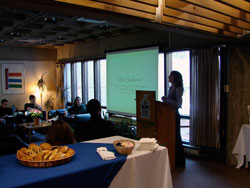
 Soldiers’ sex lives and working women’s words of experience were explored in Lady Eaton College Senior Common Room on Friday, January 22, 2010 as Trent’s History faculty and graduate students met to present their research during the annual “Day in History” event.
Throughout the day, students, professors and members of the public listened to presentations and mingled with the researchers and shared their passion for history.
“I’m just here to soak it all in,” said Cindy Turnbull, a history buff and staff member at Trent.
“I look forward to this event every year,” said Professor Fiona Harris-Stoertz, chair of the History Department. “It’s very exciting to hear a piece of someone’s research. I’m always amazed by the links and commonalities that occur across fields of study. This year we have infiltrated other departments and have members of faculties here from not only History but Women’s Studies, Ancient History and Classics and Modern Languages and Literatures,” she added, motioning to a table full of books on display that were published in 2009 by Trent’s own faculty members, noting that though the table display was full there were several missing.
Exploring the Many Facets of History
History professor Jennine Hurl-Eamon was the first to present. “Bastardy Examinations in 18th Century London could have been instrumental in establishing the practice of parents naming their children, a responsibility that at one time rested with godparents,” she argued. Economic vs. moral motivations to having babies named after military men were discussed and challenged in the question period that followed.
“That’s a good question,” was heard more than once as eyebrows raised and academic peers pondered quandaries with one another throughout the day, raising issues about the function of Imperial decision making or sharing approaches, processes and sources of study.
Cindy Ellen Morgan, a History M.A. student, played a song of treachery and rebellion on a hand-made harp while singing Cantiga #235, originally composed at the behest of King Alfonso El Sabio, 1221 – 1284, one of the most significant leaders in Spanish history. “I am interested in the history of emotions, musicology and social psychology. When I sing the pieces and put the words into my mouth, it adds another element of consideration in my work,” said Ms. Morgan, who seeks to justify the use of the cantigas as historical source.
“This day is about putting what you have out there,” explained Carol Williams, an afternoon presenter from Women’s Studies. “Feedback from your peers gets you in tune with what you are doing.”
Professor Williams, Trent’s Canada Research Chair in Gender and Feminist Studies likened her study of the ethics of representation and Indigenous photographs to a kind of dance. When Historians use an image to illustrate their work they can reproduce interpretive mistakes of the past. “You can’t isolate one image as illustrative. A field of images gives you scope. You have to look at the field of vision.”
“What are you looking for?” asked one student of Professor Hugh Elton from the Department of Ancient History and Classics. In response, Professor Elton laughed, “a smoking gun that tells me that Euchaita was located at Beyozu,” though it’s more complicated than that. Professor Elton described the exciting interdisciplinary group work with students on the Avkat Archeological Project 2007-2009.
“It’s difficult to listen to anyone else’s work without thinking about your own,” remarked Professor Elwood Jones. “For example, the sources on Bastardy Examinations and Illegitimate children make me wonder what types of sources might exist in Peterborough for something like that.” He went on to talk about how professional historians often fail to study their local history. “Who else would write that History if I didn’t do it?” Professor Jones has just recently, through Trent Valley Archives, published his tenth book, An Historian’s Notebook: 100 Stories – Mostly Peterborough.
Full List of Presentations
The line up for the day offered a broad range of presentation topics, including:
• “Wild Soldiers? A Peep into the Sex Lives of Military Men in Eighteenth-Century London" Jennine Hurl-Eamon, Department of History
• “In Cantu Veritas: Use of the Cantigas de Santa Maria as Historical Source” Cindy Ellen Morgan, History M.A. graduate student
• “The Emperor Anastasius and the granting of civic status to Euchaita” Hugh Elton, Department of Ancient History and Classics
• “Religious men and the Acquisition of Indigenous Languages in Early Colonial New Spain” Cecilia Brain, Department of Modern Languages and Literatures
• “Puncturing history’s blindness: the ethics of representation and 19th Century Indigenous photographic portraiture” Carol Williams, Canada Research Chair in Gender and Feminist Studies
• “Ordinary People in Ordinary Places: Writing Peterborough’s Local History" Elwood Jones, Professor Emeritus, Department of History
• “Words of Experience? Reading Working Women's Letters to Canada's Royal Commission on the Status of Women" Joan Sangster, Department of History
• “The Whisky Kings: The International Expansion of Seagram, 1933-1993” Graham Taylor, Department of History
Posted on Monday, January 25, 2010.