
















 On Wednesday, December 16, faculty, students, staff and members of the Peterborough community gathered at Traill College to hear presentations at the 18th annual Humanities Research Day.
 Running the gamut from explorations of epidemic, urban poverty and cultural terror in the eighteenth century to aging masculinity and the American Dream and from Prehistoric monuments to exploring neurodiversity in Victorian literature and culture, Trent faculty and students displayed research excellence, offering thoughtful, incisive, original analysis in their chosen fields.
With a welcome by Doug Evans, head of Traill College and opening remarks from Trent’s new president, Dr. Steven E. Franklin, the day was on!
Indigenous Tradition and Perspective
Dr. David Newhouse of the Indigenous Studies department led off the day-long program with his work on the intersection of Indigenous Knowledge and the Academy. For Professor Newhouse and others, the desire to use Indigenous cultural traditions and ideas as a foundation for academic work is life-long project. Using Iroquoian motif of the longhouse, the question could be framed as how to “extend the rafters” (of the university) to recognize and include the knowledge that Indigenous peoples have created over millennia.
Prof. Newhouse concluded his talk noting that there have been incredible accomplishments in bringing Indigenous Knowledge into intellectual life at Trent, including the ability to protect and nurture the space that has been – and continues to be – created.
Also in the first session was Sima Mostofi Javid, a graduate student in Environmental & Life Sciences. Javid offered a comparative study of Indigenous and scientific perspectives regarding water resources in south-central BC
Jail Fever, Hierarchy and Victorian Artists
History Professor Kevin Siena engaged the audience in his analysis of medical and popular perceptions re: the spread of “jail fever,” an eighteenth-century pre-cursor to the Plague that had Britons judging and fearing their poorer neighbours.
Noting that roughly ten per cent of Trent students are in the International Program, and cultural awareness is integral to good pedagogy, Modern Languages & Literatures professor Sheilagh Knight shared her examination of the link between the State, immigration and the education system in producing bias in French as a second language textbooks. Citing insufficient sociological depth, she noted that Canadian education is still “skewed” by inappropriate categorizations and values, inaccurate descriptions of the Global South, and class hierarchies.
Learning disabilities and Victorian artists was the focus of English professor Suzanne Bailey’s presentation, including the thought-experiments of Sir Francis Galton and William James.
Film, Poetry and GIS Mapping
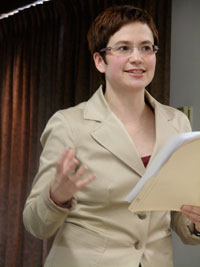
Dr. Sally Chivers of the Canadian Studies department had the rapt attention of the audience in her presentation on the ageing of the onscreen bad boy, including a deft analysis of Clint Eastwood’s role in Gran Torino. For those interested in pursuing the topic, Professor Chivers’ forthcoming book, The Silvering Screen should be a great read.
English graduate student Emily Ballantyne provided insight into her work as a genetic editor compiling a parallel text edition of P.K. Page’s Brazilian poems. From her work with Page’s manuscript, Ms. Ballantyne argues that Page’s time in Brazil was not a period of silence, but one of transformation in which the poet developed other aspects of her self and her talents.
Chelsee Arbour, a graduate student in Anthropology, spoke on the use of divergent research tools (GIS mapping and on-site study) in her exploration of the location Bronze Age and Neolithic monuments in West Penwith, UK
As the final presenter of the day, Dr. Shelagh Grant, Canadian Studies, engaged the audience in a conversation about the trials and tribulations of producing her most recent book, a comparative history of Arctic Sovereignty, Polar Imperative.
Finding a thread of commonality in the disparate presentations, in his closing remarks, English professor Dr. Zailig Pollock referred back to a question asked in response to Prof. Sheilagh Knight’s presentation about “How to critique categories without having categories yourself.” In this, Professor Pollock points to the question of truths (plural), differences, and categorization that proved a fount of inspiration to members of Trent’s humanities faculty in 2009.
Posted on Thursday, December 17, 2009.