
















Trent graduate students had tremendous success at the International Polar Year Conference held in Montreal at the end of April 2012. Students, along with Trent faculty, assembled and participated inconference activities with over 2,000 fellow Arctic and Antarctic researchers, policy and decision-makers, and a wide range of individuals from universities, industry, non-government, education and circumpolar communities.
Dr. Chris Furgal, Trent professor in Environmental Studies and Indigenous Studies – and a supervisor of some of the award winners – was in attendance. Reflecting on the conference and Trent’s performance, Professor Furgal said “The meeting was an exciting gathering of Arctic and Antarctic scientists. The performance of Trent faculty and students highlights the strength of the multidisciplinary focus and opportunities in Polar studies here at Trent. Trent students continue to represent the innovative research in this field exceptionally well and the experience in Montreal was no different.”
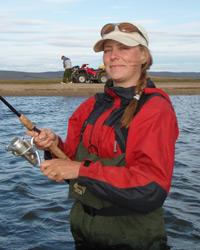
Jennie Knopp
|
Jennie Knopp, a Ph.D. candidate in Environmental and Life Sciences (ENLS), won the Knowledge to Action Award at the conference, and she was featured in a CBC interview last week. Shedding light upon the interaction of knowledge between researchers, practitioners, and Inuit residents living in the areas being studied, Ms. Knopp’s graduate work focuses upon the health and community-based monitoring of Arctic Char in the Inuvialuit Settlement Region Lakes. Arctic Char are an important food source for local Inuit and, according to Ms. Knopp, could be affected by a changing Northern climate |
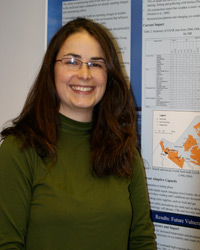
Kaitlin Breton-Honeyman
|
Kaitlin Breton-Honeyman, another graduate student in ENLS, is studying beluga habitat ecology in Nunavik. Ms. Breton-Honeyman’s poster was selected for the Indigenous Partnership of Excellence Award at the conference, and she feels that the element of Indigenous knowledge exchange was a crucial part of the overall experience. Interested in mixed-methods research, she began working with Prof. Furgal as a research assistant on a project that “aimed to improve public health and environment surveillance and monitoring in the Inuvialuit Settlement Region in the Northwest Territories.” This was her first exposure to Arctic life and it “really captivated her,” and allowed for work combining many of her “interests in multidisciplinary, Arctic-based projects.” |
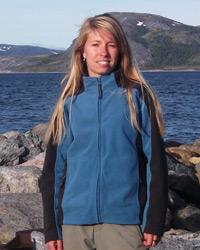
Diana Kouril
|
Diana Kouril, a first-year Master’s student in Sustainability Studies, came in third place for her poster on “Community Based Monitoring in Arctic regions”. Ms. Kouril’s current research explores community-based monitoring as an effective tool to support adaptation and community sustainability in the context of environmental change in Nunatsiavut, Labrador. Ms. Kouril became interested in Indigenous Environmental Studies during family camping trips to remote communities in the Canadian North. These experiences enabled her to learn about complex environmental, social and political issues facing Canadian Indigenous peoples. “Personally, this was a major learning curve for me as a child,” said Ms. Kouril. “These issues were not addressed in my elementary or high school education. I was able to experience them first-hand.” |
Occurring at a crucial time in their studies, students also had opportunities to participate in workshops led by experts regarding how science influences policy-making and has positive effects upon environmental concerns.
Congratulations to our graduate students for standing out in an international conference, and for drawing attention to Indigenous, environmental, social, health and economic issues.
Posted on Thursday, May 3, 2012.